Question 14 Marks
A star is emitting light at the wavelength of 5000 Å. Determine the limit of resolution of a telescope having an objective of diameter of 200 inch.
Answer$
\begin{aligned}
& \text { Data }: \lambda=5000 \AA=5 \times 10^{-7} \mathrm{~m} \\
& D=200 \times 2.54 \mathrm{~cm}=5.08 \mathrm{~m} \\
& \theta=\frac{1.22 \lambda}{D} \\
& =\frac{1.22 \times 5 \times 10^{-7}}{5.08} \\
& =1.2 \times 10^{-7} \mathrm{rad}
\end{aligned}
$
This is the required quantity.
View full question & answer→Question 24 Marks
Monochromatic electromagnetic radiation from a distant source passes through a slit. The diffraction pattern is observed on a screen 2.50 m from the slit. If the width of the central maximum is 6.00 mm, what is the slit width if the wavelength is
(a) 500 nm (visible light);
(b) 50 µm (infrared radiation);
(c) 0.500 nm (X-rays)?
AnswerData:2W = 6mm ∴ W= 3 mm = 3 × 10⁻³ m, y = 2.5 m,(a) $\lambda_1=500 \mathrm{~nm}=5 \times 10^{-7} \mathrm{~m}$
(b) $\lambda_2=50 \mu \mathrm{m}=5 \times 10^{-5} \mathrm{~m}$
(c) $\lambda_3=0.500 \mathrm{~nm}=5 \times 10^{-10} \mathrm{~m}$
Let a be the slit width.
(a) $\begin{aligned} W & =\frac{y \lambda_1}{a} \\ \therefore a & =\frac{y \lambda_1}{W}=\frac{(2.5)\left(5 \times 10^{-7}\right)}{3 \times 10^{-3}} \\ & =4.167 \times 10^{-4} m \\ & =0.4167 mm \end{aligned}$
(b) $\begin{aligned} W & =\frac{y \lambda_2}{a} \\ \therefore a & =\frac{y \lambda_2}{W}=\frac{(2.5)\left(5 \times 10^{-5}\right)}{3 \times 10^{-3}} \\ & =4.167 \times 10^{-2} m \\ & =41.67 mm \end{aligned}$
(c) $\begin{aligned} W & =\frac{y \lambda_3}{a} \\ \therefore a & =\frac{y \lambda_3}{W}=\frac{(2.5)\left(5 \times 10^{-10}\right)}{3 \times 10^{-3}} \\ & =4.167 \times 10^{-7} m \\ & =4.167 \times 10^{-4} mm \end{aligned}$
View full question & answer→Question 34 Marks
What must be the ratio of the slit width to the wavelength for a single slit to have the first diffraction minimum at $45.0^\circ?$
AnswerData: $\theta=45^{\circ}, m =1$
a $\sin \theta=m \lambda$ for $(m=1,2,3 \ldots$ minima $)$
Here, $m=1$ (First minimum)
$ \therefore a \sin 45^{\circ}=(1) \lambda$
$\therefore \frac{a}{\lambda}=\frac{1}{\sin 45^{\circ}}=1.414 $
This is the required ratio.
View full question & answer→Question 44 Marks
A parallel beam of green light of wavelength 550 nm passes through a slit of width 0.4 mm. The intensity pattern of the transmitted light is seen on a screen which is 40 cm away. What is the distance between the two first order minima?
AnswerData $: \lambda=550 nm =546 \times 10^{-9} m , a =0.4 mm =4 \times 10^{-4} m , D =40 cm =40 \times 10^{-2} m$
$y _{ md }= m \frac{\lambda D}{a}$
$\therefore y_{1 d}=1 \frac{\lambda D}{a}$ and
$2 y _{1 d }=\frac{2 \lambda D}{a}$
$=\frac{2 \times 550 \times 10^{-9} \times 40 \times 10^{-2}}{4 \times 10^{-4}}$
$=2 \times 550 \times 10^{-6}=1092 \times 10^{-6}$
$=1.100 \times 10^{-3} m =1.100 mm$
This is the distance between the two first order minima.
View full question & answer→Question 54 Marks
The intensity of the light coming from one of the slits in Young’s experiment is twice the intensity of the light coming from the other slit. What will be the approximate ratio of the intensities of the bright and dark fringes in the resulting interference pattern?
AnswerData :$ I_1 : I_2 = 2 : 1$
If $E_{10}$ and $E_{20}$ are the amplitudes of the interfering waves, the ratio of the maximum intensity to the minimum intensity in the fringe system is
$\frac{I_{\max }}{I_{\min }}=\left(\frac{E_{10}+E_{20}}{E_{10}-E_{20}}\right)^2=\left(\frac{r+1}{r-1}\right)^2$
where $r=\frac{E_{10}}{E_{20}}$.
$ \therefore \frac{I_1}{I_2}=\left(\frac{E_{10}}{E_{20}}\right)^2=r^2$
$\therefore r=\sqrt{\frac{I_1}{I_2}}=\sqrt{2}$
$\therefore \frac{I_{\max }}{I_{\min }}=\left(\frac{\sqrt{2}+1}{\sqrt{2}-1}\right)^2=\left(\frac{2.414}{0.414}\right)^2=(5.83)^2$
$=33.99 \simeq 34 . $
The ratio of the intensities of the bright and dark fringes in the resulting interference pattern is $34: 1$.
View full question & answer→Question 64 Marks
In Fraunhoffer diffraction by a narrow slit, a screen is placed at a distance of 2 m from the lens to obtain the diffraction pattern. If the slit width is 0.2 mm and the first minimum is 5 mm on either side of the central maximum, find the wavelength of light.
Answer$
\begin{aligned}
& \text { Data }: \mathrm{D}=2 \mathrm{~m}, \mathrm{y}_{1 \mathrm{~d}}=5 \mathrm{~mm}=5 \times 10^{-3} \mathrm{~m}, \mathrm{a}=0.2 \mathrm{~mm}=0.2 \times 10^{-3} \mathrm{~m}=2 \times \\
& 10^{-4} \mathrm{~m} \\
& y_{\mathrm{md}}=m \frac{\lambda D}{a} \\
& \therefore \lambda=\frac{y_{1 \mathrm{~d}} a}{D} \quad(\because \mathrm{m}=1) \\
& \lambda=\frac{5 \times 10^{-3} \times 2 \times 10^{-4}}{2} \\
& \lambda=\mathbf{5} \times \mathbf{1 0}^{-7} \mathrm{~m}=5 \times 10^{-7} \times 10^{-10} \AA=\mathbf{5 0 0 0} \AA
\end{aligned}
$
This is the wavelength of light.
View full question & answer→Question 74 Marks
In a biprism experiment, the fringes are observed in the focal plane of the eyepiece at a distance of $1.2\ m$ from the slits. The distance between the central bright band and the $20$th bright band is $0.4\ cm.$ When a convex lens is placed between the biprism and the eyepiece, $90\ cm$ from the eyepiece, the distance between the two virtual magnified images is found to be $0.9\ cm.$ Determine the wavelength of light used.
AnswerData: $D=1.2 m$
The distance between the central bright band and the $20^{\text {th }}$ bright band is $0.4 cm$.
$ \therefore y _{20}=0.4 cm =0.4 \times 10^{-2} m$
$W =\frac{y_{20}}{20}=\frac{0.4}{20} \times 10^{-2} m =2 \times 10^{-4} m ,$
$d _1=0.9 cm =0.9 \times 10^{-2} m , v _1=90 cm =0.9 m$
$\therefore u _1= D - v _1=1.2 m -0.9 m =0.3 m $
Now, $\frac{d_1}{d}=\frac{v_1}{u_1}$
$ \therefore d=\frac{d_1 u_1}{v_1} =\frac{\left(0.9 \times 10^{-2}\right)(0.3)}{0.9} m$
$ =3 \times 10^{-3} m$
$\therefore$ The wavelength of light,
$ \lambda=\frac{W d}{D} =\frac{2 \times 10^{-4} \times 3 \times 10^{-3}}{1.2} m$
$ =5 \times 10^{-7} m$
$ =5 \times 10^{-7} \times 10^{10}$
$ =5000 $
View full question & answer→Question 84 Marks
Unpolarized light with intensity $I_0$ is incident on two polaroids. The axis of the first polaroid makes an angle of $50^\circ $ with the vertical, and the axis of the second polaroid is horizontal. What is the intensity of the light after it has passed through the second polaroid?
AnswerAccording to Malus’ law, when the unpolarized light with intensity $I_0$ is incident on the first polarizer, the polarizer polarizes this incident light. The intensity of light becomes $I_1 = I_0/2.$
Now, $I_2 = I_1 \cos^2\theta$
$\therefore I_2=\left(\frac{I_0}{2}\right) \cos ^2 \theta$
Also, the angle $\theta$ between the axes of the two polarizers is $\theta_2-\theta_1$.
$\therefore I_2=\left(\frac{I_0}{2}\right) \cos ^2\left(\theta_2-\theta_1\right)$
$=\left(\frac{I_0}{2}\right) \cos ^2\left(90^{\circ}-50^{\circ}\right)$
$\therefore I_2 =\left(\frac{I_0}{2}\right) \cos ^2 40^{\circ}$
The intensity of light after it has passed through the second polaroid $=\left(\frac{ I _0}{ 2 }\right) \cos ^2 40^{\circ}=\frac{I_0}{2}$
$(0.7660)^2$
$=0.2934 I _0$
View full question & answer→Question 94 Marks
In a double-slit arrangement the slits are separated by a distance equal to 100 times the wavelength of the light passing through the slits.
(a) What is the angular separation in radians between the central maximum and an adjacent maximum?
(b) What is the distance between these maxima on a screen 50.0 cm from the slits?
AnswerData : d = 100λ, D = 50.0 cm
(a) The condition for maximum intensity in Young’s experiment is, d sin θ = nλ, n = 0, 1, 2 …,
The angle between the central maximum and its adjacent maximum can be determined by setting n equal to 1,
∴ d sin θ = λ
$ \therefore \theta & =\sin ^{-1}\left(\frac{\lambda}{d}\right)=\sin ^{-1}\left(\frac{\lambda}{100 \lambda}\right)$
$=\sin ^{-1}\left(\frac{1}{100}\right)=0.9^{\prime}=0.01571 rad$
(b) The distance between these maxima on the screen is $D \sin \theta= D \left(\frac{\lambda}{d}\right)$
$ =(50.0 cm )\left(\frac{\lambda}{100 \lambda}\right)$
$=0.50 cm$
View full question & answer→Question 104 Marks
A double-slit arrangement produces interference fringes for sodium light (λ = 589 nm) that are 0.20° apart. What
is the angular fringe separation if the entire arrangement is immersed in water (n = 1.33)?
AnswerData : θ1 = 0.20°, nw = 1.33 In the first approximation, D sin θ1 = y1 and D sin θ2 = y2 $\therefore \frac{\sin \theta_2}{\sin \theta_1}=\frac{y_2}{y_1}$ Now, $y \propto \frac{\lambda D}{d}$ For given $d$ and $D$, $y \propto \lambda$ $ \therefore \frac{y_2}{y_1}=\frac{\lambda_2}{\lambda_1} $ Now, $n_w=\frac{\lambda_1}{\lambda_2}$ From Eqs. (1), (2) and (3), we get, $ \begin{aligned} & \frac{\sin \theta_2}{\sin \theta_1}=\frac{\lambda_2}{\lambda_1}=\frac{1}{n_{ w }} \\ \therefore & \sin \theta_2=\frac{\sin \theta_1}{n_{ w }} \\ & =\frac{\sin 0.2}{1.33}=\frac{0.0035}{1.33} \\ = & 0.0026 \\ \therefore \theta_2 & =\sin ^{-1} 0.026 \\ =9^{\prime} & =0.15^{\circ} \end{aligned} $ This is the required angular fringe separation. $OR$ In the first approximation, $\Delta l=d \sin \theta$ and $\Delta l \propto \lambda$ for a given $d / D$ $\therefore d \sin \theta \propto \lambda$ for a given $d / D$ $ \therefore \frac{d \sin \theta_2}{d \sin \theta_1}=\frac{\lambda_1}{\lambda_2}=\frac{\lambda_1 / n_{ w }}{\lambda_1}=\frac{1}{n_{ w }} $ $\therefore \sin \theta_2=\frac{\sin \theta_1}{n_w}$. This gives $\theta_2= 0 . 1 5$.
View full question & answer→Question 114 Marks
The optical path of a ray of light of a given wavelength travelling a distance of $3\ cm$ in flint glass having refractive index $1.6$ is same as that on travelling a distance x cm through a medium having refractive index $1.25$. Determine the value of x.
AnswerLet $d_{fg}$ and $d_m$ be the distances by the ray of light in the flint glass and the medium respectively. Also, let $n_{fg}$ and $n_m$ be the refractive indices of the flint glass and the medium respectively.
Data : $d_{fg} = 3 cm, n_{fg} = 1.6, nm = 1.25,$
Optical path $= n_m \times d_m = n_{fg} \times d_{fg}$
$\therefore d_{ m }=\frac{n_{ fg } \times d_{ fg }}{n_{ m }}=\frac{1.6 \times 3}{1.25}=3.84 cm$
Thus, $x cm =3.84 cm$
$\therefore x =3.84$
This is the value of $x$.
View full question & answer→Question 124 Marks
Whitelight consists of wavelengths from $400\ nm$ to $700\ nm.$ What will be the wavelength range seen when white light is passed through glass of refractive index $1.55?$
AnswerLet $\lambda_1$ and $\lambda_2$ be the wavelengths of light in water for $400\ nm$ and $700\ nm$ (wavelengths in vacuum) respectively. Let $\lambda _a$ be the wavelength of light in vacuum.
$ \lambda_1=\frac{\lambda_{ a }}{n}=\frac{400 \times 10^{-9} m }{1.55}=258.06 \times 10^{-9} m$
$\lambda_2=\frac{\lambda_{ a }}{n}=\frac{700 \times 10^{-9} m }{1.55}=451.61 \times 10^{-9} m $
The wavelength range seen when white light is passed through the glass would be $258.06\ nm$ to $451.61 nm$.
View full question & answer→Question 134 Marks
Describe what is Rayleigh’s criterion for resolution. Explain it for a telescope and a microscope.
AnswerRayleigh’s criterion for minimum resolution : Two overlapping diffraction patterns due to two point sources are acceptably or just resolved if the centre of the central peak of one diffraction pattern is as far as the first minimum of the other pattern.The ‘sharpness’ of the central maximum of a diffraction pattern is measured by the angular separation between the centre of the peak and the first minimum. It gives the limit of resolution.
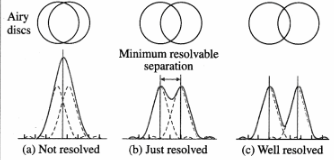
Two overlapping diffraction patterns due to two point sources are not resolved if the angular separation between the central peaks is less than the limit of resolution. They are said to be just separate, or resolved, if the angular separation between the central peaks is equal to the limit of resolution. They are said to be well resolved if the angular separation between the central peaks is more than the limit of resolution.
Resolving power of an optical instrument:
The primary aim of using an optical instrument is to see fine details, whether observing a star system through a telescope or a living cell through a microscope. After passing through an optical system, light from two adjacent parts of the object should produce sharp, distinct (separate) images of those parts. The objective lens or mirror of a telescope or microscope acts like a circular aperture. The diffraction pattern of a circular aperture consists of a central bright spot (called the Airy disc and corresponds to the central maximum) and concentric dark and bright rings.
Light from two close objects or parts of an object after passing through the aperture of an optical system produces overlapping diffraction patterns that tend to obscure the image. If these diffraction patterns are so broad that their central maxima overlap substantially, it is difficult to decide if the intensity distribution is produced by two separate objects or by one.
The resolving power of an optical instrument, e.g., a telescope or microscope, is a measure of its ability to produce detectably separate images of objects that are close together.
Definition : The smallest linear or angular separation between two point objects which appear just resolved when viewed through an optical instrument is called the limit of resolution of the instrument and its reciprocal is called the resolving power of the instrument.
Rayleigh’s criterion for minimum resolution : Two overlapping diffraction patterns due to two point sources are acceptably or just resolved if the centre of the central peak of one diffraction pattern is as far as the first minimum of the other pattern.
The ‘sharpness’ of the central maximum of a diffraction pattern is measured by the angular separation between the centre of the peak and the first minimum. It gives the limit of resolution.
The resolving power of a telescope is defined as the reciprocal of the angular limit of resolution between two closely-spaced distant objects so that they are just resolved when seen through the telescope.
Consider two stars seen through a telescope. The diameter (D) of the objective lens or mirror corresponds to the diffracting aperture. For a distant point source, the first diffraction minimum is at an angle θ away from the centre such that
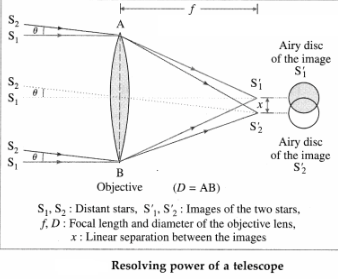
$D \sin \theta=1.22 \lambda$
where $\lambda$ is the wavelength of light. The angle $\theta$ is usually so small that we can substitute $\sin \theta \approx \theta(\theta$ in radian). Thus, the Airy disc for each star will be spread out over an angular half-width $\theta=1.22 \lambda / D$ about its geometrical image point. The radius of the Airy disc at the focal plane of the objective lens is $r=f \theta=1.22 f \lambda / D$, where / is the focal length of the objective.
When observing two closely-spaced stars, the Rayleigh criterion for just resolving the images as that of two point sources (instead of one) is met when the centre of one Airy disc falls on the first minimum of the other pattern. Thus, the angular limit (or angular separation) of resolution is
$
\theta=\frac{1.22 \lambda}{D} \ldots(1)
$
and the linear separation between the images at the focal plane of the objective lens is $y=f \theta$
$\therefore$ Resolving power of a telescope,
$
R =\frac{1}{\theta}=\frac{D}{1.22 \lambda} \ldots \text { (3) }
$
It depends
1. directly on the diameter of the objective lens or mirror,
2. inversely on the wavelength of the radiation.
View full question & answer→Question 144 Marks
Derive the conditions for bright and dark fringes produced due to diffraction by a single slit.
AnswerWhen a parallel beam of monochromatic light of wavelength λ illuminates a single slit of finite width a, we observe on a screen some distance from the slit, a broad pattern of alternate dark and bright fringes. The pattern consists of a central bright fringe, with successive dark and bright fringes of diminishing intensity on both sides. This is called ‘ the diffraction pattern of a single slit.Consider a single slit illuminated with a parallel beam of monochromatic light perpendicular to the plane of the slit. The diffraction pattern is obtained on a screen at a distance D (» a) from the slit and at the focal plane of the convex lens, Fig. $7.33.$
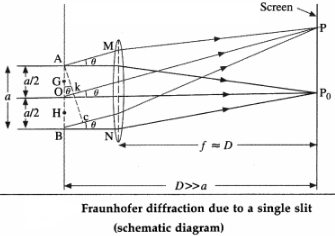
We can imagine the single slit as being made up of a large number of Huygens' sources evenly distributed over the width of the slit. Then the maxima and minima of the pattern arise from the interference of the various Huygens' wavelets.
Now, imagine the single slit as made up of two adjacent slits, each of width $a / 2$. Since, the incident plane wavefronts are parallel to the plane of the slit, all the Huygens sources at the slit will be in phase. They will therefore also in phase at the point $P _0$ on the screen, where $P _0$ is equidistant from all the Huygens sources. At $P _0$, then, we get the central maximum.
For the first minimum of intensity on the screen, the path difference between the waves from the Huygens sources A and $O$ (or $O$ and $B$ ) is $\lambda / 2$, which is the condition for destructive interference. Suppose, the nodal line $O P$ for the first minimum subtends an angle $\theta$ at the slit; $\theta$ is very small. With $P$ as the centre and $P A$ as radius, strike an arc intersecting $P B$ at $C$. Since, $D \gg a$, the arc $A C$ can be considered a straight line at right angles to $P B$. Then, $\triangle A B C$ is a right-angled triangle similar to $\triangle OP P _0 P$.
This means that, $\angle BAC = \theta$
$\therefore BC = a \sin\theta$
$\therefore $ Difference in path length,
$BC = PB – PA = (PB – PO) + (PO – PA)$
$=\frac{\lambda}{2}+\frac{\lambda}{2}$
$=\lambda$ $ \therefore a \sin \theta=\lambda$
$\therefore \sin \theta \simeq \theta=\frac{\lambda}{a} $
( $\because \theta$ is very small and in radian)
The other nodal lines of intensity minima can be understood in a similar way. In general, then, for the with minimum ( $m= \pm 1, \pm 2, \pm 3, \ldots)$.
$\theta_m=\frac{m \lambda}{a}$ (mth minimum) $\ldots$ (2)
as $\theta_m$ is very small and in radian.
Between the successive minima, the intensity rises to secondary maxima when the path difference is an odd-integral multiple of $\frac{\lambda}{2}$ :
$a \sin \theta_m=(2 m+1) \frac{\lambda}{2}=\left(m+\frac{1}{2}\right) \lambda$
i.e., at angles given by,
$\theta_{ m } \simeq \sin \theta_{ m }=\left( m +\frac{1}{2}\right) \frac{\lambda}{a}$
(with secondary maximum) ... (3) View full question & answer→Question 154 Marks
What is diffraction of light? How does it differ from interference? What are Fraunhoffer and Fresnel diffractions?
Answer1. Phenomenon of diffraction of light: When light passes by the edge of an obstacle or through a small opening or a narrow slit and falls on a screen, the principle of rectilinear propagation of light from geometrical optics predicts a sharp shadow. However, it is found that some of the light deviates from its rectilinear path and penetrates into the region of the geometrical shadow. This is a general characteristic of wave phenomena, which occurs whenever a portion of the wavefront is obstructed in some way. This bending of light waves at an edge into the region of geometrical shadow is called diffraction of light.
2. Differences between interference and diffraction :
- The term interference is used to characterise the superposition of a few coherent waves (say, two). But when the superposition at a point involves a large number of waves coming from different parts of the same wavefront, the effect is referred to as diffraction.
- Double-slit interference fringes are all of equal width. In single-slit diffraction pattern, only the non-central maxima are of equal width which is half of that of the central maximum.
- In double-slit interference, the bright and dark fringes are equally spaced. In diffraction, only the non-central maxima lie approximately halfway between the minima.
- In double-slit interference, bright fringes are of equal intensity. In diffraction, successive non-central maxima decrease rapidly in intensity.
[Note : Interference and diffraction both have their origin in the principle of superposition of waves. There is no physical difference between them. It is just a question of usage. When there are only a few sources, say two, the phenomenon is usually called interference. But, if there is a large number of sources the word diffraction is used.]
3. Diffraction can be classified into two types depending on the distances involved in the experimental setup :
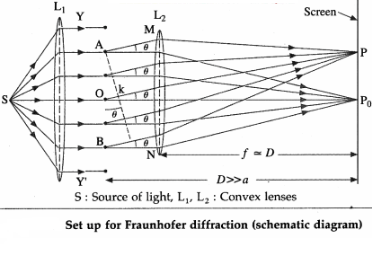
(A) Fraunhofer diffraction : In this class of diffraction, both the source and the screen are at infinite distances from the aperture. This is achieved by placing the source at the focus of a convex lens and the screen at the focal plane of another convex lens.
(B) Fresnel diffraction : In this class of diffraction, either the source of light or the screen or both are at finite distances from the diffracting aperture. The incident wavefront is either cylindrical or spherical depending on the source. A lens is not needed to observe the diffraction pattern on the screen.
View full question & answer→Question 164 Marks
What is meant by coherent sources? What are the two methods for obtaining coherent sources in the laboratory?
AnswerCoherent sources : Two sources of light are said to be coherent if the phase difference between the emitted waves remains constant.It is not possible to observe interference pattern with light from any two different sources. This is because, no observable interference phenomenon occurs by superposing light from two different sources. This happens due to the fact that different sources emit waves of different frequencies. Even if the two sources emit light of the same frequency, the phase difference between the wave trains from them fluctuates randomly and rapidly, i.e., they are not coherent.
Consequently, the interference pattern will change randomly and rapidly, and steady interference pattern would not be observed.
In the laboratory, coherent sources can be obtained by using
(1) Lloyd’s mirror and
(2) Fresnel’s biprism.
(1) Lloyd’s mirror : A plane polished mirror is kept at some distance from the source of monochromatic light and light is made incident on the mirror at a grazing angle.
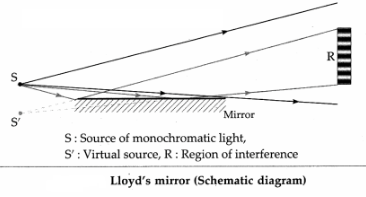
Some light falls directly on the screen as shown by the black lines in above figure, while some light falls on the screen after reflection from the mirror as shown by red lines. The reflected light appears to come from a virtual source and thus two sources can be obtained. These two sources are coherent as they are derived from a single source. Superposition of the waves coming from these coherent sources, under appropriate conditions, gives rise to interference pattern consisting of alternate bright and dark bands on the screen as shown in the figure.
(2) Fresnel’s biprism : It is a single prism having an obtuse angle of about 178° and the other two angles of about 1° each. The biprism can be considered as made of two thin prisms of very small refracting angle of about 1°. The source, in the form of an illuminated narrow slit, is aligned parallel to the refracting edge of the biprism. Monochromatic light from the source is made to pass through that narrow slit and fall on the biprism.
Two virtual images $S_1 $and $S_2$ are formed by the two halves of the biprism. These are coherent sources which are obtained from a single secondary source S. The two waves coming from $S_1$ and $S_2$ interfere under appropriate conditions and form interference fringes, like those obtained in Young’s double-slit experiment, as shown in the figure in the shaded region. The formula for y is the same as in Young’s experiment. View full question & answer→Question 174 Marks
What are the conditions for obtaining good interference pattern? Give reasons.
AnswerThe conditions necessary for obtaining well defined and steady interference pattern :
- The two sources of light should be coherent:
The two sources must maintain their phase relation during the time required for observation. If the phases and phase difference vary with time, the positions of maxima and minima will also change with time and consequently the interference pattern will change randomly and rapidly, and steady interference pattern would not be observed. For coherence, the two secondary sources must be derived from a single original source. - The light should be monochromatic :
Otherwise, interference will result in complex coloured bands (fringes) because the separation of successive bright bands (fringes) is different for different colours. It also may produce overlapping bands. - The two light sources should be of equal brightness, i.e., the waves must have the same amplitude.
The interfering light waves should have the same amplitude. Then, the points where the waves meet in opposite phase will be completely dark (zero intensity). This will increase the contrast of the interference pattern and make it more distinct. - The two light sources should be narrow :
If the source apertures are wide in comparison with the light wavelength, each source will be equivalent to multiple narrow sources and the superimposed pattern will consist of bright and less bright fringes. That is, the interference pattern will not be well defined. - The interfering light waves should be in the same state of polarization :
Otherwise, the points where the waves meet in opposite phase will not be completely dark and the interference pattern will not be distinct. - The two light sources should be closely spaced and the distance between the screen and the sources should be large : Both these conditions are desirable for appreciable fringe separation. The separation of successive bright or dark fringes is inversely proportional to the closeness of the slits and directly proportional to the screen distance.
View full question & answer→Question 184 Marks
Describe Young’s double slit interference experiment and derive conditions for occurrence of dark and bright fringes on the screen. Define fringe width and derive a formula for it.
Answer
Description of Young’s double-slit interference experiment:
1. A plane wavefront is obtained by placing a linear source $S$ of monochromatic light at the focus of a convex lens. It is then made to pass through an opaque screen $A B$ having two narrow and similar slits $S_1$ and $S_2 \cdot S_1$ and $S_2$ are equidistant from $S$ so that the wavefronts starting simultaneously from $S$ and reaching $S_1$ and $S_2$ at the same time are in phase. A screen PQ is placed at some distance from screen $A B$ as shown in below figure
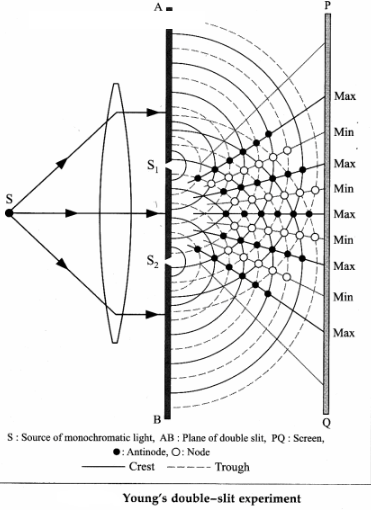
- $S_1$ and $S_2$ act as secondary sources. The crests/-troughs of the secondary wavelets superpose and interfere constructively along straight lines joining the black dots shown in above figure. The point where these lines meet the screen have high intensity and are bright.
- Similarly, there are points shown with red dots where the crest of one wave coincides with the trough of the other. The corresponding points on the screen are dark due to destructive interference.
- These dark and bright regions are called fringes or bands and the whole pattern is called interference pattern.
Conditions for occurence of dark and bright fringes on the screen :
Consider Young's double-slit experimental set up. Two narrow coherent light sources are obtained by wavefront splitting as monochromatic light of wavelength $\lambda$ emerges out of two narrow and closely spaced, parallel slits $S_1$ and $S _2$ of equal widths. The separation $S _1 S_2= d$ is very small. The interference pattern is observed on a screen placed parallel to the plane of and at considerable distance $D(D \gg d)$ from the slits. $O O$ ' is the perpendicular bisector of segment $S_1 S_2$.
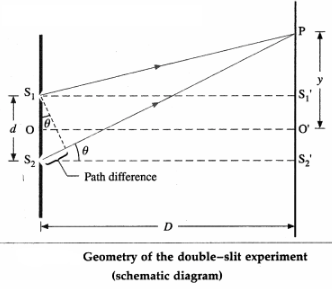
Consider, a point $P$ on the screen at a distance $y$ from $O^{\prime}(y \& D)$. The two light waves from $S_1$ and $S_2$ reach $P$ along paths $S_1 P$ and $S_2 P$, respectively. If the path difference $(\Delta I)$ between $S_1 P$ and $S_2 P$ is an integral multiple of $\lambda$, the two waves arriving there will interfere constructively producing a bright fringe at $P$. On the contrary, if the path difference between $S_1 P$ and $S_2 P$ is half integral multiple of $\lambda$, there will be destructive interference and a dark fringe will be produced at $P$.
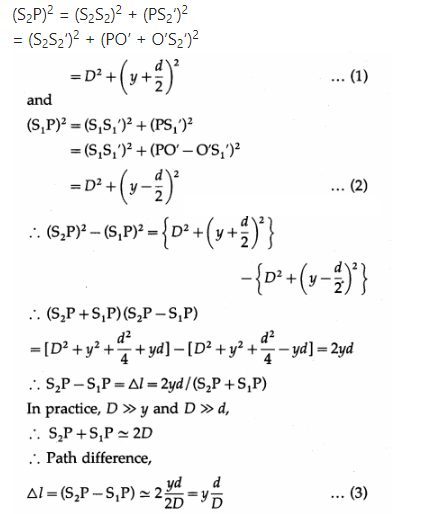
From above figure,
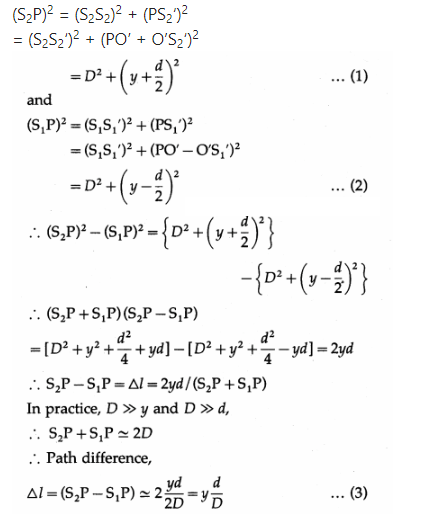
Expression for the fringe width (or band width) : The distance between consecutive bright (or dark) fringes is called the fringe width (or band width) W. Point $P$ will be bright (maximum intensity), if the path difference, $\Delta l = y _{ n } \frac{d}{D}=n \lambda$ where $n=0,1,2,3 \ldots$, Point $P$ will be dark (minimum intensity equal to zero), if $y_m \frac{d}{D}=(2 m-1) \frac{\lambda}{2}$, where, $m=1,2,3 \ldots$, Thus, for bright fringes (or bands),
$y_n=0, \lambda \frac{D}{d}, \frac{2 \lambda D}{d} \ldots \ldots$
and for dark fringes (or bands),
$y_m=\frac{\lambda D}{2}, 3 \frac{\lambda}{2} \frac{D}{d}, 5 \frac{\lambda}{2} \frac{D}{d} \cdots \cdots$
These conditions show that the bright and dark fringes (or bands) occur alternately and are equally - spaced. For Point $O ^{\prime}$, the path difference $\left( S _2 O ^{\prime}- S _1 O ^{\prime}\right)=0$. Hence, point $O ^{\prime}$ will be bright. It corresponds to the centre of the central bright fringe (or band). On both sides of $O^{\prime}$, the interference pattern consists of alternate dark and bright fringes (or band) parallel to the slit.
Let y$_n $and $y_{n + 1},$ be the distances of the nth and $(n + 1)^{th}$^ bright fringes from the central bright fringe.
$\therefore \frac{y_n d}{D}=n \lambda \quad \therefore y_n=\frac{n \lambda D}{d}$
and $\frac{y_{n+1} d}{D}=(n+1) \lambda \quad \therefore y_{n+1}=\frac{(n+1) \lambda D}{d} \ldots$
The distance between consecutive bright fringes $=y_{n+1}-y_n=\frac{\lambda D}{d}[(n+1)-n]=\frac{\lambda D}{d}$
Hence, the fringe width,
$\therefore W=\Delta y=y_{n+1}-y_n=\frac{\lambda D}{d} \text { (for bright fringes) } \ldots$
Alternately, let $y_m$ and $y_{m+1}$ be the distances of the $m$ th and $(m+1)^{\text {th }}$ dark fringes respectively from the central bright fringe.
$ \therefore \frac{y_m d}{D}=(2 m-1) \frac{\lambda}{2} \text { and }$
$\frac{y_{m+1} d}{D}=[2(m+1)-1] \frac{\lambda}{2}=(2 m+1) \frac{\lambda}{2}$
$\therefore y_m=(2 m-1) \frac{\lambda D}{2 d} \text { and }$
$y_{m+1}=(2 m+1) \frac{\lambda D}{2 d} $
$\therefore$ The distance between consecutive dark fringes,
$ y_{m+1}-y_m=\frac{\lambda D}{2 d}[(2 m+1)-(2 m-1)]=\frac{\lambda D}{d}$
$\therefore W=y_{m+1}-y_m$
$=\frac{\lambda D}{d} \text { (for dark fringes) }$
Eqs. $(7)$ and $(11)$ show that the fringe width is the same for bright and dark fringes.
[Note: In the first approximation, the path difference is $d \sin \theta$.]
View full question & answer→Question 194 Marks
What is Brewster’s law? Derive the formula for Brewster angle.
AnswerBrewster's law : The tangent of the polarizing angle is equal to the refractive index of the reflecting medium with respect to the surrounding $\left({ }_1 n_2\right)$. If $\theta_B$ is the polarizing angle, $\tan \theta_{ B }={ }_1 n_2=\frac{n_2}{n_1}$
Here $n_1$ is the absolute refractive index of the surrounding and $n_2$ is that of the reflecting medium.
The angle $\theta_B$ is called the Brewster angle.
Consider a ray of unpolarized monochromatic light incident at an angle $\theta_B$ on a boundary between two transparent media as shown in below figure. Medium 1 is a rarer medium with refractive index $n_1$ and medium 2 is a denser medium with refractive index $n_2$. Part of incident light gets refracted and the rest
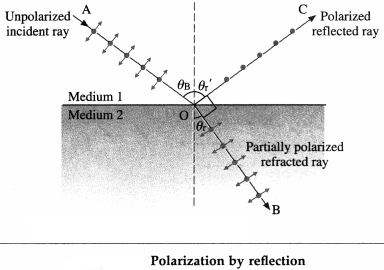
gets reflected. The degree of polarization of the reflected ray varies with the angle of incidence.
The electric field of the incident wave is in the plane perpendicular to the direction of propagation of incident light. This electric field can be resolved into a component parallel to the plane of the paper, shown by double arrows, and a component perpendicular to the plane of the paper shown by dots, both having equal magnitude. Generally, the reflected and refracted rays are partially polarized, i.e., the two components do not have equal magnitude.
In 1812, Sir David Brewster discovered that for a particular angle of incidence.$ \theta _B$, the reflected wave is completely plane-polarized with its electric field perpendicular to the plane of the paper while the refracted wave is partially polarized. This particular angle of incidence $(\theta _B)$ is called the Brewster angle.
For this angle of incidence, the refracted and reflected rays are perpendicular to each other.
For angle of refraction $\theta_{ r }$,
$\theta_{B}+\theta_{r}=90^{\circ}$
From Snell's law of refraction,
$\therefore n_1 \sin \theta_{B}=n_2 \sin \theta_{r} \ldots$
From Eqs. (1) and (2), we have,,
$n_1$ sin $\theta _B = n_2 \sin (90^\circ – \theta _B) = n_2 \cos \theta _B$
$\therefore \frac{n_2}{n_1}=\frac{\sin \theta_{ B }}{\cos \theta_{ B }}=\tan \theta_{ B }$
$\therefore \theta_{ B }=\tan ^{-1}\left(\frac{n_2}{n_1}\right)$
This is called Brewster's law. View full question & answer→Question 204 Marks
Explain what is meant by polarization and derive Malus’ law.
AnswerAccording to the electromagnetic theory of light, a light wave consists of electric and magnetic fields vibrating at right angles to each other and to the direction of propagation of the wave. If the vibrations of $\vec{E}$ in a light wave are in all directions perpendicular to the direction of propagation of light, the wave is said to be unpolarized.
If the vibrations of the electric field $\vec{E}$ in a light wave are confined to a single plane containing the direction of propagation of the wave so that its electric field is restricted along one particular direction at right angles to the direction of propagation of the wave, the wave is said to be plane-polarized or linearly polarized.
This phenomenon of restricting the vibrations of light, i.e., of the electric field vector in a particular direction, which is perpendicular to the direction of the propagation of the wave is called polarization of light.
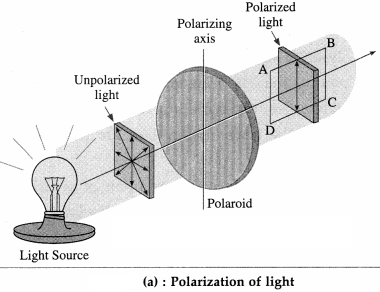
Consider an unpolarized light wave travelling along the $x$-direction. Let $c , v$ and $\lambda$ be the speed, frequency and wavelength, respectively, of the wave. The magnitude of its electric field $(\vec{E})$ is,
$E=E_0 \sin (k x-\omega t)$, where $E_0=E_{\max }=$ amplitude of the wave,$\omega=2 \pi v=$ angular frequency of the wave and $k=\frac{2 \pi}{\lambda}=$ magnitude of the wave vector or propagation vector.
The intensity of the wave is proportional to $\left|E_0\right|^2$. The direction of the electric field can be anywhere in the $y$-z plane. This wave is passed through two identical polarizers as shown in below figure.
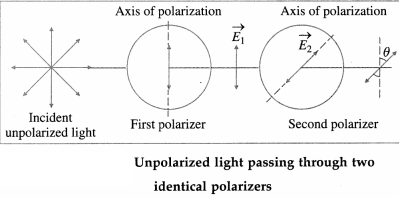
When a wave with its electric field inclined at an angle $\varphi$ to the axis of the first polarizer is passed through the polarizer, the component $E_0 \cos \varphi$ will pass through it. The other component $E_0 \sin \varphi$ which is perpendicular to it will be blocked.
Now, after passing through this polarizer, the intensity of this wave will be proportional to the square of its amplitude, i.e., proportional to $\left|E_0 \cos \varphi\right|^2$.
The intensity of the plane-polarized wave emerging from the first polarizer can be obtained by averaging $\left|E_0 \cos \varphi\right|^2$ over all values of $\varphi$ between 0 and $180^{\circ}$. The intensity of the wave will be
proportional to $\frac{1}{2}\left|E_0\right|^2$ as the average value of $\cos ^2 \varphi$ over this range is $\frac{1}{2}$. Thus the intensity of an unpolarized wave reduces by half after passing through a polarizer.
When the plane-polarized wave emerges from the first polarizer, let us assume that its electric field $\left(\overrightarrow{E_1}\right)$ is along the $y$-direction. Thus, this electric field is, $\overrightarrow{E_1}=\hat{ j } E _{10} \sin (k x-\omega t )$
where, $E _{10}$ is the amplitude of this polarized wave. The intensity of the polarized wave, $I _1 \propto\left| E _{10}\right|^2 \ldots(2)$
Now this wave passes through the second polarizer whose polarization axis (transmission axis) makes an angle θ with the y-direction. This allows only the component $E_{10} \cos \theta $ to pass through it. Thus, the amplitude of the wave which passes through the second polarizer is $E_{20} = E_{10} \cos \theta $ and its intensity,
$ I _2 \propto\left|E_{20}\right|^2$
$\therefore I _2 \propto\left|E_{10}\right|^2 \cos ^2 \theta$
$\therefore I _2= I _1 \cos _2 \theta \ldots \text { (3) }$
Thus, when plane-polarized light of intensity $I_1$ is incident on the second identical polarizer, the intensity of light transmitted by the second polarizer varies as $\cos^2\theta , i.e., I_2 = I_1 \cos^2\theta $, where$ \theta $ is the angle between the transmission axes of the two polarizers. This is known as Malus’ law
[Note : Etienne Louis Malus (1775-1812), French military engineer and physicist, discovered in 1809 that light can be polarized by reflection. He was the first to use the word polarization, but his arguments were based on Newton’s corpuscular theory.] View full question & answer→Question 214 Marks
Derive the laws of refraction of light using Huygens’ principle.
AnswerConsider a plane wavefront $A B$ of monochromatic light propagating in the direction $A ^{\prime} A$ incident obliquely at an angle i on a plane refracting surface MN. This plane refracting surface MN separates two uniform and optically transparent mediums.
Let $v_1$ and $v_2$ be the speeds of light in medium 1 (say, a rarer medium) and medium 2 (a denser medium) respectively.
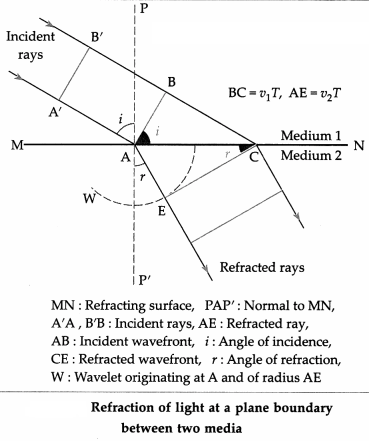
When the wavefront reaches MN at point A at $t = O , A$ becomes a secondary source and emits secondary waves in the second medium, while ray $B^{\prime} B$ reaches the surface $M N$ at $C$ at time $t=T$. Thus, $B C=v_1 T$. During the time $T$, the secondary wavelet originating at A covers a distance AE in the denser medium with radius $v _2 T$.
As all the points on CE are in the same phase of wave motion, CE represents the refracted wavefront in the denser medium. CE is the tangent to the secondary wavelet starting from A . It is also a common tangent to all the secondary wavelets emitted by points between A and C . PP is the normal to the boundary at A . $\angle A^{\prime} A P=\angle B A C=$ the angle of incidence (i) and $\angle P^{\prime} A E=\angle A C E=$ the angle of refraction ( $r$ ). From $\triangle A B C$ and $\triangle A E C$,
$\sin i=\frac{ BC }{ AC }$ and $\sin r=\frac{ AE }{ AC _{ N }}$
$\therefore \frac{\sin i}{\sin r}=\frac{ BC / AC }{ AE / AC }=\frac{ BC }{ AE }=\frac{v_1 T}{v_2 T}=\frac{v_1}{v_2}$
By definition, the refractive index of medium 2 with respect to medium 1,
${ }_1 n_2=\frac{n_2}{n_1}=\frac{v_1}{v_2}$
$\therefore \frac{n_2}{n_1}=\frac{\sin i}{\sin r}$
$\therefore n_1 \sin i=n_2 \sin r$
Here, $n _1$ and $n _2$ are the absolute refractive indices of medium 1 and medium 2 respectively. Eq. (1) is Snell's law of refraction. Also, it can be seen from the figure, that the incident ray and the refracted ray lie on the opposite sides of the normal and all three of them lie in the same plane.
Thus, the laws of refraction of light can be deduced by Huygens' construction of a plane wavefront. If $v_1>v_2$, i.e. $n_1<n_2$, then $r<i$ (bending of the refracted ray towards the normal).
[Notes:
1. Quite often, the terms vacuum and free space are used in the same sense. Absolute vacuum or a perfect vacuum-a region of space devoid of material, particles - does not exist. The term vacuum is also used to mean a region of space occupied by a gas at very low pressure. Free space means a region of space devoid of matter and fields. Its refractive index is 1 (by definition). Its temperature is $0 K . \varepsilon_0$ and $\mu_0$ are defined for free space. The refractive index of a medium with respect to air is very close to the absolute refractive index of the medium as the speed of light in air is very close to that in free space.
2. There is no lateral inversion in refraction.
3. There is no bending of light when the angle of incidence is zero (normal incidence), $r =0$ for $i =0$.] View full question & answer→Question 224 Marks
Derive the laws of reflection of light using Huygens’ principle.
AnswerConsider a plane wavefront AB of monochromatic light propagating in the direction A’A incident obliquely at an angle i on a plane refracting surface MN. This plane refracting surface MN separates two uniform and optically transparent mediums.
Let $v_1$ and $v_2$ be the speeds of light in medium 1 (say, a rarer medium) and medium 2 (a denser medium) respectively.
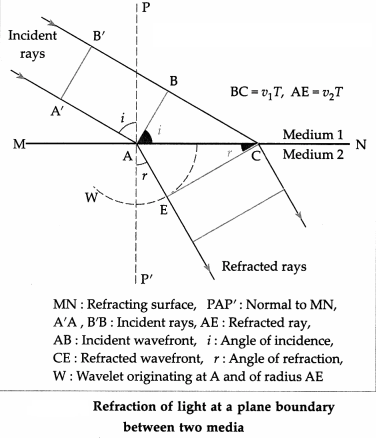
When the wavefront reaches MN at point A at $t =0, A$ becomes a secondary source and emits secondary waves in the second medium, while ray $B^{\prime} B$ reaches the surface $M N$ at $C$ at time $t=T$. Thus, $B C=v_1 T$. During the time $T$, the secondary wavelet originating at $A$ covers a distance $A E$ in the denser medium with radius $V _2 T$. As all the points on CE are in the same phase of wave motion, CE represents the refracted wavefront in the denser medium. CE is the tangent to the secondary wavelet starting from A . It is also a common tangent to all the secondary wavelets emitted by points between A and C . $PP ^{\prime}$ is the normal to the boundary at A . $\angle A ^{\prime} AP =\angle BAC =$ the angle of incidence (i) and $\angle P ^{\prime} AE =\angle ACE =$ the angle of refraction ( r ). From $\triangle A B C$ and $\triangle A E C$,
$\sin i=\frac{ BC }{ AC }$ and $\sin r=\frac{ AE }{ AC _{ N }}$
$\therefore \frac{\sin i}{\sin r}=\frac{ BC / AC }{ AE / AC }=\frac{ BC }{ AE }=\frac{v_1 T}{v_2 T}=\frac{v_1}{v_2}$
By definition, the refractive index of medium 2 with respect to medium 1,
${ }_1 n_2=\frac{n_2}{n_1}=\frac{v_1}{v_2}$
$\therefore \frac{n_2}{n_1}=\frac{\sin i}{\sin r}$
$\therefore n_1 \sin i=n_2 \sin r$
Here, $n_1$ and $n_2$ are the absolute refractive indices of medium 1 and medium 2 respectively. Eq. (1) is Snell’s law of refraction. Also, it can be seen from the figure, that the incident ray and the refracted ray lie on the opposite sides of the normal and all three of them lie in the same plane.
Thus, the laws of refraction of light can be deduced by Huygens’ construction of a plane wavefront.
If $v_1 > v_2, i.e. n_1 < n_2$, then r < i (bending of the refracted ray towards the normal).
[Notes :
(1) Quite often, the terms vacuum and free space are used in the same sense. Absolute vacuum or a perfect vacuuma region of space devoid of material, particles - does not exist. The term vacuum is also used to mean a region of space occupied by a gas at very low pressure. Free space means a region of space devoid of matter and fields. Its refractive index is 1 (by definition). Its temperature is $0 K . \varepsilon_0$ and $\mu_0$ are defined for free space. The refractive index of a medium with respect to air is very close to the absolute refractive index of the medium as the speed of light in air is very close to that in free space.
(2) There is no lateral inversion in refraction.
(3) There is no bending of light when the angle of incidence is zero (normal incidence), $r =0$ for $i =0$.] View full question & answer→Question 234 Marks
The semi vertical angle of the cone of the rays incident on the objective of a microscope is $20^{\circ}$. If the wavelength of incident light is $6600 Å$, calculate the smallest distance between two points which can be just resolved.
AnswerData : $\alpha=20^{\circ}, \lambda=6600 \hat{A}=6.6 \times 10^{-7} m , n =1$ (air) resolution between two closely-spaced distant objects so that they are just resolved when seen through the telescope.
Formula : Resolving power of a telescope $R =\frac{1}{\theta}=\frac{D}{1.22 \lambda}$
where $\theta \equiv$ the minimum angular separation of two closely-spaced celestial objects or the angular limit of resolution, $D \equiv$ the diameter of the objective lens of the telescope, $\lambda \equiv$ the wavelengh of light.
Advantages of a large objective lens in an astronomical telescope :
1. The resolving power is directly proportional to the diameter of the objective lens. Hence, a large objective lens results in a smaller Airy disc and a sharper image.
2. It collects more of the incident radiation from a distant object which results in a brighter image.
View full question & answer→Question 244 Marks
Briefly explain about radio telescope.
Question 254 Marks
Define the resolving power of a telescope and state its formula. What are the advantages of using a large objective lens in an astronomical telescope:
AnswerDefinition: The resolving power of a telescope is defined as the reciprocal of the angular limit of resolution between two closely-spaced distant objects so that they are just resolved when seen through the telescope.
Formula : Resolving power of a telescope
$
R =\frac{1}{\theta}=\frac{D}{1.22 \lambda}
$
where $\theta \equiv$ the minimum angular separation of two closely-spaced celestial objects or the angular limit of resolution, $D \equiv$ the diameter of the objective lens of the telescope, $\lambda \equiv$ the wavelengh of light.
Advantages of a large objective lens in an astronomical telescope :
1. The resolving power is directly proportional to the diameter of the objective lens. Hence, a large objective lens results in a smaller Airy disc and a sharper image.
2. It collects more of the incident radiation from a distant object which results in a brighter image.
View full question & answer→Question 264 Marks
With a neat ray diagram, explain the resolving power of a telescope. On what factors does it depend?
OR
What is meant by the angular limit of resolution and resolving power of a telescope?
Question 274 Marks
On what factors does the resolving power of a microscope depend? How can it be increased?
AnswerResolving power of a microscope
$
=\frac{2 n \sin a }{\lambda}=\frac{2 NA }{\lambda}
$
where, $\alpha \equiv$ the half angle of the angular separation between the objects at the objective lens. $n \equiv$ the refractive index of the medium between the object and the objective, $\lambda \equiv$ the wavelength of the light used to illuminate the object, $N A=n \sin \alpha=$ the numerical aperture of the objective.
Thus, the resolving power of a microscope depends directly on the NA and inversely on $\lambda$. The resolving power is increased by:
1. increasing the numerical aperture using oil-immersion objective.
2. illuminating the object with smaller wavelength radiation. But our eyes are not very sensitive to the shorter wavelength blue end of the visible spectrum. Hence, ultraviolet radiation is used for illumination with quartz lenses, but then photographs must be taken to examine the image.
View full question & answer→Question 284 Marks
Explain why microscopes of high magnifying power have oil filled (oil-immersion) objectives.
AnswerHigher angular magnification of a high magnifying power microscope is of little use if the finer details in a tiny object are obscured by diffraction effects. Hence, a microscope of high magnifying power must also have a high resolving power.
Resolving power ot a microscope $=\frac{2 n \text { stn } a}{\lambda}$
Where $\alpha \equiv$ the half angle of the angular separation between the objects, at the objective lens. $n \equiv$ the refractive index of the medium between the object and the objective, $\lambda \equiv$ the wavelength of the light used to illuminate the object.
The factor $n \sin \alpha$ is called the numerical aperture of the objective and the resolving power increases with increase in the numerical aperture. To increase a the diameter of the objective would have to be increased. But this increase in aperture would degrade the image by decreasing the resolving power. Hence, in microscopes of high magnifying power, the object is immersed in oil that is in contact with the objective. Usually cedarwood oil having a refractive index 1.5 (close to that of the objective glass) is used. Closeness of the refractive indices also reduces loss of light by reflection at the objective lens.
View full question & answer→Question 294 Marks
Define and explain the resolving power of a microscope. State the expressions for the resolving power of
(i) a microscope with a pair of non-luminous objects
(ii) a microscope with self luminous point objects.
OR
What is meant by the limit of resolution and the resolving power of a microscope?
Question 304 Marks
Explain the Rayleigh criterion for the limit of resolution for
(i) two linear objects
(ii) a pair of point objects.
Question 314 Marks
State and explain Rayleigh's criterion for minimum resolution.
Question 324 Marks
Explain and define the resolving power of an optical instrument.
AnswerResolving power of an optical instrument:
The primary aim of using an optical instrument is to see fine details, whether observing a star system through a telescope or a living cell through a microscope. After passing through an optical system, light from two adjacent parts of the object should produce sharp, distinct (separate) images of those parts. The objective lens or mirror of a telescope or microscope acts like a circular aperture. The diffraction pattern of a circular aperture consists of a central bright spot (called the Airy disc and corresponds to the central maximum) and concentric dark and bright rings.Light from two close objects or parts of an object after passing through the aperture of an optical system produces overlapping diffraction patterns that tend to obscure the image. If these diffraction patterns are so broad that their central maxima overlap substantially, it is difficult to decide if the intensity distribution is produced by two separate objects or by one.
The resolving power of an optical instrument, e.g. a telescope or microscope, is a measure of its ability to produce detectably separate images of objects that are close together.
Definition : The smallest linear or angular separation between two point objects which appear just resolved when viewed through an optical instrument is called the limit of resolution of the instrument and its reciprocal is called the resolving power of the instrument.
View full question & answer→Question 334 Marks
Plane waves of light from a sodium lamp are incident on a slit of width $2 \mu m$. A screen is located $2 m$ from the slit. Find the spacing between the first secondary maxima of two sodium lines as measured on the screen.
Answer$\lambda_1=5890 \mathring A =5890 \times 10^{-10} m$
$\lambda_2=5896 \mathring A =10^{-7} m$
$a=2 \mu m =2 \times 10^{-6} m , D=2 m$
$y_{ mb }=\left(m+\frac{1}{2}\right) \frac{\lambda D}{a}$
For $m=1,$
$y_{1 b }=\left(\frac{3}{2}\right) \frac{\lambda D}{a}=\frac{3 \lambda D}{2 a}$
$y_{ tb }$ for $\lambda_1=\frac{3 \lambda_1 D}{2 a}$ and $y_{1 b }$ for $\lambda_2=\frac{3 \lambda_2 D}{2 a}$
$\therefore y_{1 b }$ for $\lambda_2-y_{1 b }$ for $\lambda_1=\frac{3\left(\lambda_2-\lambda_1\right) D}{2 a}$
$=\frac{3(5.896-5.890) \times 10^{-7}(2)}{2\left(2 \times 10^{-6}\right)} m$
$=\frac{3 \times 0.006 \times 10^{-1} }{2} m$
$=9 \times 10^{-4} m =0.9\ mm$
This is the required spacing.
View full question & answer→Question 344 Marks
What should be the order of the size of an obstacle or aperture to produce diffraction of light?
AnswerFor pronounced diffraction, the size of an obstacle or aperture should be of the order of the wavelength of light or greater.
[Note : For diffraction from a single slit of width a with monochromatic light of wavelength $\lambda$, the condition for first minimum (dark fringe) is
$
\sin \theta_1=\frac{\lambda}{a}
$
When $a=\lambda, \theta_1=90^{\circ}$ and the central maximum spreads over $180^{\circ}$; then, while the diffraction is maximum, no fringe pattern is seen at all.
When a $x X$ (say, $a$ is of the order of a centimetre or more), $\theta_1$ is so small that there is practically no diffraction and the illuminated region on the screen is almost as given by geometrical optics. However, diffraction pattern due to a straight-edge will always be seen at the edge of the illuminated region. Hence, for an observable fringe pattern due to a single slit, a should be of the order of $X$ with $a>\lambda_{\text {. }}$.
View full question & answer→Question 354 Marks
Represent graphically intensity distribution in
(a) Young’s double-slit interference
(b) single- slit diffraction and
(c) double-slit diffraction
Question 364 Marks
Describe with a neat labelled ray diagram the Fraunhofer diffraction pattern due to a single slit. Obtain the expressions for the positions of the intensity minima and maxima. Also obtain the expression for the width of the central maximum.
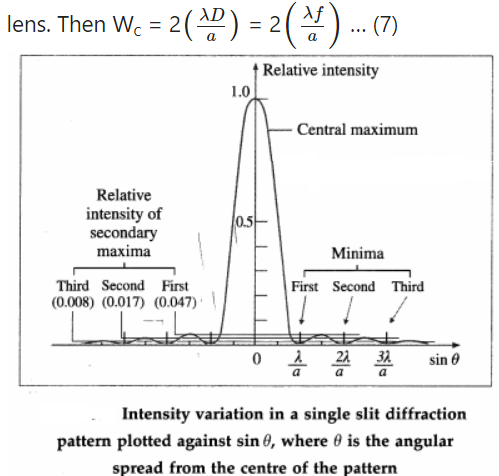
AnswerWhen a parallel beam of monochromatic light of wavelength $\lambda$ illuminates a single slit of finite width a, we observe on a screen some distance from the slit, a broad pattern of alternate dark and bright fringes. The pattern consists of a central bright fringe, with successive dark and bright fringes of diminishing intensity on both sides. This is called ‘ the diffraction pattern of a single slit.
Consider a single slit illuminated with a parallel beam of monochromatic light perpendicular to the plane of the slit. The diffraction pattern is obtained on a screen at a distance $D (» a)$ from the slit and at the focal plane of the convex lens.
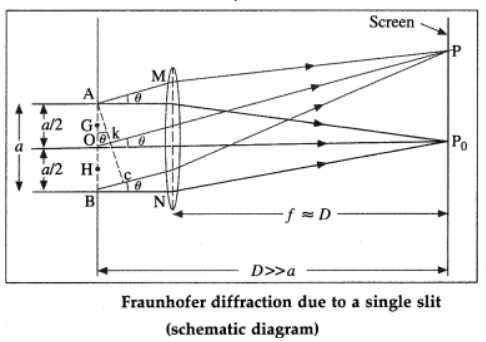
We can imagine the single slit as being made up of a large number of Huygens’ sources evenly distributed over the width of the slit. Then the maxima and minima of the pattern arise from the interference of the various Huygens’ wavelets.
Now, imagine the single slit as made up of two adjacent slits, each of width $a/2.$ Since, the incident plane wavefronts are parallel to the plane of the slit, all the Huygens sources at the slit will be in phase. They will therefore also in phase at the point $P_0$ on the screen, where $P_0$ is equidistant from all the Huygens sources. At $P_0,$ then, we get the central maximum.
For the first minimum of intensity on the screen, the path difference between the waves from the Huygens sources $A$ and $O ($or $O$ and $B)$ is $\lambda /2,$ which is the condition for destructive interference. Suppose, the nodal line $OP$ for the first minimum subtends an angle $\theta$ at the slit; $\theta$ is very small. With P as the centre and $PA$ as radius, strike an arc intersecting $PB$ at $C.$ Since, $D » a,$ the arc $AC$ can be considered a straight line at right angles to $PB.$ Then, $\triangle ABC$ is a right$-$angled triangle similar to A $OP_OP.$
This means that, $\angle BAC = \theta$
$\therefore BC = a \sin \theta$
$\therefore$ Difference in path length,
$BC = PB – PA = (PB – PO) + (PO – PA)$
The other nodal lines of intensity minima can be understood in a similar way. In general, then, for the with minimum $(wi = +1, ±2, ±3, …).$
$\theta _m = m\lambda$ a $($with minimum$) … (2)$
as $\theta _m$ is very small and in radian.
Between the successive minima, the intensity rises to secondary maxima when the path difference is an odd$$-$$integral multiple of $\lambda 2 :$
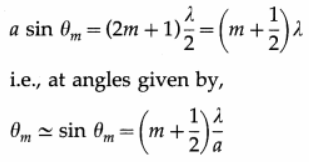
$(m^{th}$ secondary maximum$) … (3)$
Width of the central maximum :
Equation $(1)$ gives the angular half width of the central maximum. Therefore, the angular width of the central maximum is,
$2\theta = 2\lambda a … (4)$
From $\triangle OP_OP, P_OP = D \tan \theta ≃ D \sin \theta$
$(\because \theta$ is very small and in radian$)$
$\therefore y_1 = P_0P = D\lambda$ a $[$from Eq. $(1)] … (5)$
This is the distance of the first minimum from the centre of the central maximum.
$\therefore$ Width of the central bright fringe :
$W_c = 2y_{1d} = 2W = 2(\lambda Da) …(6)$
The central bright fringe is spread between the first dark fringes on either side. Thus, the width of the central bright fringe is the distance between the centres of the first dark fringe on either side.
If the lens is very close to the slit, $D$ is very nearly equal to $f,$ where f is the focal length of the
lens.
View full question & answer→Question 374 Marks
In a biprism experiment, the slit and the eyepiece are $10 \ cm$ and $80 \ cm$ away from the biprism. When a convex lens was interposed at $30 \ cm$ from the slit, the separation of the two magnified images of the slit was found to be $4.5\ mm$. If the wavelength of the source is $4500 A$ calculate the fringe width.
Answer$d _1=4.5 \ mm =4.5 \times 10^{-3} m ,$
$\lambda=4500 \mathring A =4.5 \times 10^{-7} m$
distance between the slit and the eyepiece $(D)=$ distance between the slit and the biprism $+$ distance between the biprism and the eyepiece
$=10 \ cm +80 \ cm$
$=90 \ cm$
$=0.9 m ,$
$u _1=30 \ cm =0.3$
$m v _1= D - u _1$
$=0.9 m -0.3 m$
$=0.6 m$
Linear magnification of a lens,
Linear magnification of a lens,
$\frac{\text { image size }}{\text { object size }}=\frac{\text { image distance }}{\text { object distance }}$
$\therefore \frac{d_1}{d}=\frac{v_1}{u_1} \text {}$
$\therefore d=\frac{d_1 u_1}{v_1}=\frac{4.5 \times 10^{-3} \times 0.3}{0.6}$
$\therefore d=2.25 \times 10^{-3} m$
$\therefore$ The fringe width,
$W=\frac{\lambda D}{d}$
$=\frac{4.5 \times 10^{-7} \times 0.9}{2.25 \times 10^{-3}}$
$=2 \times 0.9 \times 10^{-4}$
$ = 1 . 8 \times 1 0 ^{-4}$
$= 0 . 1 8\ m m$
View full question & answer→Question 384 Marks
In a biprism experiment, the distance between the second and tenth dark bands on the same side of the central bright band is $0.12 \ cm$, that between the slit and the biprism is $20 \ cm$ and that between the biprism and the eyepiece is $80 \ cm$. If the slit images given by the lens in the two positions are $4.5\ mm$ and $2\ mm$ apart, find the wavelength of light used.
AnswerThe distance between the second and tenth dark bands on the same side of the central band is equal to $8$ times the fringe width $(W)$.
$\therefore 8 W =0.12 \ cm\ ($by the data$)$
$\therefore W =\frac{0.12}{8} \ cm =0.015 \ cm =0.015 \times 10^{-2} m$
The distance $(D)$ between the slit and the eyepiece is equal to the sum of the distance between the slit and the biprism and the distance between the biprism and the eyepiece.
$\therefore D =20+80=100 \ cm =1 m\ ($by the data$)$
Also, $d _1=4.5\ mm$ and $d _2=2\ mm$
$\therefore$ The distance $(d)$ between the virtual images of the slit is
$d =\sqrt{d_1 d_2}= mm =3\ mm$
$=3 \times 10^{-3} m$
$\therefore$ The wavelength of light,
$d=\sqrt{d_1 d_2} =\sqrt{4.5 \times 2}\ mm =3\ mm$
$ =3 \times 10^{-3} m$
$\therefore$ The wavelength of light,
$\lambda =\frac{W d}{D}=\frac{0.015 \times 10^{-2} \times 3 \times 10^{-3}}{1}$
$ =4.5 \times 10^{-7} m$
$ =4.5 \times 10^{-7} \times 10^{10} \mathring A $
$ = 4 5 0 0 \mathring A$
View full question & answer→Question 394 Marks
An isosceles prism of refracting angle $179^{\circ}$ and refractive index 1.6 is used as a biprism by' keeping it $10 cm$ away from a slit, the edge of the biprism being parallel to the slit. The slit is illuminated by a light of wavelength $600 nm$ and the screen is $90 cm$ away from the biprism. Calculate the location of the centre of the 10 th dark band from the centre of the interference pattern and the path difference at this location.
View full question & answer→Question 404 Marks
In a biprism experiment, the slit is illuminated by light of wavelength $4800 A$. The distance between the slit and the biprism is $15 \ cm$ and that between the biprism and the eyepiece is $85 \ cm$. If the distance between the virtual sources is $3\ mm$, determine the distance between the $4^{th}$ bright band on one side and the $4^{th}$ dark band on the other side of the central band.
Answer$\lambda=4800 \mathring A =4.8 \times 10^{-7} m ,$
$d =3\ mm =3 \times 10^{-3} m$
$D =$ distance between the slit and the biprism $+$ distance between the biprism and the eyepiece $=15+85=100 \ cm =1 m$
The distance of the nth bright band from the central band is
$y_{n b } =n \lambda \frac{D}{d}$
$\therefore y_{4 b } =\frac{4 \lambda D}{d}=\frac{4 \times 4.8 \times 10^{-7} \times 1}{3 \times 10^{-3}}=6.4 \times 10^{-4} m$
The distance of the $m^{th}$ dark band from the central band is
$y_{m d } =(2 m-1) \frac{\lambda}{2} \frac{D}{d}$
$\therefore y_{4 d } =(2 \times 4-1) \frac{4.8 \times 10^{-7}}{2} \cdot \frac{1}{3 \times 10^{-3}}$
$= 5.6 \times 10^{-4} m$
$\therefore y_{4 b }+y_{4 d } =6.4 \times 10^{-4}+5.6 \times 10^{-4}$
$ =12 \times 10^{-4}$
$=1 . 2 \times 1 0 ^{-3} m$
$=1 . 2 ~ m m$
This is the required distance.
View full question & answer→Question 414 Marks
In a biprism experiment, the wavelength of red light used is $6000 A$ and the nth bright band is obtained at a point $P$ on the screen. Keeping the same setting, the source is replaced by a source of green light of wavelength $5000 A$ and the $( n +1)$ th bright band of green light coincides with point P. Find $n$.
AnswerData $: \lambda_{ r }=6000 Å, \lambda_{ g }=5000 Å$,
$y_n($ red $)=y_{n+1}$ (green) ... [ for bright bands]
The distance of the $n$th bright band from the central fringe is
$y_n=n \lambda \frac{D}{d}$
$\therefore y_n($ red $)=n \lambda_{ T } \frac{D}{d}$ and
$
\begin{aligned}
& y_{n+1}(\text { green })=(n+1) \lambda_{ g } \frac{D}{d} \\
\therefore & n \lambda_{ r } \frac{D}{d}=(n+1) \lambda_{ g } \frac{D}{d} \\
\therefore & n \lambda_{ r }=(n+1) \lambda_{ g }=n \lambda_{ g }+\lambda_{ g } \\
\therefore & n\left(\lambda_{ r }-\lambda_{ g }\right)=\lambda_{ g } \\
\therefore & n=\frac{\lambda_{ g }}{\lambda_{ r }-\lambda_{ g }}=\frac{5000}{6000-5000}=\frac{5000}{1000}= 5
\end{aligned}
$
View full question & answer→Question 424 Marks
In a biprism experiment, the $10^{th}$ dark band is observed at $2.09\ mm$ from the central bright point on the screen with red light of wavelength $6400 A$. By how much will the fringe width change if blue light of wavelength $4800 A$ is used with the same setting?
Answer$y_{10 d }=2.09\ mm , \lambda_{ r }=6400 \mathring A , \lambda_{ b }=4800 \mathring A $
$y_m($ dark band $)=\left(\frac{2 m-1}{2}\right) \frac{\lambda . D}{d}=\left(\frac{2 m-1}{2}\right) W$
$\therefore y_{10 d }=\left(\frac{2 \times 10-1}{2}\right) W_{ r }=\frac{19}{2} W_{ r }$
$\therefore W_{ r }=\frac{2}{19} y_{10 d }$
$=\frac{2}{19} \times 2.09\ mm$
$=2 \times 0.11\ mm$
$=0.22\ mm \text {}$
For the same $D$ and $d, W \propto \lambda$.
$\therefore \frac{W_{ b }}{W_{ r }}=\frac{\lambda_{ b }}{\lambda_{ r }}=\frac{4800}{6400}=\frac{3}{4}$
$\therefore W_{ b }=\frac{3}{4} W_{ r }$
$=\frac{3}{4} \times 0.22$
$=3 \times 0.055=0.165\ mm$
$\therefore$ The change $($decrease$)$ in fringe width $=W_{ r }-W_{ b }=0.22-0.165= 0 . 0 5 5\ m m$
View full question & answer→Question 434 Marks
What must be the thickness of a thin film which, when kept near one of the slits shifts the central fringe by $5 mm$ for incident light of wavelength $5890 A$ in Young's double-slit: interference experiment? The refractive index of the material of the film is 1.1 and the distance between the slits is $0.5 mm$.
AnswerData $: \lambda=5890 Å, nm =1.1$, the shift of the central bright fringe $=5$ $mm$
Let $t$ be the thickness of the film and $P$ the point on the screen where the central fringe has shifted. Suppose the film is kept in front of slit S1. Due to the film, the optical path travelled by the light passing through it increases by $(1.1-1) f=0.1 t$. Thus, the optical paths between the two beams passing through the two slits are not equal at the midpoint of the screen but are equal at $P, 5 mm$ away from the centre. At this point the distance travelled by light from the other slit $S_2$ to the screen is larger than that travelled by light from $S _1$ by $0.1 t$.
The difference in distances, $S_2 P-S_1 P=y \lambda / d$, where $y$ is the distance along the screen $=5 mm =5 \times 10^{-3} m$ and $d =0.5 mm =5 \times 10^{-4} m$.
This has to be equal to the difference in optical paths introduced by the film.
Thus, $0.1 t =5 \times 10^{-3} \times 5890 \times 10^{-10} / 5 \times 10^{-4}$.
$\therefore t =5890 \times 10^{-8} m =5.89 \times 10^{-5} m =0.0589 mm$
View full question & answer→Question 444 Marks
In Young's double-slit experiment using monochromatic light, the fringe pattern shifts by certain distance on the screen when a mica sheet of refractive index 1.6 and thickness 1.964 microns is introduced in the path of one of the interfering waves. The mica sheet is then removed and the slits-to-screen distance is doubled. It is found that the distance between successive maxima now is the same as the observed fringe shift with the mica sheet. Calculate the wavelength of the monochromatic light used.
AnswerData $: n _{ m }=1.6, b =1.964$ microns $=1.964 \times 10^{-6} m$,
$
D _2=2 D _1, W _2= y _0
$
The fringe shift with the mica sheet,
$
y _0=\frac{D_1}{d}\left( n _{ m }-1\right) b
$
Subsequent to the removal of the mica sheet and doubling the slits-toscreen distance, the new fringe width is,
$
W_2=\frac{\lambda D_2}{d}=\frac{\lambda\left(2 D_1\right)}{d}
$
Since, $W_2=y_0$,
$
\frac{2 \lambda D_1}{d}=\frac{D_1}{d}\left(n_{ m }-1\right) b
$
$\therefore$ The wavelength of the light used,
$
\begin{aligned}
\lambda & =\frac{n_{ m }-1}{2} \cdot b=\frac{1.6-1}{2} \cdot\left(1.964 \times 10^{-6}\right) \\
& =0.3 \times 1.964 \times 10^{-6} \\
& = 5 . 8 9 2 \times 1 0 ^{-7} ~ = 5 8 9 2 Å
\end{aligned}
$
View full question & answer→Question 454 Marks
Monochromatic light from a narrow slit illuminates two narrow slits $3\ mm$ apart, producing an interference pattern with bright fringes $0.15\ mm$ apart on a screen $75 \ cm$ away from the slits. Find the wavelength of the light. How will the fringe width be altered if
$(a)$ the distance of the screen from the slits is doubled
$(b)$ the separation between the slits is doubled?
AnswerData : $d =3 mm =3 \times 10^{-3} m$,
$W =0.15 mm =1.5 \times 10^{-4} m , D =75 \ cm =0.75 m$
$(i)$ The wavelength of light, $\lambda=\frac{W d}{D}$
$=\frac{1.5 \times 10^{-4} \times 3 \times 10^{-3}}{0.75}=6 \times 10^{-7} m$
$=6000 \mathring A \text {}$
$(ii)$ Fringe widths, $W=\frac{\lambda D}{d}$ and $W^{\prime}=\frac{\lambda D^{\prime}}{d}$
$\therefore \frac{W^{\prime}}{W} =\frac{D^{\prime}}{D}=2\ ($by the data$)$
$\therefore W^{\prime} =2 W=2 \times 1.5 \times 10^{-4}=3 \times 10^{-4} m$
$ =0.3\ mm\ ($new fringe width$)$
$(iii)\ W=\frac{\lambda D}{d}$ and $W^{\prime \prime}=\frac{\lambda D}{d^{\prime \prime}}$
$\therefore \frac{W^{\prime \prime}}{W} =\frac{d}{d^{\prime \prime}}=\frac{1}{2}\ ($by the data$)$
$\therefore W^{\prime \prime} =\frac{W}{2}=\frac{1.5 \times 10^{-4}}{2}=0.75 \times 10^{-4} m$
$ =0.075\ mm\ ($new fringe width$)$
View full question & answer→Question 464 Marks
On passing light of wavelength $5000 A$ through two pinholes $2\ mm$ apart, an interference pattern is formed on a screen kept parallel to the plane of the pinholes and $100 \ cm$ from them. Find the distance between the fifth bright band on one side of the central bright band and the sixth dark band on the other side.
Answer$\lambda=5000 \mathring A =5 \times 10^{-7} m ,$
$d =2 \ mm =2 \times 10^{-3} m ,$
$D =100 \ cm =1 m$
Fringe width, $W=\frac{\lambda D}{d}$
$=\frac{5 \times 10^{-7} \times 1}{2 \times 10^{-3}}$
$=2.5 \times 10^{-4} m$
$ y_n ($bright fringe $)=n \frac{\lambda D}{d}=n W$
$\therefore y_{5 b }=5 W=5 \times 2.5 \times 10^{-4} m =1.25 \times 10^{-3} m$
$ y_m ($dark fringe$)=\left(m-\frac{1}{2}\right) \frac{\lambda D}{d}=\left(m-\frac{1}{2}\right) W$
$\therefore y_{6 d }=\left(6-\frac{1}{2}\right) \times 2.5 \times 10^{-4} m =1.375 \times 10^{-3} m$
$\therefore y _{5 b }+ y _{6 d }$
$=1.25 \times 10^{-3} m +1.375 \times 10^{-3} m$
$=2.625 \times 10^{-3} m$
$=2.625 \ mm$
This is the required distance.
View full question & answer→Question 474 Marks
Sodium light of wavelength $5.896 \times 10^{-7} m$ is passed through two pinholes $0.5 mm$ apart, and an interference pattern is formed on a screen kept parallel to the plane of the pinholes and $1.2 m$ from them. Find the distance between
$(i)$ the second and the fifth bright fringes
$(ii)$ the third and the seventh dark fringes on the same side of the central bright point.
AnswerData : $\lambda=5.896 \times 10^{-7} m , d =0.5 mm =0.5 \times 10^{-3} m , D =1.2 m$
$(i)$ The distance of the nth bright fringe from the central bright point is
$y_{ n }=\frac{n \lambda D}{d}$
$\therefore y_2=\frac{2 \lambda D}{d}$ and $y_5=\frac{5 \lambda D}{d}$
$\therefore y_5-y_2=\frac{3 \lambda D}{d}$
$=\frac{3 \times 5.896 \times 10^{-7} \times 1.2}{0.5 \times 10^{-3}}$
$=5.896 \times 7.2 \times 10^{-4}$
$=4.245 \times 10^{-3} m$
The distance between the second and the fifth bright fringes on the same side of the central bright point is $4.245 \times 10^{-3} m$.
$(ii)$ The distance of the mth dark fringe from the central bright point is
$y_m =\frac{(2 m-1) \lambda D}{2 d \text {}}$
$\therefore y_3 =\frac{5 \lambda D}{2 d}$ and $y_7=\frac{13 \lambda D}{2 d}$
$\therefore y_7-y_3=\frac{8 \lambda D}{2 d}=\frac{4 \lambda D}{d}$
$=\frac{4 \times 5.896 \times 10^{-7} \times 1.2}{0.5 \times 10^{-3}}$
$=5.896 \times 9.6 \times 10^{-4}$
$=5.66 \times 10^{-3} m$
The distance between the third and the seventh dark fringes on the same side of the central bright point is $5.66 \times 10^{-3} m$.
View full question & answer→Question 484 Marks
In a double-slit experiment, the optical path difference between the waves coming from two coherent sources at a point $P$ on one side of the central bright band is $7.5 \times 10^6 m$ and that at a point $Q$ on the other side of the central bright band is $1.8 \times 10^6 m$. How many bright and dark bands are observed between points $P$ and $Q$ if the wavelength of light used is $6 \times$ $10^7 m$ ?
AnswerData : $\Delta l _1=7.5 \times 10^{-6} m , \Delta l _2=1.8 \times 10^{-6} m \lambda=6 \times 10^{-7} m$
For point $P :$ Let $p \frac{\lambda}{2}=\Delta l _1$
$
\therefore p=\frac{2 \Delta l_1}{\lambda}=\frac{2 \times 7.5 \times 10^{-6}}{6 \times 10^{-7}}=\frac{150}{6}=25
$
The path difference $\Delta l _1$ is an odd integral multiple of $\lambda / 2: \Delta l _1=(2 m -$
1) $\frac{\lambda}{2}$, where $m$ is an integer,
$\therefore 2 m -1=25 \therefore m =13$
$\therefore$ Point $P$ is at the centre of the 13 th dark band.
For point Q :
Let $q \frac{\lambda}{2}=\Delta l _2$
$
\therefore q=\frac{2 \Delta l_2}{\lambda}=\frac{2 \times 1.8 \times 10^{-6}}{6 \times 10^{-7}}=\frac{36}{6}=6
$
The path difference $\Delta I _2$ is an even integral multiple of $\frac{\lambda}{2}: \Delta l _2=(2 n ) \frac{\lambda}{2}$,
where $n$ is an integer
$
\therefore 2 n =6 \therefore n =3
$
$\therefore$ Point $Q$ is at the centre of the 3rd bright band. Between points $P$ and $Q$, excluding the respective bands at $P$ and $Q$, the number of dark bands $=12+3=15$ and the number of bright bands (including the central bright band) $=12+2+1=15$
View full question & answer→Question 494 Marks
In Young's double$-$slit experiment with slits of equal width, a point $P$ on the screen is at a distance equal to one$-$fourth of the fringe width from the central maximum. If the intensity at the central maximum is $I_0$ find the intensity at $P$.
AnswerData : $y=\frac{W}{4}$
Path difference,
$\Delta l= S _2 P - S _1 P =\frac{y d}{D}=\frac{W d}{4 D}=\frac{\lambda D}{4 d} \cdot \frac{d}{D}=\frac{\lambda}{4}\left(\text { as } W=\frac{2 D}{d}\right)$
$\therefore$ Phase difference,
$\phi=\frac{2 \pi}{2} \times \Delta l=\frac{2 \pi}{2} \times \frac{\lambda}{4}=\frac{\pi}{2} rad$
Since, the slits have equal width, the intensities of the two interfering waves are equal, say $I_0$.
Then the intensity at a point on the screen is $I=4 I_0 \cos ^2 \frac{\phi}{2}$At the central maximum, $\varphi=0$.
$\therefore I_c=4 I_0$
$\therefore$ At point $P,$
$I_p=I_c \cos ^2\left(\frac{\phi}{2}\right)-I_c \cos ^2 \frac{\pi / 2}{2}$
$-I_c \cos ^2 \frac{\pi}{4}-I_c\left(\frac{1}{\sqrt{2}}\right)^2=\frac{I_c}{2}$
The intensity at $P$ is half that at the central maximum.
View full question & answer→Question 504 Marks
At a point on the two$-$slit interference pattern obtained using a source of green light of wavelength $5500 A$, the path difference is $4.125\ pm$. Is the point at the centre of a bright or dark fringe? Hence, find the order of the fringe.
AnswerPath difference, $\Delta I=4.125 \times 10^6 \lambda=5500 A =5.5 \times 10^7 m$
Let $p$ be an integer such that $p_2 \frac{i}{2}-\Delta l$,
$\therefore \mu=\frac{2 \Delta l}{\lambda}=\frac{2 \times 4.125 \times 10^{-4}}{5.5 \times 10^{-7}}-\frac{8.25 \times 10}{5.5}$
$-\frac{k 25}{55}-15$
$\therefore \Delta l=15 \frac{\lambda}{2}$
As the path difference is an odd integral multiple of $\frac{\lambda}{2}$ the point is at the centre of a dark fringe.
$\therefore p=2 m-1(m=1,2,3 \ldots)$
$\therefore 2 m-1=15$
$\therefore m=8$
$\therefore$ The order of the fringe is $8 ($i.e, the point lies at the centre of the $8$ th dark fringe$).$
View full question & answer→Question 514 Marks
In Young's double $-$ slit experiment using monochromatic light of wavelength $\lambda,$ the intensity of light at a point on the screen where the path difference is $\lambda$ is $1$ . What is the intensity of light at a point where the path difference is $\lambda / 3$ ?
AnswerData : $\Delta I_1=\lambda, I_1=1, \Delta I_2=\lambda / 3$
We assume that light waves coming out of the two slits are of equal intensity lo.
Then at a point in the interference pattern where the phase difference between the interfering waves is $\varphi$, the resultant intensity is,
$1=2 l_0(1+\cos \varphi)$
Phase difference $(\varphi)=\frac{2 \pi}{\lambda} \times$ path difference $(\Delta \mid)$
$\therefore$ For $\Delta l_1-\lambda \phi_1=\frac{2 t}{i} \times \lambda=2 \approx$ rad
$\therefore I_1 =2 l_0\left(1+\cos \phi_1\right)=2 I_9(1+\cos 2 \pi)$
$ =2 l_0(1+1)=4 I_0$
$\therefore l_0 =\frac{l_3}{4}=\frac{l}{4}$
For, $\Delta l_2=\lambda / 3, \phi_2=\frac{2 \pi}{2} \times \frac{\lambda}{3}=\frac{2 \pi}{3} rad$
$\cos \frac{2 \pi}{3}=\cos 12 O^{\circ}=-\sin 30^{\circ}=-\frac{1}{2}$
$\therefore I_2=2 I_0\left(1+\cos \phi_2\right)=2 \times \frac{1}{4}\left(1+\cos \frac{2 \pi}{3}\right)$
$-2 \times \frac{I}{4}\left(1-\frac{1}{2}\right)=2 \times \frac{1}{4} \times \frac{1}{2}=\frac{I}{4}$
$\therefore$ A The intensity of light at a point where the path difference is $N / 3$ is $\lambda / 4$.
View full question & answer→Question 524 Marks
In Young's double$-$slit experiment, the ratio of the intensities at the maxima and minima in the interference pattern is $36: 16$. What is the ratio of the widths of the two slits?
AnswerData $: \frac{I_{\max }}{l_{\min }}=\frac{36}{16}$
$\frac{I_{\max }}{I_{\min }}-\left(\frac{E_{10}+E_{20}}{E_{10}-E_{20}}\right)^2$
$\therefore \frac{36}{16}-\left(\frac{E_{10}+E_{20}}{I_{10}-E_{20}}\right)^2$
$\therefore \frac{E_{10}+E_{20}}{E_{10}-E_{20}}=\frac{6}{4}=\frac{3}{2}$
By componendo$-$dividendo, $\frac{E_{10}}{E_{20}}=\frac{3+2}{3-2}=5$
Therefore, the ratio of the slit widths,
$\frac{ w _1}{ w _2}=\frac{l_1}{l_2}=\left(\frac{E_{10}}{E_{20}}\right)^2=(5)^2=25$
View full question & answer→Question 534 Marks
Monochromatic light waves of intensities $l_1$ and $l_2$ and a constant phase difference $\varphi$ produce an interference pattern. State an expression for the resultant intensity at a point in the pattern. Hence deduce the expressions for the resultant intensity, maximum intensity and minimum intensity if $I _1= I _2= I _0$
View full question & answer→Question 544 Marks
Monochromatic light waves of amplitudes $E_{10}$ and $E_{20}$ and a constant phase difference $\varphi$ produce an interference pattern. State an expression for the resultant amplitude at a point in the pattern. Hence, deduce the conditions for
$(i)$ constructive interference with maximum intensity
$(ii)$ destructive interference with minimum intensity. Also show that the ratio of the maximum and minimum intensities is
$\frac{I_{\max }}{I_{\min }}=\left(\frac{E_{10}+E_{50}}{E_{10}-E_{50}}\right)^2$
AnswerConsider a two-source interference pattern produced by monochromatic light waves of angular frequency $\omega$, wavelength $\lambda$ amplitudes $E_{10}$ and $E_{20}$ and a constant phase difference $\varphi$.Let the individual electric fields along the same line due to the waves at some point in the interference pattern be
$E_1=E_{10} \sin \omega t$ and $E_2=E_{20} \sin (\omega t+\varphi)$
By the principle of superposition of waves, the resultant electric field (displacement) at that point is the algebraic sum
$E=E_1+E_2=E_{10} \sin \omega t-E_{20} \sin (e t+\phi)$
$E_{10} \sin \omega t+E_{20} \sin \cot \cos \phi+E_{20} \cos \cot \sin \phi$
$-\left(E_{10}+E_{20} C 00 \phi\right) \sin \omega t+E_{20} \sin \phi \cos \omega t$
$\text { Let } E_{10}+E_{70} \cos \phi-R \cos \theta \text { and }$
$E_{20} \sin \phi-R \sin \theta$
$\therefore E=R \cos \theta \sin \omega t-R \sin \theta \cos \omega t$
$=R(\sin \omega i \cos \theta+\cos \omega i \sin \theta)$
$= R \sin (\omega f +\theta)$
The resultant amplitude is,
$|R|=\sqrt{E_{10}^2+E_{20}^2+2 E_{10} \tilde{E}_{20} \cos \phi}$
Since, the intensity of a wave is proportional to the square of its amplitude, the resultant intensity at $P$,
$\left.|\propto| R\right|^2$
$\therefore l \propto E_{10}^2+E_{20}^2+2 \Gamma_{10} \Gamma_{20} 005 $
Thus, the intensity depends on $\cos \varphi$.
The condition for constructive interference with maximum intensity is $\cos \varphi$ is maximum, equal to $1$ , i.e., $\varphi=2 n \pi(n=0,1,2,3 \ldots)$ (3)
The condition for destructive interference with minimum intensity is $\cos \varphi$ is minimum equal to
$-1, \text { i.e., }$
$\phi=(2 m-1) m \quad(m=1,2,3 \ldots)$
At points where $R$ and $J$ are maximum,
$R_{\min }=E_{10}+E_{20}$
$\text { and } I_{\min } \propto E_{10}^2+E_{20}^2+2 E_{10} E_{20}$
$\therefore I_{\min } \propto\left(E_{10}+E_{20}\right)^2$
At points where $K$ and $I$ are minimum,
$R_{\min }-\left|E_{10}-E_{20}\right|$
$\text { and } d_{\min } \text { o. } E_{C_0}+E ?_0-2 E_{20} E_{20}$
$\therefore I_{\min } \propto\left(L_{10}-L_{20}\right)^2$
$\therefore \text { From liqs. (6) and (B), }$
$\frac{t_{\text {mas }}}{l_{\text {ais }}}-\left(\frac{t_{10}+t_{20}}{t_{10}-t_{20}}\right)^2$
Note : We can write the above expression as
$\frac{L_{\text {ses }}}{I_{\text {wit }}}=\left(\frac{1+E_{29} / E_{19}}{1-E_{29} / E_{i 9}}\right)^{ \pm}=\left(\frac{1+r}{1-r}\right)^2 \text {. }$
where $r$ is the amplitude ratio $\frac{E_{30}}{E_{10}}. 1$
View full question & answer→Question 554 Marks
Obtain expressions in terms of electric field, for the resultant amplitude and the intensity for the interference pattern produced by monochromatic light waves from two coherent sources.
Question 564 Marks
In Young's double-slit experiment, a glass slide of refractive index $n_g$ and thickness $b$ is placed in front of one of the slits. What happens to the interference pattern and fringe width
? Derive an expression for the positions of the bright fringes in the interference pattern.
View full question & answer→Question 574 Marks
State the conditions for constructive and destructive interference of light.
Answer(1) Constructive interference (brightness) : There is constructive interference at a point and the brightness or intensity is maximum there, if the two waves of light of the same frequency arrive at the point in phase, i.e., with a phase difference of zero or an integral multiple of $2 \pi$ radians.
A phase difference of $2 \pi$ radians corresponds to a path difference $\lambda$ where $\lambda$ is the wavelength of light. Since
$\frac{\text { phase difference }}{2 x}-\frac{\text { path difference }}{\lambda}$.
for constructive interference with maximum intensity of light, phase difference $=0,2 \pi, 4 \pi$, $6 \pi$... rad
$=n(2 \pi) rad$
or path difference $=0, \lambda, 2 \lambda, 3 \lambda \ldots$, etc.
$=n \lambda$
where $n=0,1,2,3, \ldots$, etc.
(2) Destructive interference (darkness) : There is destructive interference at a point and the point is the darkest, i.e. the intensity of light is minimum, if the two waves of light of the same frequency and intensity arrive at the point in opposite phase, i.e., with a phase difference of an odd-integral multiple of $\pi$ radians. A phase difference $2 \pi$ radians corresponds to a path difference $\lambda$ where $\lambda$ is the wavelength of light.
$\therefore$ For destructive interference with minimum intensity of light, phase difference $=\pi, 3 \pi, 5 \pi$, ... rad
$=(2 m-1) \pi rad$
or path difference $=\lambda / 2,3 \lambda / 2,5 \lambda / 2$, e., etc.
$
=(2 m-1) \frac{\lambda}{2}
$
where $m=1,2,3, \ldots$ etc.
View full question & answer→Question 584 Marks
Explain how the phenomenon of interference can be demonstrated in a ripple tank.
Question 594 Marks
State and explain the principle of superposition of waves.
AnswerPrinciple of superposition of waves : The dis-placement at a point due to the combined effect of a number of waves arriving simultaneously at the point is the vector sum of the displacements due to the individual waves arriving at the point.
Explanation : This is a general principle of linear systems applied to wave phenomena. When two or more wave trains arrive at a point simultaneously, they interpenetrate without: disturbing each other. The resultant displacement at that point is the vector sum of the displacements due to the individual waves arriving at the point. The amplitude and phase angle of the resulting disturbance are functions of the inolvidual amplitudes and phases.
Notes :
1. In the case of mechanical waves, e.g. sound, the displacement is that of a vibrating particle of the medium.
2. When we consider superposition of electromagnetic waves, light in this chapter, the term displacement refers to the electric field component of the electromagnetic wave.
View full question & answer→Question 604 Marks
Two polarizers are so oriented that the maximum amount of light is transmitted. To what fraction of its maximum value is the intensity of the transmitted light reduced when the second polarizer is rotated through $(a) 300 , (b) 600$ ?
AnswerData : $\theta=30^{\circ}, 60^{\circ}$,
$I _2= I _2 \cos ^2 \theta$
where $I_1$ is the intensity of the incident light and $I_2$ is that of the transmitted light.
$(i)$ For $\theta=30^{\circ}$
$I_2=I_1\left(\cos 30^{\circ}\right)^2=I_1\left(\frac{\sqrt{3}}{2}\right)^2=\frac{3}{4} I_1$
$I_2=0.75 I _1$
$=75 \% \text { of } I _1$
$(ii)$ For $\theta=60^{\circ}$
$I_2=I_1\left(\cos 60^{\circ}\right)^2$
$=I_1\left(\frac{1}{2}\right)^2=\frac{1}{4} I_1$
$=0.25 I _1=25 \%$ of $I _1$
View full question & answer→Question 614 Marks
Explain the phenomenon of polarization by scattering.
Question 624 Marks
Explain the phenomenon of polarization of light by reflection.
Question 634 Marks
With a neat labelled diagram, explain the use of a pair of polarizers to vary the intensity of light. What are crossed polarizers?
Question 644 Marks
What is a Polaroid? Explain its construction.
Question 654 Marks
Explain the terms:
1. polarizing axis of a polarizer
2. plane of vibration
3. plane of polarization.
Question 664 Marks
How are polarized light and unpolarized light represented in a ray diagram ?
OR
How will you distinguish between polarized and unpolarized light in a ray diagram?
Question 674 Marks
What is meant by polarized light? How does it differ from unpolarized light?
AnswerAccording to the electromagnetic theory of light, a light wave consists of electric and magnetic fields vibrating at right angles to each other and to the direction of propagation of the wave. If the vibrations of the electric field $\vec{E}$ in a light wave are confined to a single plane containing the direction of propagation of the wave so that its electric field is restricted along one particular direction at right angles to the direction of propagation of the wave, the wave is said to be plane-polarized or linearly polarized.
If the vibrations of $\vec{E}$ in a light wave are in all directions perpendicular to the direction of propagation of the light wave, the light wave is said to be unpolarized. Ordinary light, e.g. that emitted by a bulb, is unpolarized.
According to Biot, unpolarized light may be considered as a superposition of many linearly polarized waves, with random orientations. Also, these component waves are noncoherent, that is, irregular in their phase relationships.
[Note: Ordinary light consists of wave trains, each coming from a separate atom in the source. A beam of ordinary light in a single direction consists of millions of such wave trains from the very large number of atoms in the source radiating in that direction. Hence, the vibrations of $\vec{E}$ are in all transverse directions with equal probability. Thus, light from an ordinary source is.un-polarized.]
View full question & answer→Question 684 Marks
The width of a plane incident wavefront is found to be doubled in a denser medium if it makes an angle of 70° with the surface. Calculate the refractive index for the denser medium.
Question 694 Marks
A parallel beam of monochromatic light is incident on a glass slab at an angle of incidence $60^{\circ}$. Find the ratio of the width of the beam in glass to that in air if the refractive index of glass is $\frac{3}{2}$.
Data: $i =60, a n _g=1.5$
By Snell's law, ang $=\frac{\sin i}{\sin r} \therefore \sin r=\frac{\sin i}{\operatorname{sn} n_g}$
View full question & answer→Question 704 Marks
A ray of light is incident on a glass slab making an angle of $30^{\circ}$ with the surface. Calculate the angle of refraction in glass and the speed of light in glass. The refractive index of glass and speed of light in air are $1.5$ and $3 \times 10^8 m / s,$ respectively.
AnswerData : $v_{\text {air }}=3 \times 10^8 m / s ; n =1.5$
The angle of incidence $(i)$ is the angle made by the incident ray with the normal drawn to the refracting surface.
$\therefore i =90^{\circ}-30^{\circ}=60^{\circ}$
$(a)$ Angle of refraction $(r)$ in glass:
$n=\frac{\sin i}{\sin r}$
$\therefore \sin r=\frac{\sin i}{n}=\frac{\sin 60^{\circ}}{1.5}$
$=\frac{0.8660}{3 / 2}=0.5773$
$\therefore r=\sin ^{-1} 0.5773=35^{\circ} 16^{\prime}$
$(b)$ Speed of light $( \left.v _\text{glass }\right)$ in glass :
$n=\frac{v_{\text {air }}}{v_{\text {glass }}}$
$\therefore v_{\text {ghas }}=\frac{v_{\text {air }}}{n}$
$=\frac{3 \times 10^{ g }}{1.5}=2 \times 10^8 m / s$
View full question & answer→Question 714 Marks
Monochromatic light of wavelength $632.8\ nm$ is incident from air on a water surface. What are the wavelength, frequency and speed of $(a)$ reflected and $(b)$ refracted light? $[$Given : Refractive index of water $=1.33 ]$
AnswerLet $v$ be the frequency of the light and $\lambda_1$ and $\lambda_2$ the wavelengths of reflected and refracted light respectively.
Data : $\lambda_1=632.8\ nm =632.8 \times 10^{-9} m$,
$c =3 \times 10^8 m / s , a _{ w }=1.33$
$(a)$ For reflected light:
When the wave travels in air, its speed $v_1=c$
$\therefore v_1=c=v \lambda_1$
$v=\frac{c}{\lambda_1}=\frac{3 \times 10^8}{632.8 \times 10^{-9}}=\frac{3}{632.8} \times 10^{17}$
$v=4.741 \times 10^{14} Hz$
$(b)$ For refracted light:
Frequency does not change while going from one medium to other.
$\therefore V =4.741 \times 10^{14} Hz$
${ }_{ a }{ }^{n_w} =\frac{v_1}{v_2}=\frac{v \lambda_1}{v \lambda_2}=\frac{\lambda_1}{\lambda_2}$
$\lambda_2 =\frac{\lambda_1}{{ }^n n_{ w }}=\frac{632.8 \times 10^{-9}}{1.33}$
$ =4.757 \times 10^{-7} m =475.7\ nm$
Now, $a _{ w }=\frac{v_1}{v_2}=\frac{c}{v_2}$
$\therefore v_2 =\frac{c}{{ }_{ a } n_{ w }}=\frac{3 \times 10^8}{1.33}$
$ =2.255 \times 10^8 m / s$
This is the speed of the light in water.
View full question & answer→Question 724 Marks
The refractive indices of glycerine and diamond with respect to air are $1.46$ and $2.42$ respectively. Calculate the speed of light in glycerine and in diamond. From these calculate the refractive index of diamond with respect to glycerine.
AnswerLet $n_g$ and $n_d$ be the refractive indices of glycerine and diamond respectively.
Also, let $v_a, v_g$ and $v_d$ be the speeds of light in air, glycerine and diamond respectively.
Data : $v_a=3 \times 10^8 m / s$
$n _{ g }=1.46,$
$n _{ d }=2.42$
$(i)$ Refractive index of glycerine with respect to air,
$n_{ g }=\frac{v_{ a }}{v_{ g }}$
$\therefore v_{ g }=\frac{v_{ a }}{n_{ g }}=\frac{3 \times 10^{ g }}{1.46}=2.055 \times 10^8 m / s$
$(ii)$ Refractive index of diamond with respect to air,
$n_{ d }=\frac{v_{ a }}{v_{ d }}$
$\therefore v_{ d }=\frac{v_{ a }}{n_{ d }}=\frac{3 \times 10^8}{2.42}=1.24 \times 10^8 m / s$
$(iii)$ Refractive index of diamond with respect to glycerine,
${ }_g n_{ d }=\frac{v_{ g }}{v_{ d }}=\frac{2.055 \times 10^s}{1.24 \times 10^8}= 1 . 6 5 7$
View full question & answer→Question 734 Marks
Suppose a parallel beam of monochromatic light is incident normally at a boundary separating two media. Explain what happens to the wavelength and frequency of the light as it propagates from medium 1 to medium 2. What happens when the medium 1 is vacuum ?
Question 744 Marks
Explain the construction and propagation of a spherical wavefront using Huygens’ principle.
Question 754 Marks
Explain the construction and propagation of a plane wavefront using Huygens’ principle.
Question 764 Marks
Define and explain:
(a) a wave normal
(b) a ray of light.
Answer(a) Wavenormal: A wave normal at a point on a wavefront is defined as a line drawn perpendicular to the wavefront in the direction of propagation of the wavefront.
In a homogeneous isotropic medium, a wavefront moves parallel to itself. Thus, at any point in the medium, the direction in which the wavefront moves is always perpendicular to the wavefront at that point. This direction is given by the wave normal at that point.
(b) Ray of light The direction in which light is propagated is called a ray of light.
This term (ray of light) is also used to mean a narrow beam of light waves. Only in a homogeneous isotropic medium is a ray of light the same as a wave normal. For spherical wavefronts spreading out from a point source, the rays are radially divergent. The rays corresponding to a plane' wavefront form a parallel beam.
View full question & answer→Question 774 Marks
State the characteristics of the electromagnetic waves.
Answer1. The electromagnetic waves are transverse in nature as they propagate by oscillating electric and magnetic fields that are perpendicular to each other and also perpendicular to the direction of propagation of the wave.
2. These waves do not require any material medium for their propagation, i.e. they can travel even through vacuum.
3. The wavelength of the electromagnetic waves ranges from very small $(<1 fm )$ to very large ( $>1 km$ ). The waves are classified in the order of increasing wavelength as $\gamma$ rays, $X$ rays, ultraviolet, visible, infrared. microwave and radio waves.
4. In vacuum, the speed of electromagnetic waves does not depend on the frequency of the wave. But, in a material medium, it depends on the frequency. For a given frequency, the speed is different in different mediums.
[Note : $1 fm$ (femtometre) $=10^{15} m$.
View full question & answer→Question 784 Marks
Give a brief account of Huygens' wave theory of light. State its merits and demerits.
AnswerHuygens' wave theory of light [Christiaan Huygens (1629-95), Dutch physicist) :
1. Light emitted by a source propagates in the form of waves. Huygens' original theory assumed them to be longitudinal waves.
2. In a homogeneous isotropic medium, light from a point source spreads by spherical waves.
3. It was presumed that a wave motion needed a medium for its propagation. Hence, the theory postulated a medium called luminiferous ether that exists everywhere, in vacuum as well as in transparent bodies. Ether had to be assigned some extraordinary properties, a high modulus of elasticity (to account for the high speed of light), zero density' (so that it offers no resistance to planetary motion) and perfect transparency-
4. The different colours of light are due to different wavelengths.
Merits :
1. Huygens' wave theory satisfactorily explains reflection and refraction as well as their simultaneity.
2. In explaining refraction, the theory concludes that the speed of light in a denser medium is less than that in a rarer medium, in agreement with experimental findings.
3. The theory was later used by Young in 1800-04, Fraunhofer and Fresnel in 1814 to satisfactorily explain interference, diffraction and rectilinear propagation of light. The phenomenon of polarization could also be explained considering the light waves to be transverse.
Demerits :
1. It was found much later that the hypothetical medium, luminiferous ether, has no experimental basis. Einstein discarded the idea of ether completely in 1905.
2. Phenomena like absorption and emission of light, photoelectric effect and Compton effect, cannot be explained on the basis of the wave theory.
[Note: To decide between the particle and wave theories of light, Dominique Francois Jean Arago (1786-1853). French physicist, suggested the measurement of the speed of light in air and water. The experiment was performed in 1850 by Leon Foucault (1819-68), French physicist, using Arago's experimental equipment. He found that the speed of light in water is less than that in air.
View full question & answer→Question 794 Marks
State the postulates of Newton's corpuscular theory of light.
AnswerSir Isaac Newton developed the corpuscular theory of light proposed by Rene Descartes (1596-1650), French philosopher and mathematician. The theory assumed that light consists of a stream of corpuscles emitted by a luminous source.
Postulates of Newton's corpuscular theory of light:
1. Light corpuscles are minute, light and perfectly elastic particles.
2. A luminous source emits light corpuscles in all directions which then travel at high speed in straight lines in a given medium.
3. The constituent colours of white light are due to different sizes of the corpuscles.
4. The light corpuscles stimulate the sense of sight on their impact on the retina of the eye.
5. A reflective surface exerts a force of repulsion normal to the surface on the light: corpuscles when they strike the surface.
6. A transparent medium exerts a force of attraction normal to the surface on the light. corpuscles striking the surface. This force is different for different mediums.
Notes :
1. A consequence of the assumption (6) is that, according to the corpuscular theory, the speed of light in a denser medium is greater than that in air and has different values for different mediums.
2. It was known from earliest recorded times that when light is incident on the surface of glass or water, it is partly reflected and partly transmitted, simultaneously. To explain this, Newton postulated that the corpuscles must have fits of easy reflection and fits of easy transmission and must pass periodically from one state to the other.
View full question & answer→