- While trying to pull a cart, ahorse pushes the ground backward with some force. The ground in turn exerts an equal and opposite reaction force upon the feet of the horse. This reaction force causes the horse to move forward.
An empty space is devoid of any such reaction force. Therefore, a horse cannot pull a cart and run in empty space.
- This is due to inertia of motion. When a speeding bus stops suddenly, the lower part of a passenger’s body, which is in contact with the seat, suddenly comes to rest. However, the upper part tends to remain in motion (as per the first law of motion). As a result, the passenger’s upper body is thrown forward in the direction in which the bus was moving.
- While pulling a lawn mower, a force at an angle $\theta$ is applied on it, as shown in the following figure.
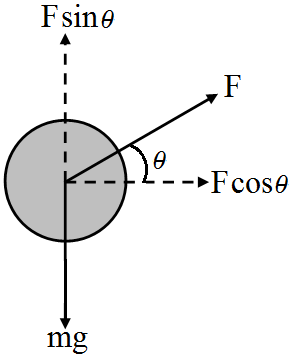
The vertical component of this applied force acts upward. This reduces the effective weight of the mower. On the other hand, while pushing a lawn mower, a force at an angle $\theta$ is applied on it, as shown in the following figure.
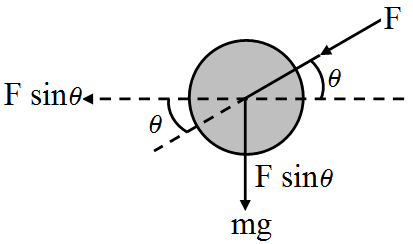
In this case, the vertical component of the applied force acts in the direction of the weight of the mower. This increases the effective weight of the mower.
Since the effective weight of the lawn mower is lesser in the first case, pulling the lawn mower is easier than pushing it.
- According to Newton’s second law of motion, we have the equation of motion:
$\text{F}=\text{ma}=\frac{\text{m}\triangle\text{v}}{\triangle\text{t}}\ ....(\text{i})$
Where,
F = Stopping force experienced by the cricketer as he catches the ball
m = Mass of the ball
$\triangle\text{t}$ = Time of impact of the ball with the hand
It can be inferred from equation (i) that the impact force is inversely proportional to the impact time, i.e.,
$\frac{\text{F}\propto1}{\triangle\text{t}}\ ...(\text{ii})$
Equation (ii) shows that the force experienced by the cricketer decreases if the time of impact increases and vice versa.
While taking a catch, a cricketer moves his hand backward so as to increase the time of impact $(\triangle\text{t})$. This is turn results in the decrease in the stopping force, thereby preventing the hands of the cricketer from getting hurt.