Question
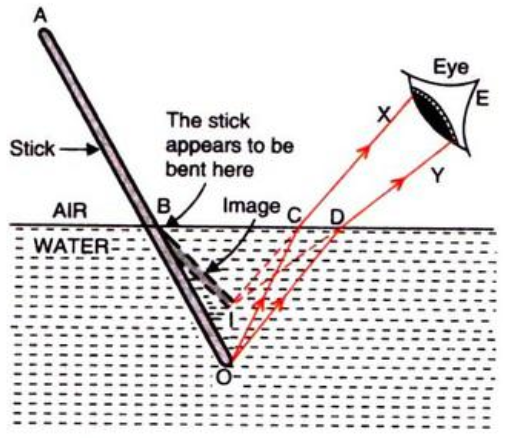
Explain why, a stick half immersed in water appears to be bent at the surface. Draw a labelled diagram to illustrate your answer.
Answer

The apparent bending of the stick is due to the refraction of light when it passes from water into air. A ray of light OC coming from O passes from water into air and gets refracted away from normal (along CX). Another ray OD gets refracted along DY. The two refracted rays CX and DY, when produced backwards, appear to meet at point I. Thus, I is the virtual image of the end O of the stick. So, the stick appears to be bent as shown below.

Need a full question paper?

Generate a complete, print-ready paper with questions like this in minutes — across 16+ boards, with answer keys.

Start Generating Free

Similar questions

Explain why, more complex multicellular organisms cannot give rise to new organisms through regeneration.
P, Q, R and S are four major types of phytohormones. P is a phytohormone which functions mainly as a growth inhibitor. It promotes the wilting and falling of leaves. Q, R and S are phytohormones which all promote growth of plants in various ways. Q is responsible for the phenomenon of phototropism in plants. R is involved mainly in shoot extensions. The phytohormone S helps in breaking the dormancy of seeds and buds. What are P, Q, R and S? Give one reason each for your choice.
Write a displacement reaction for non-metal.
Samples of four metals A, B, C and D were taken and added to the following solution one by one. The results obtained have been tabulated as follows.
Metal Iron (II) sulphate Copper (II) sulphate Zinc sulphate Silver nitrate
A No reaction Displacement ----- -----
B Displacement ----- No reaction -----
C No reaction No reaction No reaction Displacement
D No reaction No reaction No reaction No reaction
Use the Table above to answer the following questions about metals A, B, C and D.
  1. Which is the most reactive metal?
  2. What would you observe if B is added to a solution of Copper(II) sulphate?
  3. Arrange the metals A, B, C and D in the order of decreasing reactivity.
Iqbal treated a lustrous, divalent element M with sodium hydroxide. He observed the formation of bubbles in reaction mixture. He made the same observations when this element was treated with hydrochloric acid. Suggest how can he identify the produced gas. Write chemical equations for both the reactions.
  1. Define the following terms:
(i) Valency. (ii) Atomic size.
  1. How do the valency and the atomic size of the element vary going from left to right along a period in the modern periodic table?
Why is biogas considered an ideal fuel for domestic use?
$i$. An electric lamp of $100$ ohms, a toaster of resistance $50$ ohms and a water filter of resistance $500$ ohms are connected in parallel to a $220V$ source. what is the resistance of the electric iron connected to the same source that takes as much current as all the three appliances and what is the current through it?
$ii$. Which uses more energy, a $250 W \ TV$ set for $1$ hour or a $1,200 W$ toaster for $10$ minutes?
What are the by-products of fertiliser industries? How do they affect the environment?
Consider the following elements:
Ca, Cl, Na, I, Li, Ba, Sr, K, Br.
Separate these elements into three groups (families) of similar properties. State one property in each case on the basis of which you have made your choice.