Question
Explain why alkyl groups act as electron donors when attached to a $\pi$ system.
Answer

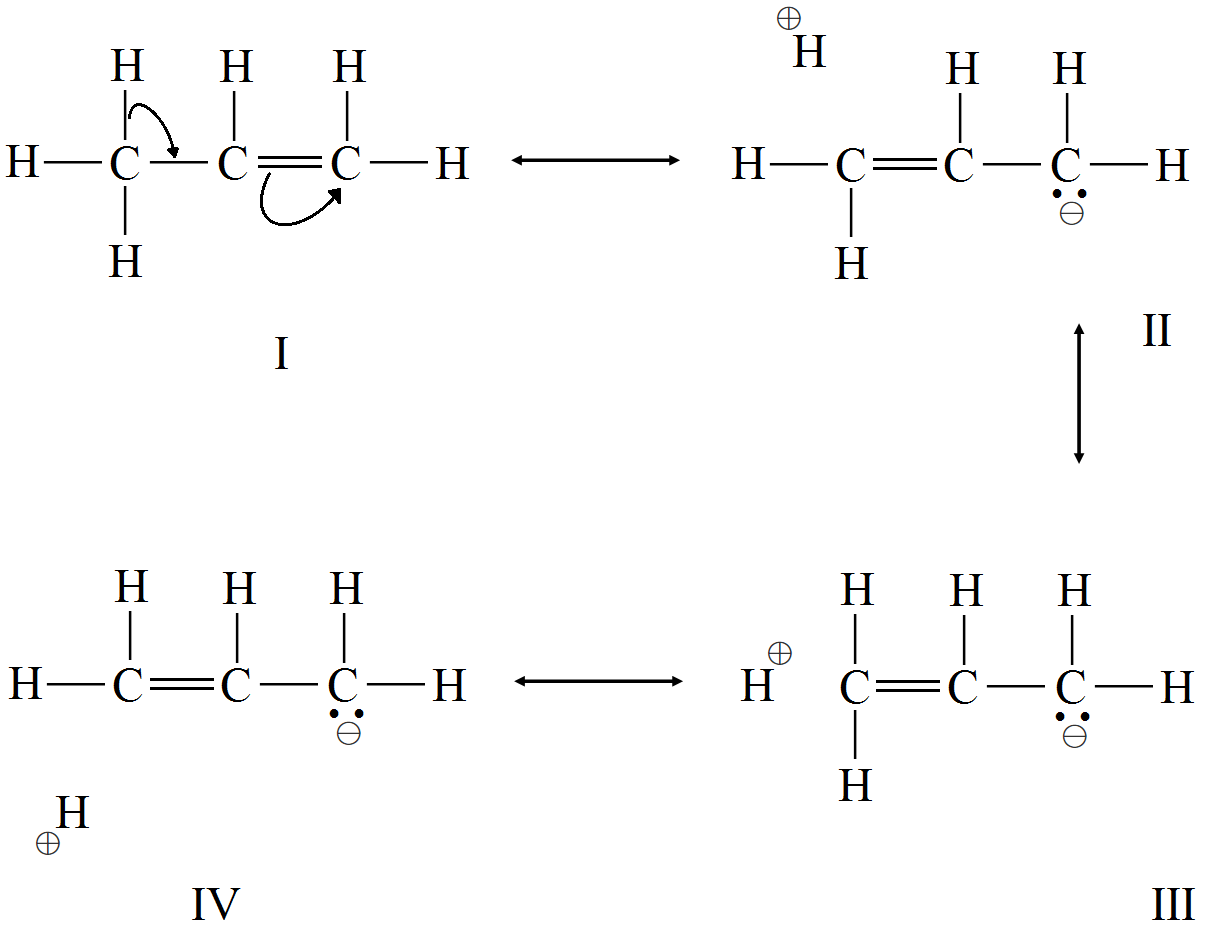
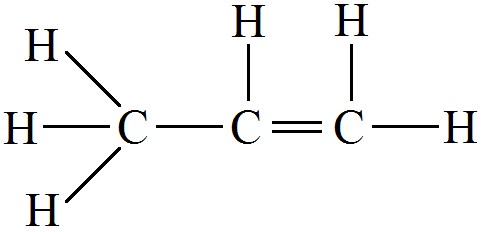
When an alkyl group is attached to a $\pi$ system, it acts as an electron-donor group by the process of hyperconjugation. To understand this concept better, let us take the example of propene.

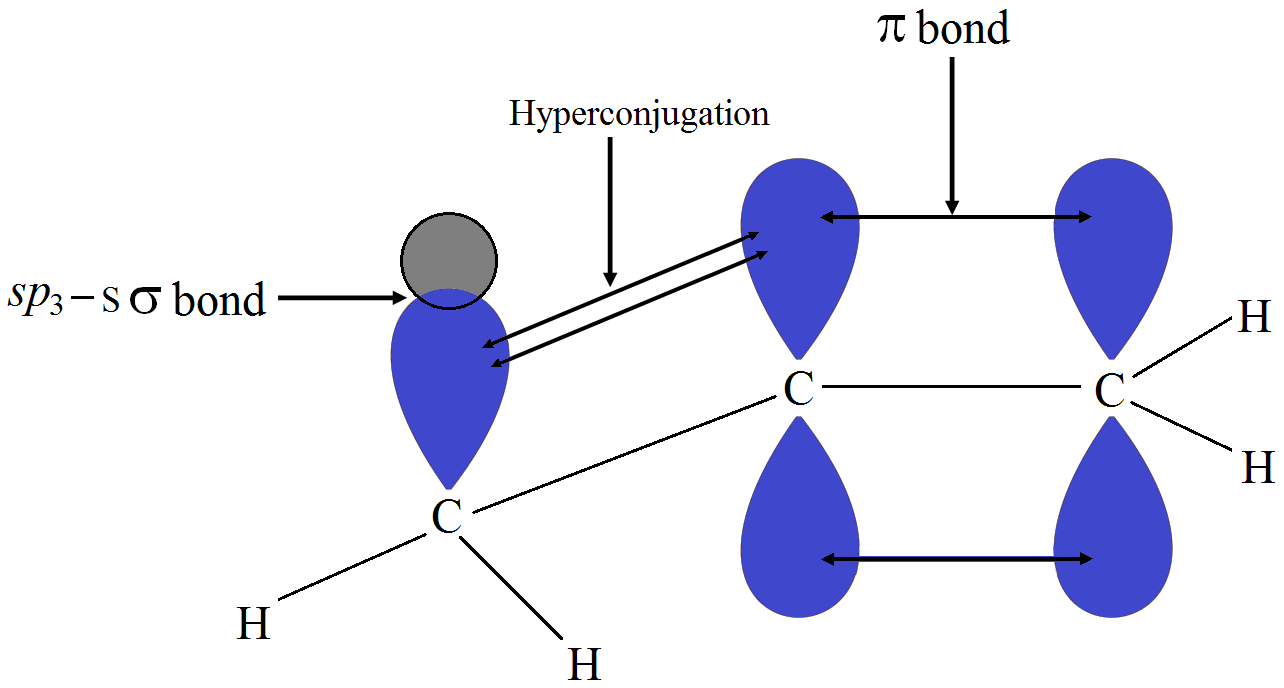
In hyperconjugation, the sigma electrons of the C-H bond of an alkyl group are delocalised. This group is directly attached to an atom of an unsaturated system. The delocalisation occurs because of a partial overlap of a $sp^3 -s$ sigma bond orbital with an empty p orbital of the $\pi$ bond of an adjacent carbon atom.
The process of hyperconjugation in propene is shown as follows:

This type of overlap leads to a delocalisation (also known as no-bond resonance) of the $\pi$ electrons, making the molecule more stable.

Need a full question paper?

Generate a complete, print-ready paper with questions like this in minutes — across 16+ boards, with answer keys.
Start Generating Free

Similar questions

What is common ion effect? Explain with examples.
Which important property did Mendeleev use to classify the elements in his periodictable and did he stick to that?
1. Two liquids (A) and (B) can be separated by the method of fractional distillation. The boiling point of a liquid (A) is less than the boiling point of a liquid (B). Which of the liquids do you expect to come out first in the distillate? Explain.
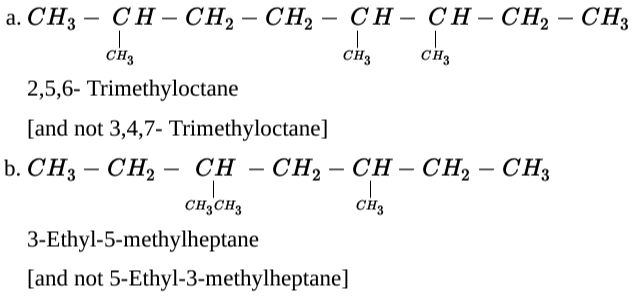
2. Structures and IUPAC names of some hydrocarbons are given below. Explain why the names given in the parentheses are incorrect.
Image
How is a covalent bond formed? Explain the rules of covalent bond formation with examples.
Chlorine is prepared in the laboratory by treating manganese dioxide $\left(\mathrm{MnO}_2\right)$ with aqueous hydrochloric acid according to the reaction
$4 \mathrm{HCl}_{(\mathrm{aq})}+\mathrm{MnO}_{2(\mathrm{~s})} \rightarrow 2 \mathrm{H}_2 \mathrm{O}_{(\mathrm{l})}+\mathrm{MnCl}_{2(\mathrm{aq})}+\mathrm{Cl}_{2(\mathrm{~g})}$
How many grams of HCl react with 5.0 g of manganese dioxide?
Calculate the concentration of nitric acid in moles per litre in a sample which has a density, $1.41 \mathrm{~g} \mathrm{~mL}^{-1}$ and the mass per cent of nitric acid in it being $69 \%$.
  1. State Henry's Law.
  2. Assign reason for the following:
  1. A solution of $NH_4Cl$ in water shows pH less than 7.
  2. In qualitative analysis $NH_4Cl$ is added before adding $NH_4OH$ for testing $Fe^{3+}$ or $AP^{3+}$ ions.
  1. Consider the reaction:
$\text{N}_2(\text{g})+3\text{H}_2(\text{g})\rightleftharpoons2\text{NH}_3+\text{Heat}$
Indicate the direction in which the equilibrium will shift when:
  1. Temperature is increased.
  2. Pressure is increased.
Match the following equilibria with the corresponding condition.
Column I
Column II
i.
Liquid ⇌ Vapour
a.
Saturated solution
ii.
Solid ⇌ Liquid
b.
Boiling point
iii.
Solid ⇌ Vapour
c.
Sublimation point
iv.
Solute(s) ⇌ Solute (solution)
d.
Melting point
 
 
e.
Unsaturated solution
8 Arrange benzene, n-hexane and ethyne in decreasing order of acidic behaviour. Also give reason for this behaviour.
$\Delta\text{G}$ is net energy available to do useful work and is thus a measure of “free energy”. Show mathematically that $\Delta\text{G}$ is a measure of free energy. Find the unit of $\Delta\text{G}$ . If a reaction has positive enthalpy change and positive entropy change, under what condition will the reaction be spontaneous?