Question
Explain why: An optical pyrometer (for measuring high temperatures) calibrated for an ideal black body radiation gives too low a value for the temperature of a red hot iron piece in the open, but gives a correct value for the temperature when the same piece is in the furnace.
Answer

An optical pyrometer calibrated for an ideal black body radiation gives too low a value for temperature of a red hot iron piece kept in the open. Black body radiation equation is given by: $\text{E}=\sigma(\text{T}^4-\text{T}_0^4)$ Where, E = Energy radiation. T = Temperature of optical pyrometer. $T_0$ = Temperature of open space. $\sigma$ = Constant. Hence, an increase in the temperature of open space reduces the radiation energy. When the same piece of iron is placed in a furnace, the radiation energy, $\text{E}=\sigma\text{T}^4$

Need a full question paper?

Generate a complete, print-ready paper with questions like this in minutes — across 16+ boards, with answer keys.

Start Generating Free

Similar questions

Calculate the acceleration due to gravity at the surface of Mars if its diameter is $6760km$ and mass one tenth that of the earth. The diameter of earth is $12742km$ and acceleration due to gravity on the earth is $9.8m/ s^2$.
A function $\text{f}(\theta)$ is defined as: $\text{f}(\theta)=1-\theta+\frac{\theta^2}{2!}-\frac{\theta^3}{3!}+\frac{\theta^4}{4!}$ Why is it necessary for q to be a dimensionless quantity?
Three particles, each of mass $200g$, are kept at the corners of an equilateral triangle of side $10\ cm$. Find the moment of inertia of the system about an axis:
  1. Joining two of the particles.
  2. Passing through one of the particles and perpendicular to the plane of the particles.
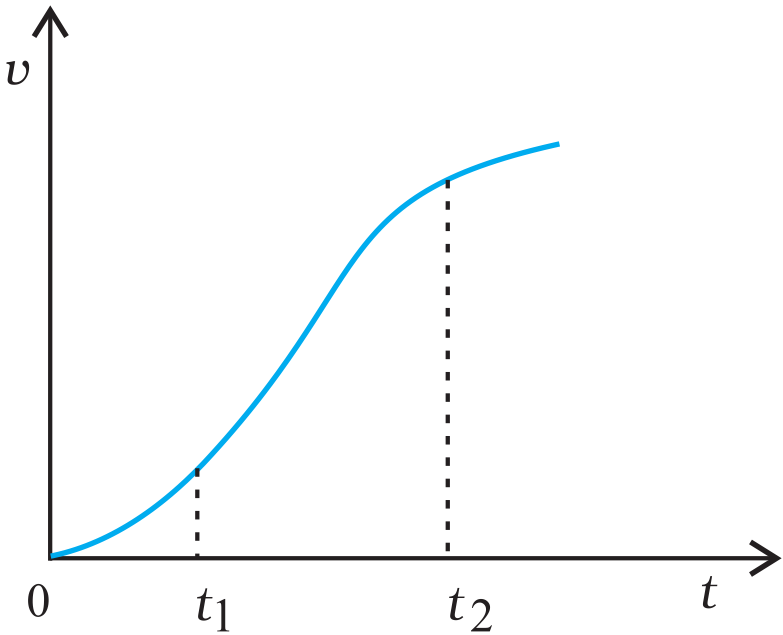
The velocity-time graph of a particle in one-dimensional motion is shown in:

Which of the following formulae are correct for describing the motion of the particle over the time-interval $t_1$ to $t_2$:
a. $x\left(t_2\right)=x\left(t_1\right)+v\left(t_1\right)\left(t_2-t_1\right)+(1 / 2) a\left(t_2-t_1\right)^2$
b. $v\left(t_2\right)=v\left(t_1\right)+a\left(t_2-t_1\right)$
c. $v_{\text {average }}=\left(x\left(t_2\right)-x\left(t_1\right)\right) /\left(t_2-t_1\right)$
d. $\mathrm{a}_{\text {average }}=\left(\mathrm{v}\left(\mathrm{t}_2\right)-\mathrm{v}\left(\mathrm{t}_1\right)\right) /\left(\mathrm{t}_2-\mathrm{t}_1\right)$
e. $x\left(t_2\right)=x\left(t_1\right)+v_{\text {average }}\left(t_2-t_1\right)+(1 / 2) a_{\text {average }}\left(t_2-t_1\right)^2$
f. $x\left(t_2\right)-x\left(t_1\right)=$ area under the v-t curve bounded by the $t$-axis and the dotted line shown.
The condition of air in a cloeed room is described as follows. Temperature $=25^{\circ} \mathrm{C}$, relative humidity $=60 \%$, pressure $=104 \mathrm{kPa}$. If all the water vapour is removed from the room without changing the temperature, what will be the new pressure? The saturation vapour pressure at $25^{\circ} \mathrm{C}=3.2 \mathrm{kPa}$.
The focal lengths of a convex lens for red, yellow and violet rays are 100cm, 98cm and 96cm respectively. Find the dispersive power of the material of the lens.
A car is moving in a circular horizontal track of radius 10m with constant speed of 10m/s. A plumb bob is suspended from roof by a light rigid rod of length 1m. Find the angle made by the rod with the track.
The wheel of a car is rotating at a speed of 20 revolutions/second. If due to acceleration its rotation speed becomes 75 revolutions/second in 10 seconds, then find the angular acceleration and angular displacement after this time
A coil of inductance $5.0\ mH$ and negligible resistance is connected to the oscillator of the previous problem. Find the peak currents in the circuit for $\omega=100\text{s}^{-1},500\text{s}^{-1},1000\text{s}^{-1}.$
At what distance should two charges, each equal to $1C$, be placed so that the force between them equals your weight?