Question
Explain why antibiotics are more effective in curing bacterial disease than viral diseases?

Answer

Viruses have few genes, sometimes less than 10, and thus few proteins that can be targeted. By contrast, bacteria have thousands of different genes and proteins. There are just more targets to shoot at with bacteria. Bacteria (except in spore stages) must be continuously active metabolically, and thus can be poisoned at any time. Viruses are metabolically inert until they have already infected a host cell, and are not susceptible to the actions of antivirals until then. An exception would be drugs that block viral adhesion to host cells, thus preventing their entry.
Viruses use a lot of host cell proteins for their replication and spread. Any drug that targets host cell proteins will be toxic to the host. Viruses often hijack host genes, and thus their proteins can be closely related to host proteins. Making a drug that discriminates between viral and host versions of a protein is very very difficult. Viruses are far more diverse than bacteria. Whereas most antibiotics are effective against many different species of bacteria, antivirals usually are very specific to one type of virus.
Need a full question paper?

Generate a complete, print-ready paper with questions like this in minutes — across 16+ boards, with answer keys.

Start Generating Free

Similar questions

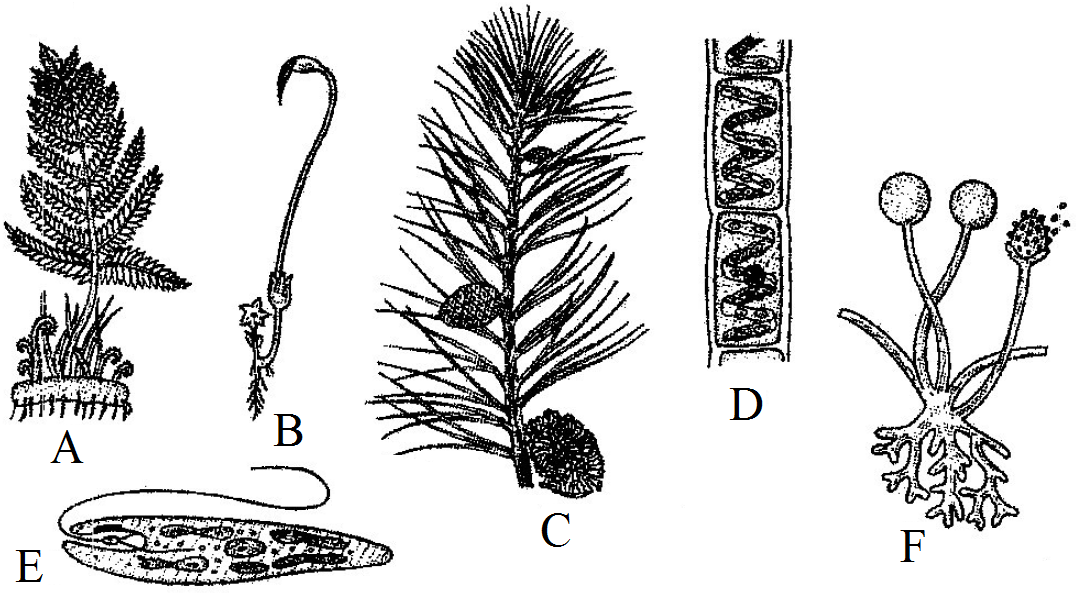
  1. Dentify figures A to F?
  2. What is the phylum of D, E and F?
  3. What is the division of A, B, and C?
  4. Which of them is unicellular and eularyotic organism?
  5. Which one of them exhibits (i) Heterotrophic nutrition; (ii) Micotrophic nutririon.
  6. Which one of them is multicellular decomposer?
  7. Which one amphibian of plant kingdom?
  8. In which one of them play xylem lacks vessels and phloem is without companion cells?
  9. What is the scientific name of esch of them: (i) Male shield fern; (ii) Bread mould?
  10. In which of them endosperm is haploid?
Give the fsour characteristics of algae.
What mass of nitrogen $N_2$, will contain the same number of molecules as $1.8g$ of water, $H_2O$? (Atomic masses: $N = 14u; H = 1u; O = 16u$)
There is a water reservoir (river) near a village. Due to insufficient rain, farmers are worried about their crops. Suggest and explain the irrigation practice that can be adopted to supply water to the entire agricultural land in the village.
Write a note on plasmolysis.
What is pasturage and how it is related of honey production?
Explain the general characters of phylum Arthropoda. Give one example of following classes (i) Crustacea; (ii) Myriapoda; (iii) Insecta; (iv) Arachnida.
What is the theory behind immunisation$?$ How does it came in limelight$?$
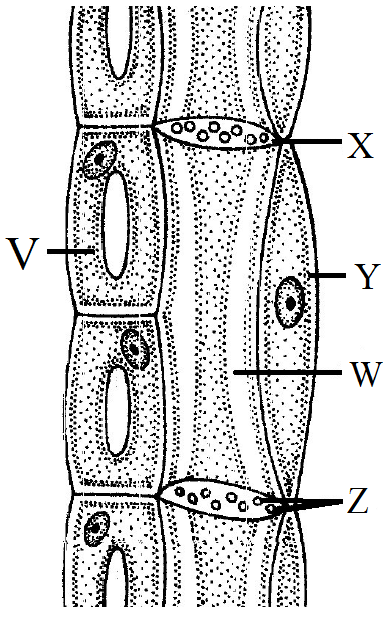
  1. Identify the figure. What is its function$?$
  2. Label $V$ and $W.$
  3. Label $X, Y$ and $Z.$
  4. W loses its nucleus in the mature state, still it remains alive. Explain how$?$
State and prove the law of conservation of linear momentum.