Question
Explain why $\mathrm{BeH}_2$ molecule has a zero dipole moment although the Be–H bonds are polar.

Answer

The Lewis structure for $\mathrm{BeH}_2$ is as follows:
$\text{H}:\text{Be}:\text{H}$
There is no lone pair at the central atom ( Be ) and there are two bond pairs. Hence, $\mathrm{BeH}_2$ is of the type $\mathrm{AB}_2$. It has a linear structure.

Dipole moments of each H -Be bond are equal and are in opposite directions. Therefore, they nullify each other.
Hence, $\mathrm{BeH}_2$ molecule has zero dipole moment.

Need a full question paper?

Generate a complete, print-ready paper with questions like this in minutes — across 16+ boards, with answer keys.

Start Generating Free

Similar questions

  1. Name the metal used in photoelectric cells.
  2. Why diamond is used as an abrasive?
  3. What are allotropes?
Enthalpy of combustion of carbon to $CO _2$ is $-393.5 kJ mol ^{-1}$. Calculate the heat released upon formation of 35.2 g of $CO _2$ from carbon and dioxygen gas.
How many litres of oxygen are required for complete combustion of 6.0 gram of ethane at standard temperature and pressure.
i. Arrange $\mathrm{NH}_3, \mathrm{PH}_3, \mathrm{AsH}_3, \mathrm{SbH}_3$ in increasing order of boiling point.
ii. Identify complex, interstitial, covalent and polymeric hydrides from the following.
$\mathrm{BeH}_2, \mathrm{AsH}{ }_3, \mathrm{LaH}_3, \mathrm{LiAlH}_4$.
pH of $0.08 \mathrm{mol} \mathrm{~dm}^{-3} \mathrm{HOCl}$ solution is 2.85 . Calculate its ionisation constant.
Give reasons:
  1. Beryllium halides are polymeric.
  2. $Be(OH)_2$ dissolves in NaOH but $Mg(OH)_2$ does not.
  3. MgO is used as refractory material.
The diameter of zinc atom is 2.6 $\mathring{\text{A}}$.Calculate,
  1. Radius of zinc atom in pm
  2. Number of atoms present in a length of 1.6cm if the zinc atoms are arranged side by side lengthwise.
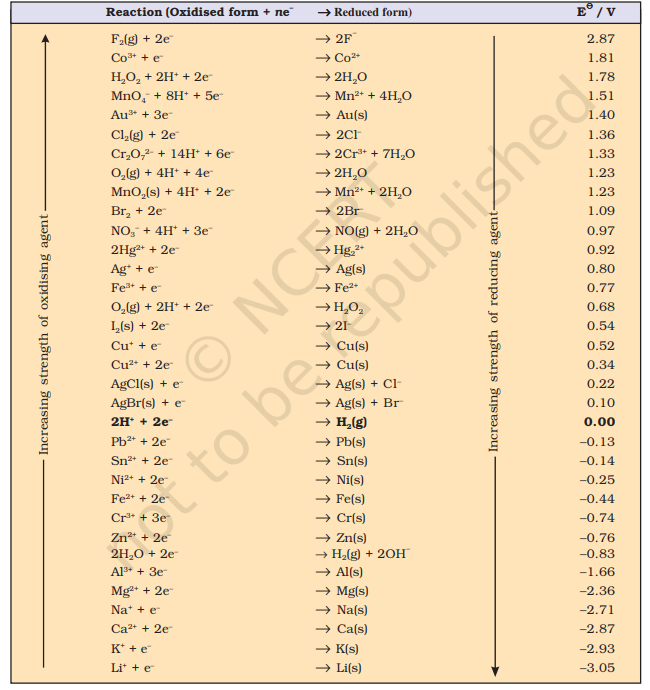
Using the standard electrode potentials given in the Table, predict if the reaction between the following is feasible:

$\mathrm{Fe}^{3+}(\mathrm{aq})$ and $\mathrm{l}^{-}(\mathrm{aq})$.
221.4J is needed to heat 30 g of ethanol from $15^{\circ} C$ to $18^{\circ} C$. Calculate (a) specific heat capacity, and (b) molar heat capacity of ethanol.
  1. Identify the oxidant and reductant in the following reactions:
    1. $\text{Zn}\text{(s)}+\frac{1}{2}\text{O}_2\text{(g)}\xrightarrow{ \ \ \ \ \ \ \ }\text{ZnO}\text{(s)}$
  1. ​​​​​​​$\text{Zn}\text{(s)}+2\text{H}^+\text{(aq)}\xrightarrow{ \ \ \ \ \ }\text{Zn}^{2+}\text{(aq)}+\text{H}_2\text{(g)}$
  1. Name the products obtained when copper is heated with conc.$\mathrm{HNO}_3$.