Question
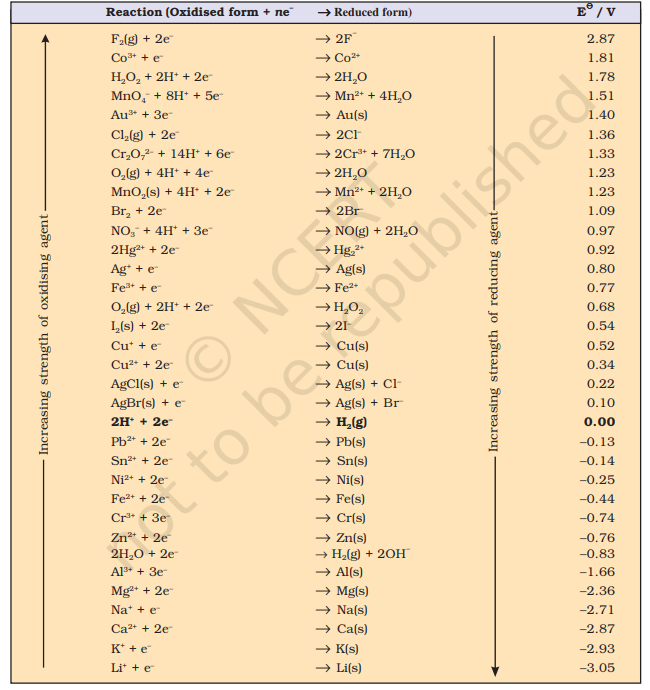
Using the standard electrode potentials given in the Table, predict if the reaction between the following is feasible:
$\mathrm{Fe}^{3+}(\mathrm{aq})$ and $\mathrm{l}^{-}(\mathrm{aq})$.
Answer

The possible reaction between $\mathrm{Fe}^{3+}(\mathrm{aq})$ and $\mathrm{l}^{-}(\mathrm{aq})$. is given by, $2\text{Fe}^{3+}_{(\text{aq})}+2\text{I}^-_{(\text{aq})}\rightarrow2\text{Fe}^{2+}_{(\text{aq})}+\text{I}_{2(\text{s})}$$\text{Oxidation half equation:}\ \ \ \ \ \ \ \ \ \ 2\text{I}^-_{(\text{aq})}\xrightarrow{\ \ \ \ \ \ \ }\text{I}_{2(\text{s})}+2\text{e}^-;\ \ \text{E}^\circ=-0.54\text{V}\\\text{Reduction half equation:}\ [\text{Fe}^{3+}_{(\text{aq})}+\text{e}^-\xrightarrow{\ \ \ \ \ \ }\text{Fe}^{2+}_{(\text{aq})}]\times2;\ \ \text{E}^\circ=+0.77\text{V}\\\overline{\ \ \ \ \ \ \ \ \ \ \ \ \ \ \ \ \ \ \ \ \ \ \ \ \ \ \ \ \ \ \ \ \ \ \ \ \ \ \ \ \ \ \ \ \ \ \ \ \ \ \ \ \ \ \ \ \ \ \ \ \ \ \ \ \ \ \ \ \ \ \ \ \ \ \ \ \ \ \ \ \ \ \ \ \ \ \ \ \ \ \ \ \ \ \ \ \ \ \ \ \ \ \ \ \ \ \ \ \ \ \ \ \ \ \ \ \ \ }\\ \ \ \ \ \ \ \ \ \ \ \ \ \ \ \ \ \ \ \ \ \ \ \ \ \ \ \ \ \ \ \ \ \ \ \ \ \ \ 2\text{Fe}^{3+}_{(\text{aq})}+2\text{I}^-_{(\text{aq})}\xrightarrow{\ \ \ \ \ \ \ \ }2\text{Fe}^{2+}_{(\text{aq})}+\text{I}_{2(\text{s})};\ \ \text{E}^\circ=+0.23\text{V}$
E° for the overall reaction is positive. Thus, the reaction between $\text{Fe}^{3+}_{(\text{aq})}$ and $\text{I}^-_{(\text{aq})}$ is feasible.

Need a full question paper?

Generate a complete, print-ready paper with questions like this in minutes — across 16+ boards, with answer keys.

Start Generating Free

Similar questions

The following techniques are used to quantitatively estimate extra elements in organic compound. Identify the name of the method and the element estimated by this method.
i. A known mass of an organic compound is heated with fuming $\mathrm{HNO}_3$ in presence of $\mathrm{AgNO}_3$.
ii. Organic compound is heated with dry copper oxide in atmosphere of $\mathrm{CO}_2$.
iii. Organic compound is heated with conc. $\mathrm{H}_2 \mathrm{SO}_4$.
Write Lewis symbols for the following atoms and ions: S and $S ^{2-} ; Al$ and $Al ^{3+} ; H$ and $H ^{-}$
Why does the boundary between liquid phase and gaseous phase disappear on heating a liquid upto critical temperature in a closed vessel? In this situation what will be the state of the substance?
Explain the following:
  1. A piece of Mg continues to burn in $SO_2$​​​​​​​.
  2. Al cannot be used for storing NaOH.
  1. Determine group and block of elements with atomic number 29 and 35.
  2. Define $\pi$ bonds.
Among alkaline earth metals:
  1. Which has lowest density.
  2. Lowest melting point.
  3. Sulphate of which metal is used in X-ray tubes.
  4. Shous diagonal relationship.
  5. Best reducing agent in group 2.
  6. Gives crimson red colour to the flame.
If $4g$ of $NaOH$ dissolves in 36g of $H_2O$, calculate the mole fraction of each component in the solution. Also, determine the molarity of solution (specific gravity of solution is $1g mL^{–1}).$
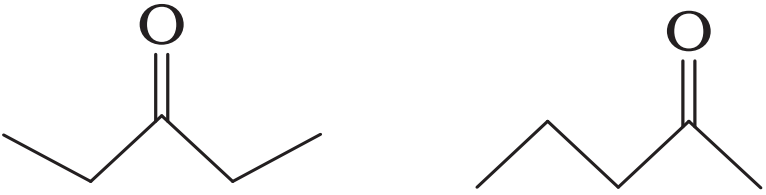
What is the relationship between the members of following pairs of structures? Are they structural or geometrical isomers or resonance contributors?
Account for the following:
i. Which is smaller $\mathrm{Fe}^{2+}$ or $\mathrm{Fe}^{3+}$, why?
ii. Chlorine (Cl) have more negative electron gain enthalpy than Fluorine (F).
[Atomic no.: $\mathrm{F}=9, \mathrm{Cl}=17]$
iii. Anions are bigger in size than their parent atom.
Write important chemical reaction of ethene.