Question
Explain, why no tracks are left on the ice during ice skating?

Answer

The weight of the body acts on a very small area of skate, in comparison to that of ice. Under this high pressure, ice melts to form water below 0°C. The water so formed makes the surface water skating more slippery. But as soon as the skater moves further, the water does not experience any pressure and re-freezes into ice leaving no track on ice surface.

Need a full question paper?

Generate a complete, print-ready paper with questions like this in minutes — across 16+ boards, with answer keys.
Start Generating Free

Similar questions

A person standing between two vertical cliffs and is $640$ m away from the nearest cliff. He shouted and heard the first echo after $45s$ and the second echo after further $3s$. Calculate the speed of sound in air and the distance between the cliffs.
QUESIION 50 g of ice at $0^{\circ} C$ is added to 300 g of a liquid at $30^{\circ} C$. What will be the final temperature of the mixture when all the ice has melted? The specific heat capacity of the liquid is $2.65 Jg ^{-1}{ }^{\circ} C ^{-1}$ while that of water is $4.2 Jg ^{-1}{ }^{\circ} C ^{-1}$. Specific latent heat of fusion of ice $=336 Jg ^{-1}$.
Define the term principal foci as applied to a concave lens. Illustrate your answer with the aid of proper diagrams. Show the focal length of the lens in the diagram.
Write three conditions necessary to obtain a pure spectrum on a screen. Name the instrument in which the conditions stated by you are fulfilled.
Explain, why is the p.d. between the terminals of a storage battery less when it is supplying current than when it is on open circuit. A battery of e.m.f. 10 volts and internal resistance 2.5 ohms has two resistances of 50 ohms each connected to it. Calculate the power dissipated in each resistance
(a) When they are in series,
(b) When they are in parallel.
In each case calculate the power dissipated in the battery.
(i) What is Earthing?
(ii) Draw a diagram showing (a) a bulb (b) a heater in a domestic household circuit, showing clearly the position of fuse, live wire, neutral wire and switches.
(iii) An electric circuit operating at 250 V has the following appliances connected in parallel and the energy cost ₹5.40 per kVAh. Calculate the monthly bill of a month of 30 days.
(a) 4 bulbs of 100 W each working 8 hours a day.
(b) Two room heaters of resistance $50 \Omega$ each, working 2 hours a day.
(c) Two air conditioners drawing current of 8 A , working 6 hours a day.
State the types (or kinds) of lever, and give two examples of each kind.
Draw images in case of a concave lens when the object is at any point on the principal axis between the lens and infinity.
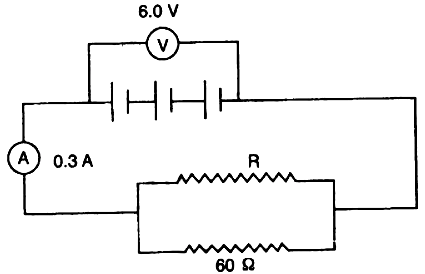
In the figure below, the ammeter A reads $0.3 A$. Calculate:
(i) the total resistance of the circuit
(ii) the value of $R$
(iii) the current flowing through$ R.$