Question
Explain why steel is more elastic than rubber.

Answer

Consider two pieces of wires, one of steel and the other of rubber.
Suppose both are of equal length (L) and of equal area of cross-section (a).
Let each be stretched by equal forces, each being equal to F.
We find that the change in length of the rubber wire (l_r) is more than that of the steel
$(l_s) i.e. l_r < ls.$ If $Y_s​​​​​​​$​​​​​​​_ and $Y_r​​​​​​​$​​​​​​​_ the Young's moduli of steel and rubber respectively,
then from the definition of Young's modulus, $\text{Y}_\text{s}=\frac{\text{F.L}}{\text{a.l}_\text{s}}\text{ and }\text{Y}_\text{r}=\frac{\text{F.L}}{\text{a.l}_\text{r}}$
$\therefore\frac{\text{Y}_\text{s}}{\text{Y}_\text{r}}=\frac{\text{l}_\text{r}}{\text{l}_\text{s}}.$
As $\text{l}_\text{r}>\text{l}_\text{s}\therefore\frac{\text{Y}_\text{s}}{\text{Y}_r}>1\ \text{or }\text{Y}_\text{r}$
i.e., the Young's modulus of steel is more than that of rubber.
Hence steel is more elastic than rubber.OR
Any material which offers more opposition to the deforming force to change its configuration is more elastic.

Need a full question paper?

Generate a complete, print-ready paper with questions like this in minutes — across 16+ boards, with answer keys.
Start Generating Free

Similar questions

Two parallel rail tracks run north-south. Train A moves north with a speed $54 km / h ^{-1}$ and $\operatorname{train} B$ moves south with a speed of $90 km / h ^{-1}$. What is the:
i. Velocity of $B$ with respect to $A$ ?
ii. Velocity of ground with respect to B?
iii. Velocity of a monkey running on the roof of train $A$ against its motion (with a speed of $10 km^{-1}$ with respect to train A ) as observed by a man standing on the ground?
OR
Obtain any one equation of motion for constant acceleration using method of calculus.
A boy travelling in an open car moving on a levelled road with constant speed tosses a ball vertically up in the air and catches it back. Sketch the motion of the ball as observed by a boy standing on the footpath. Give explanation to support your diagram.
The length, breadth and thickness of a block of metal were measured with the help of a Vernier Callipers. The measurements are: $\text{l}=(5.250\pm0.001)\text{cm}$ $\text{b}=(3.450\pm0.001)\text{cm}$ $\text{t}=(1.740\pm0.001)\text{cm}$ Find the percentage error in volume of the block.
Derive a relation for the time taken by a projectile to reach the highest point and the maximum height attained?
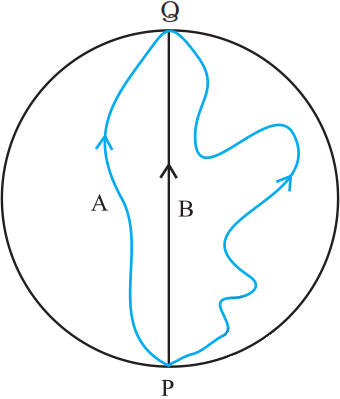
Three girls skating on a circular ice ground of radius 200m start from a point P on the edge of the ground and reach a point Q diametrically opposite to P following different paths as shown in Fig. What is the magnitude of the displacement vector for each? For which girl is this equal to the actual length of path skate?
A child sits stationary at one end of a long trolley moving uniformly with a speed V on a smooth horizontal floor. If the child gets up and runs about on the trolley in any manner, what is the speed of the CM of the (trolley + child) system?
If the unit of force is 100N, unit of length is 10m and unit of time is 100s, what is the unit of mass in this system of units?
What are isotherms? Explain the process of liquiefication using it.
In a pure semiconductor, the number of conduction electrons is $6 \times 10^{19}$ per cubic metre. How many holes are there in a sample of size 1cm × 1cm × 1mm?
$0.75g$ of petroleum was burnt in a bomb calorimeter which contains $2kg$ of water and has a water equivalent $500$ grams. The rise in temp. was $3°C$. Determine the calorific value of petroleum.