Question
What are isotherms? Explain the process of liquiefication using it.

Answer

Isotherms are P-V graphs drawn at same temperature. When pressure is increased, volume is reduced at constant temperature. Beyond certain level, the pressure remains same for certain reduction in volume and then the pressure increases sharply. As temperature is increased, the constant portion reduces and at a temperature called critical temperature, the flat portion is absent. In each isotherm, before the flat portion is reached, the substance is in gaseous state and beyond the flat portion, it is in the liquid state. During the flat portion of P-V graph, the gas is under liquefication and so both gaseous and liquid states co-exist. Beyond T. it is not possible to liquefy the gas whatever large the pressure may be.
Need a full question paper?

Generate a complete, print-ready paper with questions like this in minutes — across 16+ boards, with answer keys.

Start Generating Free

Similar questions

Compute the fractional change in volume of a glass slab, when subjected to a hydraulic pressure of $10$ atm.
A refrigerator is to maintain eatables kept inside at $9^{\circ} \mathrm{C}$. If room temperature is $36^{\circ} \mathrm{C}$, calculate the coefficient of performance.
The acceleration associated with a mass 'm' moving in a circular path is to be found. It is given that the velocity at any instant is v = krt, where k is a constant. Classify the motion and find acceleration.
Define longitudinal and transverse waves and also draw diagram of both.
The potential barrier existing across an unbiased $p-n.$ junction is $0.2$ volt. What minimum kinetic energy a hole should have to diffuse from the $p-$side to the $n-$side if,
  1. The junction is unbiased.
  2. The junction is forwardbiased at $0.1$ volt.
  3. The junction is reverse$-$biased at $0.1$ volt?
Define centripetal acceleration. Give two examples.
Calculate the change in the energy of a $500kg$ satellite when it falls from an altitude of $200km$ to $199km$. If this change takes place during one orbit. Calculate the retarding force on the satellite. Given, mass of the earth = $6 \times 10^{24}kg$ and radius of the earth = $6400km$.
Taking the moon's orbit around earth to be r and mass of earth 81 times the mass of the moon. Find the position of the point from the earth, where the net gravitational field is zero.
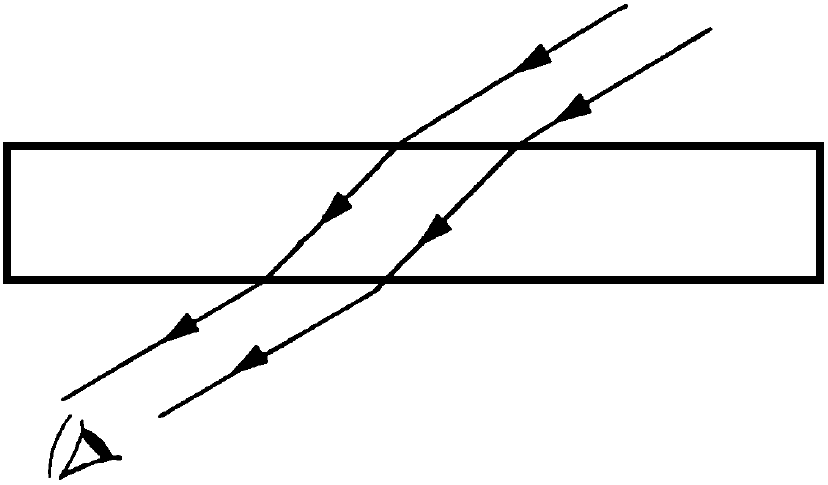
A narrow beam of light passes through a slab obliquely and is then received by an eye. The index of refraction of the material in the slab fluctuates slowly with time. How will it appear to the eye? The twinkling of stars has a similar explanation.
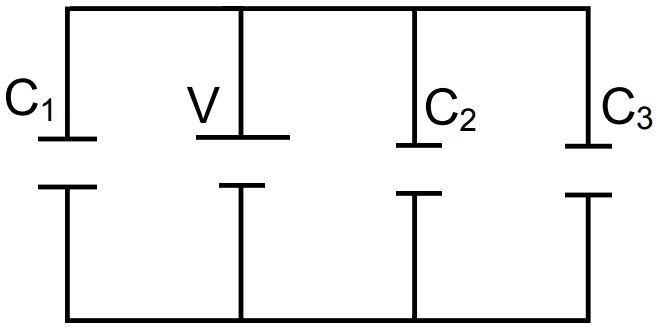
Find the charges on the three capacitors connected to a battery as shown in figure. Take $\text{C}_1=2.0\mu\text{F},\ \text{C}_2=4.0\mu\text{F},\ \text{C}_3=6.0\mu\text{F}$ and V = 12 volts.