Question
Explain why: The coolant in a chemical or a nuclear plant (i.e., the liquid used to prevent the different parts of a plant from getting too hot) should have high specific heat.

Answer

The coolant in a chemical or nuclear plant should have a high specific heat. This is because higher the specific heat of the coolant, higher is its heat-absorbing capacity and vice versa. Hence, a liquid having a high specific heat is the best coolant to be used in a nuclear or chemical plant. This would prevent different parts of the plant from getting too hot.

Need a full question paper?

Generate a complete, print-ready paper with questions like this in minutes — across 16+ boards, with answer keys.
Start Generating Free

Similar questions

At t = 0, a particle is at rest at origin. Its acceleration is $2m/s^2$ for the first 3s and $-2m/s^2$ for next 3s. Plot the acceleration versus time and velocity versus time graph.
If Length, Time and Energy are fundamental units, find the dimension of mass.
Two cylinders A and B of equal capacity are connected to each other via a stopcock. A contains a gas at standard temperature and pressure. B is completely evacuated. The entire system is thermally insulated. The stopcock is suddenly opened. Answer the following: Do the intermediate states of the system (before settling to the final equilibrium state) lie on its P-V-T surface?
What happens when a light sphere collides head-on with a more massive sphere initially at rest?
A compound microscope forms an inverted image of an object. In which of the following cases it is kely to create difficulties?
Consider a pair of identical pendulums, which oscillate with equal amplitude independently such that when one pendulum is at its extreme position making an angle of 2° to the right with the vertical, the other pendulum makes an angle of 1° to the left of the vertical. What is the phase difference between the pendulums?
These days people use steel utensils with copper bottom. This is supposed to be good for uniform heating of food. Explain this effect using the fact that copper is the better conductor.
A block of wood is floating on water at 0°C with a certain volume x above the level of water. The temperature of water is gradually increased from 0°C to 8°C. How does the volume x change with change in temperature?
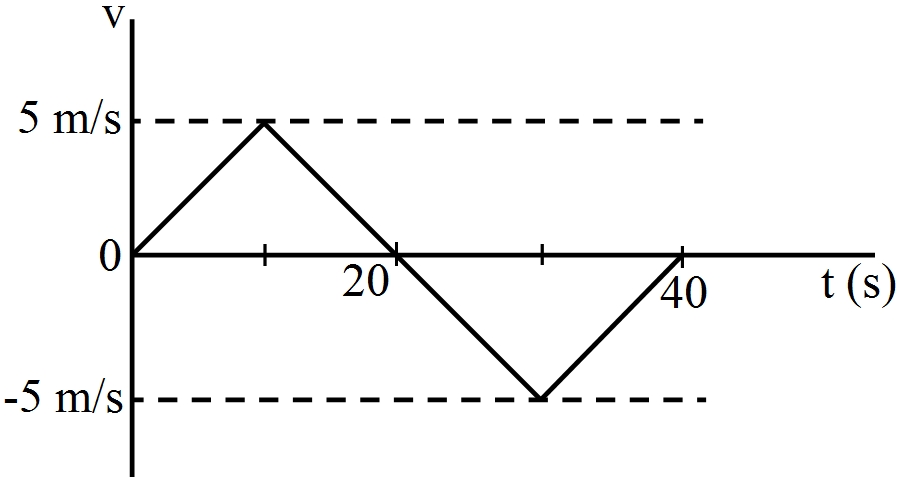
From the velocity-time plot shown in figure, find the distance travelled by the particle during the first 40 seconds. Also find the average velocity during this period.
The heart rate (number of heart beats per minute) scales as $\frac{1}{\text{L}}$ where L is the characteristic length of the mammal. Can you explain this? If the scale factor of a human relative to a rhesus monkey is about 2.5, what is the monkey's heart rate?