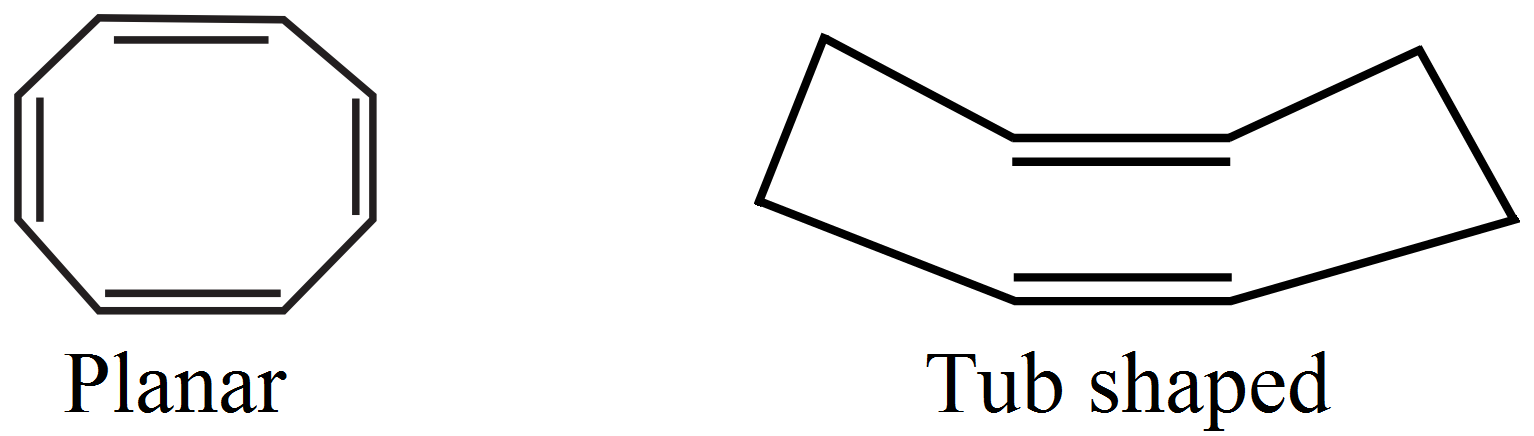
Question
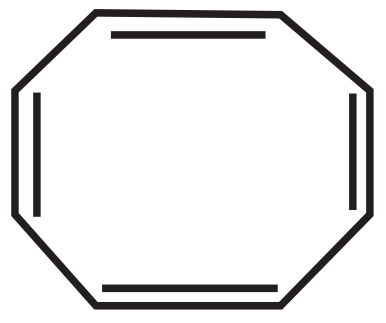
Explain why the following system are not aromatic?
Need a full question paper?

Generate a complete, print-ready paper with questions like this in minutes — across 16+ boards, with answer keys.

Start Generating Free

Similar questions

Use the data given in the following table to calculate the molar mass of naturally occuring argon isotopes:
Isotope
Isotopic molar mass
Abundance
36Ar
35.96755g mol–1
0.337%
38Ar
37.96272g mol–1
0.063%
40Ar
39.9624g mol–1
99.600%
The Ksp of Ag2CrO4 AgCl, AgBr and AgI are respectively, 1.1 × 10-12, 1.8 × 10-10, 5.0 × 10-13, 8.3 × 10-17, which one of the following salts will precipitate first AgNO3 solution is adding to a solution containing equal mole of NaCl, NaBs, NaI and Na2CrO4.
In a reaction
A + B2 → AB2
Identify the limiting reagent, if any, in the following reaction mixtures.
2 mol A + 3 mol B.
Calculate the percentage of nitrogen in NH3· (Atomic mass of N = 14,H = 1amu)
In periodic table how reactivity of elements get changed ?
What is the total number of sigma and pi bond in the following molecules?
  1. $\text{C}_2\text{H}_3\text{Cl}$
  2. $\text{C}_4\text{H}_4\text{Cl}_2$
  3. $\ \ \ \ \ \ \ \ \ \ \ \ \ {\text{H}\ \ \ \ \text{H}}\\\ \ \ \ \ \ \ \ \ \ \ \ \ |\ \ \ \ \ \ \ |\\ \text{H}_3\text{C}-\text{C}=\text{C}-\text{C}\equiv\text{C}-\text{H}$
Consider the elements:
Cs, Ne, I and F
Identify the element which exhibits neither the negative nor does the positive oxidation state.
Arrange the following in order of decreasing bond angles.
  1. $\text{CH}_4, \text{NH}_3, \text{H}_2\text{O}, \text{BF}_3, \text{C}_2\text{H}_2$
  2. $\text{NH}_3, \text{NH}^‑_2, \text{NH}^+_4$
Write IUPAC names of the following compound:
$\text{CH}_3(\text{CH}_2)_4\text{CH}(\text{CH}_2)_3\text{CH}_3\\\ \ \ \ \ \ \ \ \ \ \ \ \ \ \ \ \ \ \ \ \ |\\\ \ \ \ \ \ \ \ \ \ \ \ \ \ \ \ \ \ \ \text{CH}_2-\text{CH}(\text{CH}_3)_2$
Why are positive ions called cations, whereas negative ions are called anions?