Question
Explain the lateral shift for a ray refracted from a glass slab with parallel sides.

Answer


Image
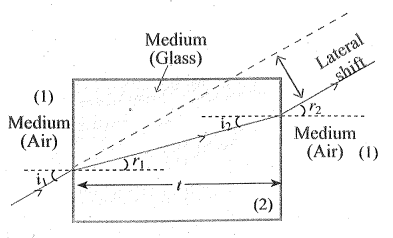
→As shown in figure ray is incident on a rectangular slab at an angle $i_1$ and is refracted through an angle $r_1$ and travels through the glass slab.
→This ray is incident on the other surface of the slab at an angle $i_2$.
→From this point a ray emerges at an angle $r_2$. Here, $i_1=r_2$ can be easily proved from Snell's law.
→Here, emergent ray is parallel to incident ray. Thus there is no deviation of incident ray.
→The perpendicular distance between the incident ray and the emergent ray is called lateral shift.

Need a full question paper?

Generate a complete, print-ready paper with questions like this in minutes — across 16+ boards, with answer keys.
Start Generating Free

Similar questions

The torque on a current loop is zero if the angle between the positive normal and the magnetic field is either $\theta=0^\circ$ or $\theta=180^\circ$ In which of the two orientations, the equilibrium is stable?
How the radii of different stable orbits are related to principal quantum number?
In a potentiometer arrangement for determining the emf of a cell, the balance point of the cell in open circuit is 350cm. When a resistance of $9\Omega$ is used in the external circuit of the cell, the balance point shifts to 300cm. Determine the internal resistance of the cell.
Two identical metal spheres of exactly equal mass have been taken. One is charged with negative charge say q and the other with the same amount of positive charge. Will there be any difference in the mass of the two spheres? If yes then why?
The amount of electric charge passing through a cross-section of wire in time t is $\mathrm{Q}(\mathrm{t})=\mathrm{At}^2+\mathrm{Bt}+\mathrm{C}$
Where $\mathrm{A}, \mathrm{B}$ and C are constants having values 5,4 and 1 respectively.
Calculate the value of electric current at $t=4 \mathrm{~s}$.
Suppose you are given a chance to repeat the alpha-particle scattering experiment using a thin sheet of solid hydrogen in place of the gold foil. (Hydrogen is a solid at temperatures below 14 K.) What results do you expect?
Two spheres A and B with radii $a$ and $b$ respectively are at the same potential. What will be the ratio of surface charge densities at $A$ and $B$ ?
How does a charge q oscillating at certain frequency produce electromagnetic waves?Sketch a schematic diagram depicting electric and magnetic fields for an electromagnetic wave propagating along the Z-direction.
If the distance of the observation point from the central point of the small electric dipole is halved, then how many times will the intensity of the electric field increase?
Can you add two vectors representing physical quantities having different dimensions? Can you multiply two vectors representing physical quantities having different dimensions?