Question
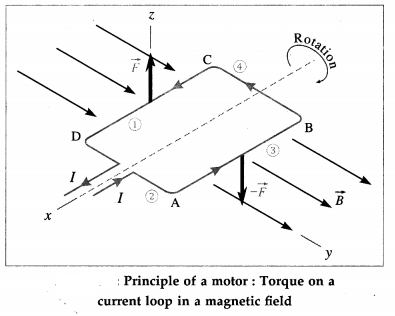
Explain with a neat labelled diagram how the magnetic forces on a current loop produce rotary motion as in an electric motor.
Need a full question paper?

Generate a complete, print-ready paper with questions like this in minutes — across 16+ boards, with answer keys.

Start Generating Free

Similar questions

It is observed in an experiment on photoelectric effect that an increase in the intensity of the incident radiation does not change the maximum kinetic energy of the electrons. Where does the extra energy of the incident radiation go? Is it lost? State your answer with explanatory reasoning.
Derive the ideal gas equation, $\mathrm{PV}=\mathrm{nRT}$.
OR
Derive the equation of state for an ideal gas.
Three capacitors of capacities $8 \mu F , 8 \mu F$ and $4 \mu F$ are connected in series and a potential difference of $120 V$ is maintained across the combination. Calculate the charge on the capacitor of capacity $4 \mu F$. Also calculate the potential difference across it.
A stretched sonometer wire emits a fundamental note of frequency $256 Hz$. Keeping the stretching force constant and reducing the length of the wire by $10 cm$, the frequency becomes $320 Hz$. Calculate the original length of the wire.
State and explain the hydrostatic paradox. OR Explain hydrostatic paradox.
Using Ampere's law, obtain an expression for the magnetic induction near a current-carrying straight infinitely long wire.
Explain the phenomenon of polarization of light by reflection.
Describe the construction of the cyclotron with a neat labelled diagram
State the uses of a potentiometer.
An electron in an atom is revolving round the nucleus in a circular orbit of radius $5.3 \times 10^{-11} m$, with a speed of $2 \times$ $10^6 ms^{-1}$ Find the resultant orbital magnetic moment and angular momentum of electron. (charge on electron $e =$ $1.6 \times 10^{-19} C$, mass of electron $m _{ e }=9.1 \times 10^{-31} kg$.)