Question
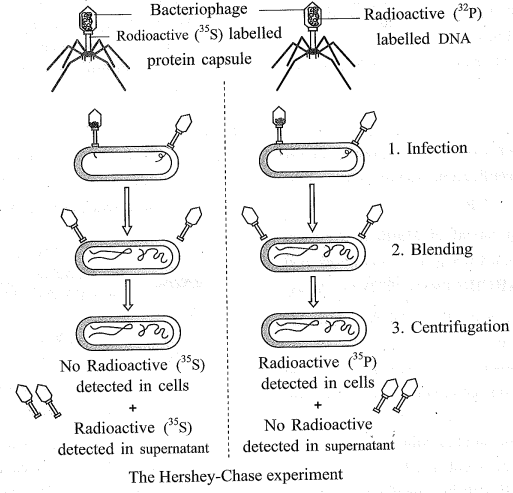
Explain with diagram - Hershey and Chase experiment.###On the basis of experimental proof explain the diagram that DNA is genetic material.###How did Hershey and Chase differentiate between DNA and protein in their experiment while proving that DNA is the genetic material?

Answer

→ The unequivocal proof that DNA is the genetic material came from the experiments of Alfred Hershey and Martha Chase (1952). They worked with viruses that infect bacteria called bacteriophages.
→ The bacteriophage attaches to the bacteria and its genetic material then enters the bacterial cell.
→ The bacterial cell treats the viral genetic material as if it was its own and subsequently manufactures more virus particles.
→ Hershey and Chase worked to discover whether it was protein or DNA from the viruses that entered the bacteria.
→ They grew some viruses on a medium that contained radioactive phosphorus and some others on medium that contained radioactive sulfur.
→ Viruses grown in the presence of radioactive phosphorus contained radioactive DNA but not radioactive protein because DNA contains phosphorus but protein does not.
→ Similarly, viruses grown on radioactive sulfur contained radioactive protein but not radioactive DNA because DNA does not contain sulfur.
→ Radioactive phages were allowed to attach to E.coli bacteria.
→ Then, as the infection proceeded, the viral coats were removed from the bacteria by agitating them in a blender.
→ The virus particles were separated from the bacteria by spinning them in a centrifuge.
→ Bacteria which was infected with viruses that had radioactive DNA were radioactive, indicating that DNA was the material that passed from the virus to the bacteria.
→ Bacteria that were infected with viruses that had radioactive proteins were not radioactive.
→ This indicates that proteins did not enter the bacteria from the viruses.
→ DNA is therefore the genetic material that is passed from virus to bacteria.
Image

Need a full question paper?

Generate a complete, print-ready paper with questions like this in minutes — across 16+ boards, with answer keys.

Start Generating Free

Similar questions

Read the following and answer any four questions from 2(i) to 2(v) given below:

Restriction endonuclease was isolated for the first ti me by W. Arb er in 1962 in bacteria. Restriction endonucleases cut the DNA duplex at specific points therefore they are also called as molecular scissors or biological scissors. Three types of restriction endonucleases are Type I, Type II and Type III but only Type II restriction endonucleases are used in recombinant DNA technology. Restriction endonuclease EcoR I recognises the base sequence GAATTC in DNA duplex and cut strands between G and A.

  1. Only type II restriction enzymes are used in gene manipulation because
  1. ATP is not required for cleaving.
  2. It consists of three different subunits.
  3. It makes cleavage or cut in both the strands of DNA molecule.
  4. Both (a) and (c).
  1. Which of the following ions are used by restriction endonucleases for restriction?
  1. Mg2+ ions
  2. Mn2+ ions
  3. Na2+ ions
  4. K2+ ions
  1.  Restriction endonuclease was isolated for the first time in a:
  1. Plant cell.
  2. Animal cell.
  3. Prokaryotic cell.
  4. Genninal cell.
  1. Restriction endonucleases are also called as molecular or biological scissors because,
  1. They cleave base pairs of DNA only at their terminal ends.
  2. They cleave one or both the strands of DNA.
  3. They act only on single stranded DNA.
  4. None of these.
  1. Select the option that correctly states the working action of restriction endonuclease EcoR I on DNA sequence GAATTC
  1. $\ \ \ \ \ \ \ \ \ \ \ \ \downarrow\\5'-\text{GAATTC}-3'\\3'-\text{CTTAAG}-5'\\\ \ \ \ \ \ \ \ \ \ \ \ \ \ \ \ \ \ \uparrow$

  2. $ \ \ \ \ \ \ \ \ \ \ \downarrow\\5'-\text{GAATTC}-3'\\3'-\text{CTTAAG}-5'\\\ \ \ \ \ \ \ \ \ \ \ \ \ \ \ \ \ \ \ \ \uparrow$

  3. $\ \ \ \ \ \ \ \ \ \ \ \ \ \ \ \ \ \ \ \ \ \downarrow\\5'-\text{GAATTC}-3'\\3'-\text{CTTAAG}-5'\\\ \ \ \ \ \ \ \ \ \uparrow$

  4. $\ \ \ \ \ \ \ \ \ \ \ \ \ \ \ \downarrow\\5'-\text{GAATTC}-3'\\3'-\text{CTTAAG}-5'\\\ \ \ \ \ \ \ \ \ \ \ \ \ \ \uparrow$

Describe Sex Determination in honey bee with diagram.
Read the following and answer any four questions from (i) to (v) given below:

X and Y are communicable diseases, whereas Wand Z are non-communicable diseases.X is transmitted through vectors whereas Y is transmitted through droplet infection. Wis caused due to a hormone deficiency, whereas Z is a degenerative disease. Based on the above information, answer the following questions.

  1. Identify W, X, Y and Z.
 
W
X
Y
Z
(a)
Coronary artery disease
Cholera
Chikungunya
Chikungunya
(b)
Diabetes
Malaria
Rhinitis
Alzheimer's disease
(c)
Alzheimer's disease
AIDS
Shigella
Plague
(d)
Gonorrhea
Diphtheria
Pertussis
Anthrax
  1. Select the correct statement.
  1. If X is sleeping sickness then its vector is Leishrnania.
  2. If Y is diphtheria then it is caused by Bacillus anthracis.
  3. If W is hypothyroidism then it is caused by deficiency of thyroxine hormone.
  4. If Z is myocardial infarction then patient develops acute rheumatic fever, joint pain and throat infection.
  1. If X and Y both are usual diseases then which of the following holds true?
  1. X could be dengue caused by flavivirus and Y could be AIDS caused by HIV.
  2. X could be chikungunya whereas Y could be rhinitis.
  3. X could be hepatitis whereas Y could be rabies.
  4. X could be chicken pox caused by Va rice/la zoster virus whereas Y could be yellow fever caused by flavivirus
  1. If X and Y both are bacterial diseases then select the correct match from the following.
  1. X- Bubonic plague-Yersinia pestis
  2. Y-Leprosy- Mycobacteriurn leprae
  3. X-Whooping cough-Bordetella pertussis
  4. Y-Botulism-Clostridiurn botulinum
  1. Assertion: Communicable diseases could be contagious or non-contagious.

Reason: Diseases that spread through vectors are non-contagious disease.

  1. Both assertion and reason are true, and reason is the correct explanation of assertion.
  2. Both assertion and reason are true, but reason is not the correct explanation of assertion.
  3. Assertion is true, but reason is false.
  4. Both assertion and reason are false.
Origin and Evolution of Man:
Write a short note on embryo development.###With a labeled diagram discuss stages in embryo development in a dicot.
Read the following and answer any four questions from 6(i) to 6(v) given below:

Rama lives in a society where a robbery occurred last night. Robbers came into the flat and murdered the old lady residing there. Police came and restricted the entry into the flat. They took samples from the room, where the dead body was found. While examining, they found that there is some blood and tissue in the nails of old lady. According to their observation, police filtered out their inspection to three suspects viz. servant, cook and milkman. Finally after two days of robbery, police caught the criminal. It was the old lady's cook. Rama was amazed to see that how quickly police completed and shut the case. She asked the inspector that how they did it? The police man told her that it become possible due to the sample collected from the victim, that lead them to the criminal. TI1e sample taken from nail scraping was amplified using PCR and then tested.

  1. What technique was used by the police to identify the criminal?
  1. DNA fingerprinting.
  2. Gel electrophoresis.
  3. Molecular diagnosis.
  4. Clonning.
  1. In PCR, the temperature used to denature the DNA is about:
  1. 76º
  2. 25º
  3. 95º
  4. 40º
  1. Which of the following statements regarding PCR is correct?
  1. Taq polymerase, which is isolated from bacterium Thermus aquaticus is stable at low temperature only.
  2. With the help of DNA ligase, the complementary sticky ends of the DNA are joined to produce a rDNA.
  3. Since the sequence of primers are complementary to 5' end of the template DNA, they anneal to it.
  4. DNA purified from the cell is precipitated by adding hot ethanol.
  1. Taq polymerase synthesises DNA region between the primers using:
  1. Mg2+
  2. dNTPs
  3. DNA ligase
  4. Both (a) and (b).
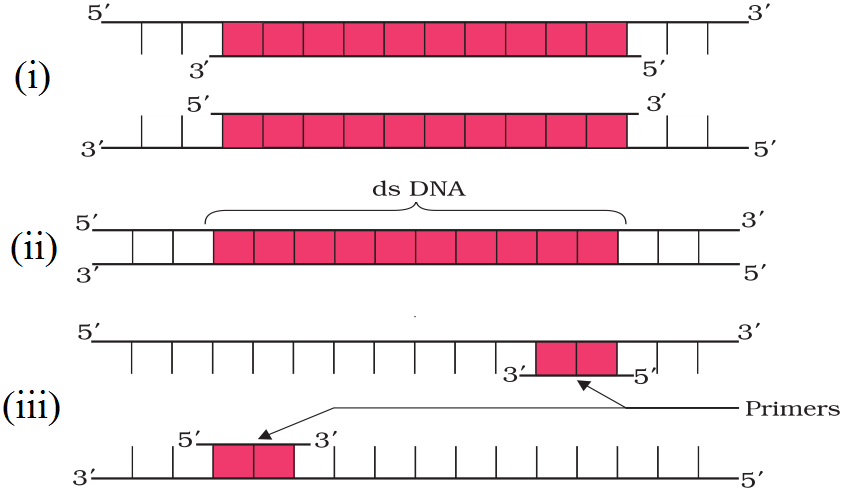
  1. Given below are steps of polymerase chain reaction.

Select the option that correctly mention the sequence in which they occur.

  1. (ii) → (iii) → (i)
  2. (i) → (ii) → (iii)
  3. (iii) → (i) → (ii)
  4. (ii) → (i) → (iii)
Read the following and answer any four questions from (i) to (v) given below:

Intrauterine devices are most widely accepted methods of contraception. These are used by females and are inserted by doctor or nurses in the uterus through vagina. However, these devices are not recommended for those who eventually intend to conceive.

  1. How does CuT prevent conception?
  1. Cu ions make uterus unsuitable for implantation.
  2. Cu ions make cervix hostile to the sperms.
  3. Cu ions suppress sperms motility.
  4. Cu ions inhibit ovulation.
  1. Which of the following IUDs makes uterus unsuitable for implantation?
  1. LNG-20.
  2. Multiload 375.
  3. Cu7.
  4. Lippes loop.
  1. Identify the correct statement for IUDs.
  1. They slowly release synthetic progesterone in the body.
  2. They increase phagocytosis of sperms within the uterus.
  3. They block entry of sperms through the cervix.
  4. Both (b) and (c).
  1. Select the correct matched pair.
  1. Hormone releasing IUD - LNG-20.
  2. Non-medicated IUD - Progestasert.
  3. Copper releasing IUD - Lippes loop.
  4. None of these.
  1. Assertion: IUDs can cause excess menstrual bleeding and pain.

Reason: IUDs can perforate uterus.

  1. Both assertion and reason are true, and reason is the correct explanation of assertion.
  2. Both assertion and reason are true, but reason is not the correct explanation of assertion.
  3. Assertion is true, but reason is false.
  4. Both assertion and reason are false.
Read the following and answer any four questions from (i) to (v) given below:

Regular change in temperature that occurs at specific intervals of time is called thennoperiodicity. It is of two types-diurnal and seasonal thermoperiodicity. Diumal periodicity refers to temperatures of day and night. It determines periods ofannual activity. In season periodicity different temperature prevails in different seasons of the year. 'Tiley favour different aspects of plant and animal life termed as phenology. For example in wheat, leaf growth requires a temperature of 10º-25ºC. Apple requires temperature below 7ºC for a period of 800 hrs before flowering and fruiting can occur. Low temperature is required for germination of some seeds as well as flowering in some plants. It also determines growth, reproduction, colour and morphology of animals. Both low and high temperature cause stress in organisms which is overcome by particular adaptations.

  1. Some plants require low temperature treatment for flowering. This phenomenon is known as:
  1. Photoperiodism.
  2. Vemalisation.
  3. Thermoperiodism.
  4. None of these.
  1. Animals found in arctic zones are called.
  1. microtherms
  2. Megatherms
  3. Mesotherms
  4. Hekistotherms
  1. Which of the following parts of wheat plant grows maximum in temperature around 10º-25ºC?
  1. Root
  2. Seeds
  3. Leaf
  4. Stem
  1. "Different temperatures prevail in different seasons of the year." It represents:
  1. Diurnal thermoperiodicity.
  2. Seasonal periodicity.
  3. Homeostasis.
  4. Thermoregulation.
  1. Assertion: Low and high temperature causes stress in organisms.

Reasons: Organisms show specific adaptations to overcome stressful condition.

  1. Both assertion and reason are true and reason is the correct explanation of assertion
  2. Both assertion and reason are true but reason is not the correct explanation of assertion.
  3. Assertion is true but reason is false.
  4. Both assertion and reason are false.
Read the following and answer any four questions from (i) to (v) given below:
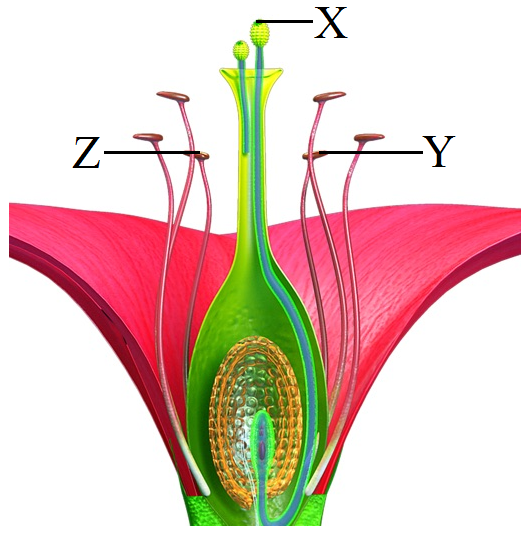
Cross pollination is the transfer of pollen grains from the anther of a one flower to the stigma of a genetically different flower. It is performed with the help of an external agency which may be abiotic (e.g., wind, water) or biotic (e.g., insects, birds, bats, snails). The diagram shows the carpel of an insect pollinated flower.

  1. What is the most likely reason for non germination of pollen grain Z?
  1. Pollen grains X and Y were brought to the stigma earlier, therefore, their germination inhibited the germination of pollen grain Z.
  2. Pollen grain Z was brought to the flower by wind, while pollen grains X and Y were brought to the flower by insect.
  3. Pollen grain Z lacks protrusions that allow it to adhere properly onto the stigma surface.
  4. Pollen grain Z comes from a flower of an incompatible species.
  1. Which of the following best describes the function of the pollen tube?
  1. It acts as a conduit to transport male gametes from the anther to the ovule.
  2. It acts as a conduit to transport male gametes from the stigma to the ovule.
  3. It contains key nutrients that serve to nourish the newly-formed zygote.
  4. It digests the tissues of the stigma, style, and ovary.
  1. Pollination of a flower in which the pollen is carried by an insect is called:
  1. Anemophily.
  2. Ornithophily.
  3. Entomophily.
  4. Malacophil.
  1. Refer to the given characteristics of some flowers.
  1. The stamens hang out of the flower, exposing the anthers to the wind.
  2. The pollen grains are tiny and light.
  3. The flower has a sweet scent.
  4. The flower petals are brightly colored.
  1. Pollenkitt is generally found in:
  1. Anemophilous flowers.
  2. Entomophilous flowers.
  3. Ornithophilous flowers.
  4. Malacophilous flowers.
Read the following and answer any four questions from (i) to (v) given below:

Reerna, Jai and Ankit are suffering from autoimmune diseases of adrenal cortex, joints and thyroid gland, respectively. Their immune system failed to recognise self and non-self and started destroying their body's own proteins. They are seeking proper medical help for their conditions but their condition cannot be cured completely.

Based on the above information, answer the following questions.

  1. Select the option that correctly identifies autoimmune diseases of Reema, Jai and Ankit.
S no.
Reema
Jai
Ankit
(a)
Diabetes
Grave's disease
Rheumatic fever
(b)
Pernicious anaemia
Multiple sclerosis
Myasthenia gravis
(c)
Addison's disease
Rheumatoid arthritis
Hashismoto's thyroiditis
(d)
Systemic lupus erythematosus
Severe combined immunodeficiency disease
AIDS
  1. Reema's autoimmune condition is characterised by
  1. Undersecretion of insulin.
  2. Destruction of RB Cs and low RB C count.
  3. Undersecretion of adrenal cortex hormones.
  4. Low production of intrinsic factor required for absorption of B12
  1. What do you think is the major cause of Jai's condition?
  1. Deterioration of myelin sheath around nerve cells, leading to loss of precise muscle control
  2. Destruction of heart cells, leading to weakening of entire heart wall.
  3. Destruction of beta cells, leading to undersecretion of insulin.
  4. Deposition of immune complexes of IgM, IgG and complement in joints thereby inflaming joints, destroying articular cartilage and fusing bones.
  1. How do you think Ankit's condition got diagnosed?
  1. Low level of thyroid hormone and elevated levels of TSH in Ankit's blood.
  2. Presence of antibodies against thyroid pen oxidase (TPO antibodies) in Ankit's blood.
  3. Elevated erythrocyte sedimentation rate (ESR), reduced C-reactive protein (CRP) in Ankit.
  4. Both (a) and (b)
  1. Assertion: Immunosuppressive drugs often reduce the severity of autoimmune disorders.

Reason: Monoclonal antibodies have been successfully used in the treatment of autoimmune disease.

  1. Both assertion and reason are true, and reason is the correct explanation of assertion.
  2. Both assertion and reason are true, but reason is not the correct explanation of assertion.
  3. Assertion is true, but reason is false.
  4. Both assertion and reason are false.