Question
Explain with suitable examples the differ-ent types of phyllotaxy.

Answer

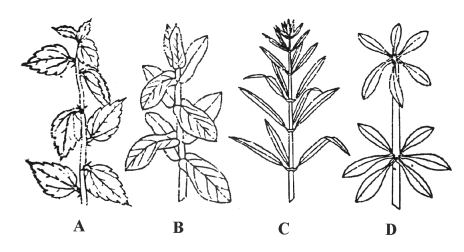
The arrangement of leaves on the stem or branch is called phyllotaxy. It is of the following types (Fig. 5.10):
1. Alternate: One leaf appears at each node. If on one node the leaf is on the left and on the next and previous nodes it is on the right, then it is called alternation. Example: Hibiscus, Mustard etc.
2. Spiral: When the leaves are arranged at the node in such a way that there is one leaf at each node and by joining their bases with a line, a spiral shape is formed.
3. Opposite: When two leaves appear opposite to each other at a node. There are two types of it:
(i) Opposite superposed: When both the leaves emerge on the same side at each node. Example: Guava.
(ii) Opposite decussate: When pairs of leaves at successive nodes make an angle of 90° to each other.
Example: Aak (Calotropis).
4. Whorled: When more than two leaves remain at-tached in a whorled form at one node. Example: Nerium (Devil Tree).
Image
Fig. 5.10: A. Alternate, B. Opposite Superposed, C. Opposite Decussate D. Whorled
Functions of Leaves:
→Photosynthesis: The main function of leaves is to produce food through photosynthesis.
→Exchange of gases: Exchange of atmospheric oxygen and carbon dioxide takes place through the leaf stomata present on the leaves.
→Transpiration: Water is lost in the form of vapour through the leaf stomata which controls the tem-perature of the plants and sap absorption occurs through transpiration pull.
→Specialized functions: Leaves get modified for some specific functions like food collection, pro-tection, climbing, catching insects and vegetative propagation.

Need a full question paper?

Generate a complete, print-ready paper with questions like this in minutes — across 16+ boards, with answer keys.
Start Generating Free