Question
Explain zero biased junction diode.

Answer

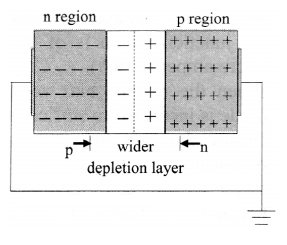
$i.$ When a diode is connected in a zero bias condition, no external potential energy is applied to the $p-n$ junction.
$ii.$ The potential barrier that exists in a junction prevents the diffusion of any more majority carriers across it. However, some minority carriers $($few free electrons in the $p-$region and few holes in the $n-$region$)$ drift across the junction.
$iii.$ An equilibrium is established when the majority carriers are equal in number $(n_e = n_h)$ and both moving in opposite directions. The net current flowing across the junction is zero. This is a state of‘dynamic equilibrium’.
$iv.$ The minority carriers are continuously generated due to thermal energy.
$v.$ When the temperature of the $p-n$ junction is raised, this state of equilibrium is changed.
$vi.$ This results in generating more minority carriers and an increase in the leakage current. An electric current, however, cannot flow through the diode because it is not connected in any electric circuit
Image

Need a full question paper?

Generate a complete, print-ready paper with questions like this in minutes — across 16+ boards, with answer keys.

Start Generating Free

Similar questions

Define angular dispersion for a prism. Obtain its expression for a thin prism. Relate it with the refractive indices of the material of the prism for corresponding colours.
State Hooke’s law. Draw a labelled graph of tensile stress against tensile strain for a metal wire up to the breaking point. In this graph show the region in which Hooke’s law is obeyed.
Draw a neat labelled diagram for angle of dip.
Explain formation of energy bands in solid sodium with neat labelled energy band diagrams.
State and prove parallelogram law of vector addition and determine magnitude and direction of resultant vector.
Find a vector which is parallel to $\overrightarrow{ v }=\hat{i}-2 \hat{j}$ and has a magnitude $10.$
State the characteristics of the vector product $($cross product$)$ of two vectors.
Explain in brief temperature dependence of electrical conductivity of metals and semiconductors with the help of graph.
Activity to understand the dependence of boiling point on pressure:
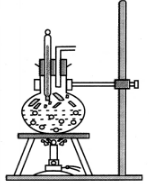
Take a round bottom flask, more than half filled with water. Keep it over a burner and fix a thermometer and steam outlet through the cork of the flask as shown in figure. As water in the flask gets heated, note that first the air, which was dissolved in the water comes out as small bubbles. Later bubbles of steam form at the bottom but as they rise to the cooler water near the top, they condense and disappear. Finally, as the temperature of the entire mass of the water reaches 100 oc, bubbles of steam reach the surface and boiling is said to occur. The steam in the flask may not be visible hut as it comes out of the flask, It condenses as tiny droplets of water giving a foggy appearance.
Image
If now the steam outlet is closed for a few seconds to increase the pressure in the flask, you will notice that boiling stops. More heat would be required to raise the temperature (depending on the increase in pressure) before boiling starts again. Thus, boiling point increases with increase in pressure. Let us now remove the burner. Allow water to cool to about 80°C. Remove the thermometers and steam outlet. Close the flask with a air tight cork. Keep the flask turned upside down on a stand. Pour icecold water on the flask. Water vapours in the flask condense reducing the pressure on the water surface inside the flask. Water begins to boil again, now at a lower temperature. Thus boiling point decreases with decrease in pressure and increases with increase in pressure.
Discuss qualitative idea for the gravitational force of attraction due to a hollow, thin spherical shell of uniform density on a point mass situated inside it.