Question
Explanation hydrogen spectrum on the basis of Bohr's principle.

Answer

Explanation of Hydrogen spectrum on the basis of Bohr's principle:
In general the energy of electron in nth orbit of the hydrogen atom is given by: $E _n=-\left(13.6 / n^2\right) eV$.
$E_1=-\left(13.6 / 1^2\right) eV =-13.6 eV$
$E _2=-\left(13.6 / 2^2\right) eV =-1.51 eV$
$E_3=-\left(13.6 / 3^2\right) e V=-0.85 e V$
$E _4=-\left(13.6 / 4^2\right) eV =-0.54 eV$
$E _5=-\left(13.6 / 5^2\right) eV =-0.37 eV$
...................................................................
$E_{\infty}=-\left(13.6 / \infty^2\right) e V=0$
From these values it is obvious that the electron in hydrogen atom can have only certain discrete values of energy while revolving in different orbits. It is also obvious that the first orbit corresponds to the lowest energy and is called ground state. As $n$ increases, the energy becomes less negative i.e, goes on increasing. When $n$ becomes very large $(n \rightarrow \infty)$ the energy becomes zero. This zero level represents the state of maximum energy. The minimum energy required to remove an electron from n = 1 to n = ∞ is called ionisation energy of H2 atom and it is equal to difference of E1 and $E_{\infty}$ infty i.e., it is 13.6 eV. Zero energy state is called ionisation state of the atom. It is also obvious that with increasing value of $n$ the difference between the energy of different states goes on decreasing.
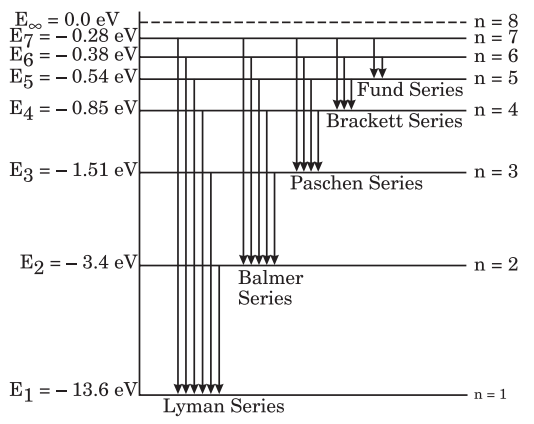
Image
Taking all the above points into account if a diagram is drawn in which the energies of the different orbits (energy states) of H2 atom are represented by parallel horizontal lines with some suitable energy scale, this diagram is called energy level diagram of H2 atom. In this diagram the transitions corresponding to different spectral series of hydrogen atom are also shown.
formula :
$\frac{1}{\lambda}= R \left(\frac{1}{n_1^2}-\frac{1}{n_2^2}\right)$ ...(1)
On the basis of this formula production of all the five spectral series can be explained as follows :
(1) Lymann Series : When the electron of hydrogen atom transits from some higher energy level to the first energy level (lowest energy level), (i.e., n1 = 1 and n2 = n = 2 ,3,4,....) then the emitted spectral lines are obtained in the ultraviolet region of the spectrum and make the Lymann series. Hence the wavelength of these lines can be found by the following form of the above equation (1),
$\frac{ 1 }{\lambda}= R \left(\frac{ 1 }{ 1 ^2}-\frac{ 1 }{ n ^2}\right), \quad$ where $n=2,3,4, \ldots$
Where R is Rydberg's constant and its value is 1.097$\times 10^7 m^{-1}$. Somewhere it is also denoted by RH.
The series lies in the ultra-violet. Lymann, in 1916, photographed the lines of this series of hydrogen spectrum. Hence this series is named 'Lymann series'. The longest wavelength of this series (for n = 2 ) is 1216 Å and the shortest wavelength (for n = ∞ ) is 912 Å. The wavelength (912 Å) corresponding to n = ∞ is called the 'series limit'.
(2) Balmer Series : Its wavelengths are given by
$\frac{1}{\lambda}= R \left(\frac{1}{2^2}-\frac{1}{n^2}\right),(n=3,4,5, \ldots)$ ...(2)
The lines of this series were seen and studied for the first time by Balmer in 1885. Hence this series is named as Balmer series. The longest wavelength of this series (for n = 3 ) is 6563 Å and the shortest wavelength (for n = ∞) is 3646 Å.
For n = 3 4, 5, 6, ...the spectral lines of Balmer series were termed as $H _\alpha, H _\beta, H _\gamma, H _\delta, \ldots$ and so on.
(3) Paschen Series : Its wavelengths are given by
$\frac{1}{\lambda}= R \left(\frac{1}{3^2}-\frac{1}{n^2}\right),(n=4,5,6, \ldots$ ...(3)
The series lies in the near infrared region.
This series was discovered by Paschen.
The greatest wavelength of this series is 18751 Å and the shortest is 8107 Å.
(4) Brackett Series : Its wavelengths are given by
$\frac{1}{\lambda}= R \left(\frac{1}{4^2}-\frac{1}{n^2}\right),(n=5,6,7, \ldots$ ...(4)
The series lies in the far infrared region.
This series was discovered by Brackett in 1922. The greatest wavelength of this series is 40500 Å and the shortest is 14516 Å.
(5) Pfund Series : Its wavelengths are given by
$\frac{1}{\lambda}= R \left(\frac{1}{3^2}-\frac{1}{n^2}\right),(n=6,7,8, \ldots)$ ...(5)
The series lies in far infrared region.
This series was discovered by Pfund is 1924. The largest wavelength of this series is 74000 Å and shortest is 23673 Å.

Need a full question paper?

Generate a complete, print-ready paper with questions like this in minutes — across 16+ boards, with answer keys.
Start Generating Free

Similar questions

A $100\ kg$ block is started with a speed of $2.0\ ms^{-1}$ on a long, rough belt kept fixed in a horizontal position. The coefficient of kinetic friction between the block and the belt is $0.20.$
  1. Calculate the change in the internal energy of the block$-$belt system as the block comes to a stop on the belt.
  2. Consider the situation from a frame of reference moving at $2.0ms^{-1}$ along the initial velocity of the block. As seen from this frame, the block is gently put on a moving belt and in due time the block starts moving with the belt at $2.0\  ms^{-1}$ Calculate the increase in the kinetic energy of the block as it stops slipping past the belt.
  3. Find the work done in this frame by the external force holding the belt.
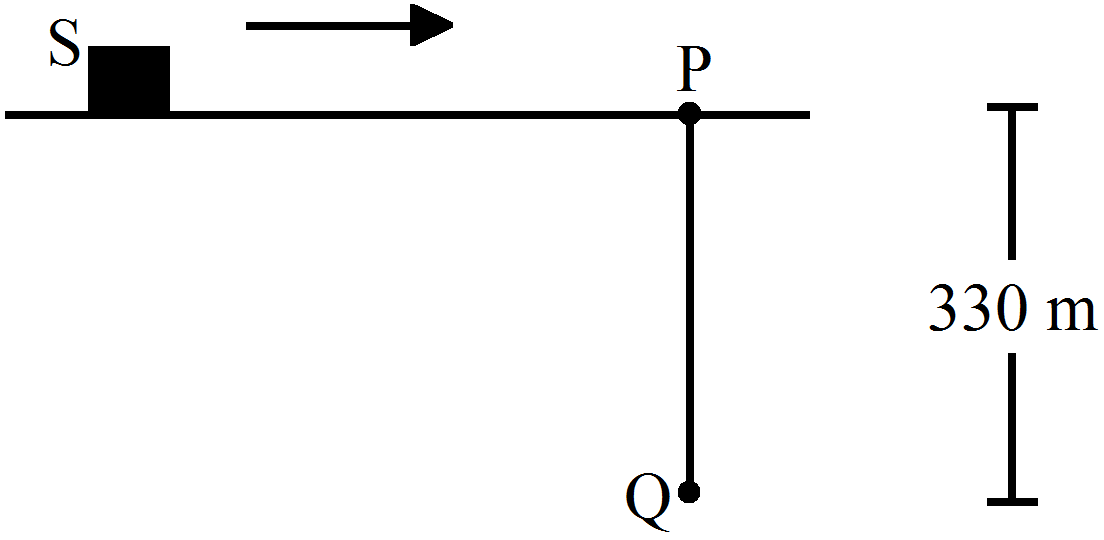
Figure, shows a source of sound moving along the X-axis at a speed of 22m/s continuously emitting a sound of frequency 2.0kHz which travels s in air at a speed of 330m/s. A listener Q stands on the Y-axis at a distance of 330 m from the origin. At t = 0, the source crosses the origin P.
  1. When does the sound emitted from the source at P reach the listener Q?
  2. What will be the frequency heard by the listener at this instant?
  3. Where will the source be at this instant?
 
A person stands on a spring balance at the equator.
  1. By what fraction is the balance reading less than his true weight?
  2. If the speed of earth's rotation is increased by such an amount that the balance reading is half the true weight, what will be the length of the day in this case?
The pulley shown in figure has a radius $10\ cm$ and moment of inertia $0.5\ kg-m^2$ about its axis. Assuming the inclined planes to be frictionless, calculate the acceleration of the $4.0\ kg$ block.
A block of weight 100N is slowly slid up on a smooth incline of inclination 37° by a person. Calculate the work done by the person in moving the block through a distance of 2.0m, if the driving force is:
  1. Parallel to the incline.
  2. In the horizontal direction.
When a light ray passes from the atmosphere (a) through the combination of two mediums water (b) and glass (c), then find the relationship between the refractive indices of the three mediums.
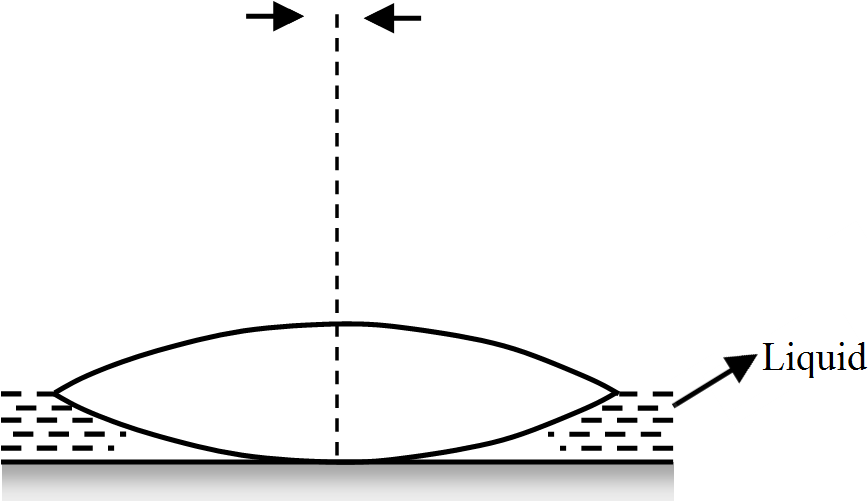
  1. An equiconvex lens with radii of curvature of magnitude r each, is put over a liquid layer poured on top of a plane mirror. A small needle, with its tip on the principal axis of the lens, is moved along the axis until its inverted real image coincides with the needle itself. The distance of the needle from the lens is measured to be 'a'. On removing the liquid layer and repeating the experiment the distance is found to be 'b'.
Given that two values of distances measured represent the focal length values in the two cases, obtain a formula for the refractive index of the liquid.
  1. If $r = 10\ cm, a = 15\ cm, b = 10\ cm$, find the refractive index of the liquid.
$a.$ Using the ray diagram for a system of two lenses of focal lengths $f_1$ and $f_2$ in contact with each other, show that the two lens system can be regarded as equivalent to a single lens of focal length $f$, where
$\frac{1}{ f }=\frac{1}{ f _1}+\frac{1}{ f _2}$
Also write the relation for the equivalent power of the lens combination.
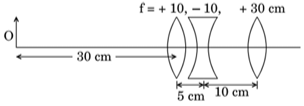
$b.$ Determine the position of the image formed by the lens combination given in the figure.
Image
A charged particle is accelerated through a potential difference of $12kV$ and acquires a speed of $1.0 \times 10^6m s^{−1}$. It is then injected perpendicularly into a magnetic field of strength $0.2T.$ Find the radius of the circle described by it.
A small bulb is placed at the bottom of a tank containing water to a depth of 80 cm. What is the area of the surface of water through which light from the bulb can emerge out? Refractive index of water is 1.33. (Consider the bulb to be a point source.)