Question
Express the equation of a simple harmonic progressive wave in different forms.

Answer


A simple progressive wave travelling along the positive $x$-direction is given by $y=A \sin (\omega t-$ kx) ... (1)
where $A$ is the amplitude of the wave, $k$ is the wave number and co is the angular frequency.
Wave number, $k=\frac{2 \pi}{\lambda}$
$
\therefore y=A \sin \left(\omega t-\frac{2 \pi}{\lambda} x\right)
$
Angular frequency, $\omega=2 \pi n$, Eq. (2) can be written as
$
\begin{aligned}
\therefore y & =A \sin \left(2 \pi n t-\frac{2 \pi}{\lambda} x\right)^{} \\
y & =A \sin 2 \pi\left(n t-\frac{x}{\lambda}\right) \\
y & =A \sin 2 \pi n\left(t-\frac{x}{n \lambda}\right)
\end{aligned}
$
But $n \lambda=v$, the velocity of the wave.
$
y=A \sin 2 \pi n\left(t-\frac{x}{v}\right)
$
Also, writing $n=\frac{v}{\lambda}$ in Eq. (3), we get,
$
y=A \sin \frac{2 \pi}{\lambda}(v t-x)
$
Frequency of vibrations, $n=\frac{1}{T}$, Eq. (2) can be written as $y = A \sin 2 \pi\left(\overline{ T }-\frac{x}{\lambda}\right)$
Equations (1), (2), (3), (4), (5) and (6) are the different forms of the equation of a simple harmonic progressive wave.

Need a full question paper?

Generate a complete, print-ready paper with questions like this in minutes — across 16+ boards, with answer keys.
Start Generating Free

Similar questions

Define:
(1) retentivity
(2) coercivity.
A circular disc of moment of inertia $10 \mathrm{~kg} \cdot \mathrm{m}^2$ is rotated about its transverse symmetry axis at a constant frequency of $60 \mathrm{rpm}$ by an electric motor of power 31.42 watts. When the motor is switched off, how many rotations does it complete before coming to rest?
Obtain an expression for the electric field intensity at a point outside a charged conducting spherical shell.
Hence, obtain an expression for the electric intensity (i) on the surface of (i.e., just outside) the spherical conductor (ii) inside the spherical conductor.
Answer in brief:
Explain the spectral distribution of blackbody radiation.
Explain analytically how stationary waves are formed. What are nodes and antinodes? Show that distance between two adjacent nodes or antinode is \(\frac{\lambda}{4}\).
Calculate the energy released in the following reactions, given the masses to be ${ }_{88}^{223} Ra$ : $223.0185 u _8^{209} Pb : 208.9811,{ }_6^{14} C : 14.00324,{ }_{92}^{236} U : 236.0456,{ }_{56}^{140} Ba : 139.9106,{ }_{36}^{94} Kr$ : 93.9341, ${ }_6^{11} C : 11.01143,{ }_5^{11} B : 11.0093$. Ignore neutrino energy.
(a) ${ }_{88}^{223} Ra \rightarrow{ }_{82}^{209} Pb +{ }_6^{14} C$
(b) ${ }_{92}^{836} U \rightarrow{ }_{56}^{140} Ba +{ }_{36}^{94} Kr +2 n$
(c) ${ }_6^{11} C \rightarrow{ }_5^{11} B + e ^{+}+$neutrino
A steel sphere of mass $0.02 kg$ attains a terminal speed $vi =0.5 m / s$ when dropped into a tall cylinder of oil. The same sphere is then attached to the free end of an ideal vertical spring of spring constant $8 N / m$. The sphere is immersed in the same oil and set into vertical oscillation. Find
(i) the damping constant
(ii) the angular frequency of the damped SHM.
(iii) Hence, write the equation for displacement of the damped SHM as a function of time, assuming that the initial amplitude is $10 cm .\left[ g =10 m / s ^2\right]$
Why are curved roads banked?
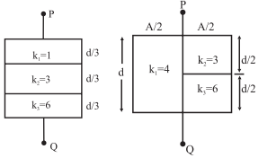
Find the equivalent capacitance between P and Q. Given, area of each plate = A and separation between plates = d.

Image
A motor van weighing $4400 \mathrm{~kg}$ (i.e., a motor van of mass $4400 \mathrm{~kg}$ ) rounds a level curve of radius $200 \mathrm{~m}$ on an unbanked road at $60 \mathrm{~km} / \mathrm{h}$. What should be the minimum value of the coefficient of friction to prevent skidding? At what angle should the road be banked for this velocity?