Question
Factorise the expressions: $q^2- 10q + 21$

Answer

$q^2– 10q + 21$
$= q^2– 10q + 25 – 4$
$= {(q)^2– 2(q) (5) + (5)^2} – 4$
$= (q – 5)^2– (2)^2. . . .$ [Using Identity $II]$
$= (q – 5 – 2) (q – 5 + 2). . . .$ [Using Identity $III]$
$= (q – 7) (q – 3)$

Need a full question paper?

Generate a complete, print-ready paper with questions like this in minutes — across 16+ boards, with answer keys.
Start Generating Free

Similar questions

The three angles of a quadrilateral are respectively equal to $110^\circ , 50^\circ $ and $40^\circ .$ Find its fourth angle.
Using prime factorisation, find the square root of 1025.
$PQRS$ is a rectangle. The perpendicular $ST$ from $S$ on $PR$ divides $\angle\text{S}$ in the ratio $2 : 3$. Find $\angle\text{TPQ}$
Subtract: $\frac{\text{ab}}{7}-\frac{35}{3}\text{bc}+\frac{6}{5}\text{ac}$ from $\frac{3}{5}\text{bc}-\frac{4}{5}\text{ac}$
There are $180$ multiple choice questions in a test. If a candidate gets $4$ marks for every correct answer and for every unattempted or wrongly answered question one mark is deducted from the total score of correct answers. If a candidate scored $450$ marks in the test, how many questions did he answer correctly?
Simplify:
$2 x^2\left(x^3-x\right)-3 x\left(x^4+2 x\right)-2\left(x^4-3 x^2\right)$
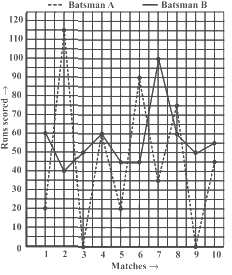
The given graph represents the total runs scored by two batsmen $A$ and $B$, during each of the ten different matches in the year $2007.$ Study the graph and answer the following question:

Among the two batsmen, who is steadier? How do you judge it?
Rani purchases a pair of shoes whose sale price is Rs $175$. If she pays $VAT$ at the rate of $7\%$, how much amount does she poy as $VAT$? Also, find the net value of the pair of shoes.
An employee works in a company on a contract of $30$ days on the condition that he will receive Rs. $120$ for each day he works and he will be fined Rs. $10$ for each day he is absent. If he receives Rs. $2300$ in all, for how many days did he remain absent?
Solve: $\text{m}-\frac{(\text{m}-1)}{2}=1-\frac{(\text{m}-2)}{3} $