Question
Factorise: $x^3 - 6x^2 + 11x - 6$

Answer

Let $p(x)=x^3-6 x^2+11 x-6$ Constant term of $p(x)=-6$
$\therefore$ Factors of $-6$ are $\pm 1, \pm 2, \pm 3, \pm 5, \pm 6$ By trial,
we find that $p(1)=0$, so $(x-1)$ is a factor of $p(x)$.
$\left[\therefore(1)^3-6(1)^2+11(1)-6=1-6+11-6=0\right]$
Now, we see that $x^3-6 x^2+11 x-6=x^3-x^2-5 x^2+5 x+6 x-6$
$=x^2(x-1)-5 x(x-1)+(6 x-1)=(x-1)\left(x^2-5 x+6\right)[$ taking $(x-1)$ common factor $]$
Now, $\left(x^2-5 x+6\right)=x^2-3 x-2 x+6[$ by spliting middle term]
$= x(x - 3) -2(x - 3) = (x - 3)(x - 2) $
$\therefore x^3 - 6x^2 + 11x - 6 = (x - 1)(x - 2)(x - 3)$

Need a full question paper?

Generate a complete, print-ready paper with questions like this in minutes — across 16+ boards, with answer keys.
Start Generating Free

Similar questions

A rectangular plot is given for constructing a house, having a measurement of $40\ m$ long and $15\ m$ in the front. According to the laws, a minimum of $3\ m$, wide space should be left in the front and back each and $2\ m$ wide space on each of other sides. Find the largest area where house can be constructed. 
Find the value of $x$ for which the angles $(2x - 5)^\circ$ and $(x - 10)^\circ $ are the complementary angle.
Find the value k if $x - 3$ is a factor of $k^2x^3 - kx^2 + 3kx - k.$
Construct the following and give justification: A triangle $PQR$ given that $QR = 3cm, \angle\text{PQR}=45^\circ$ and $QP - PR = 2cm.$
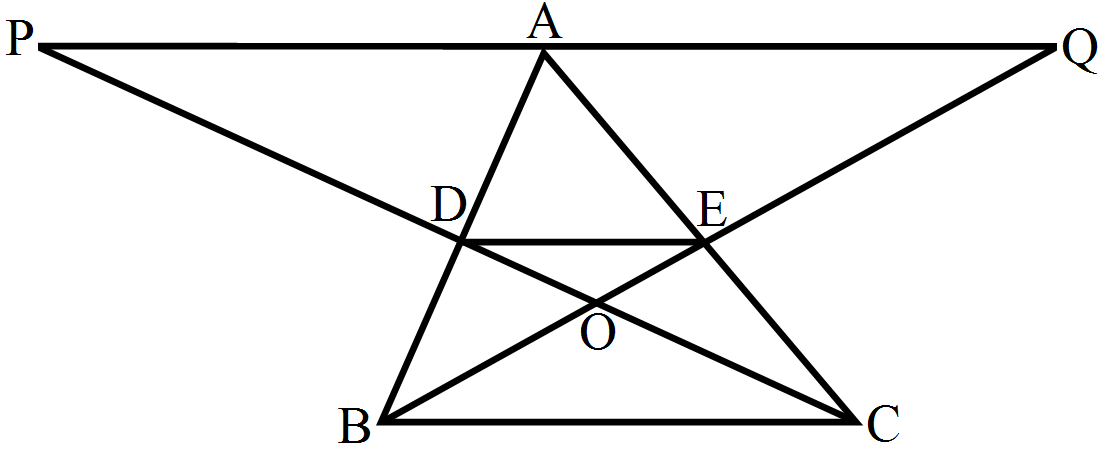
In the adjoining figure, $D$ and $E$ are respectively the midpoints of sides $AB$ and $AC$ of $\triangle\text{ABC}.$ If $PQ || BC$ and $CDP$ and $BEQ$ are straight lines then prove that$\text{ar}(\triangle\text{ABQ})=\text{ar}(\triangle\text{ACP}).$
The area of a trapezium is $475 cm^2$ and its height is $19 cm$ . Find the lengths of its parallel sides if one side is $4 cm$ greater than the other.
Evaluate: $\frac{(25)^{\frac{5}{2}}\times(729)^{\frac{1}{3}}}{(125)^{\frac{2}{3}}\times(27)^{\frac{2}{3}}\times8^{\frac{4}{3}}}$
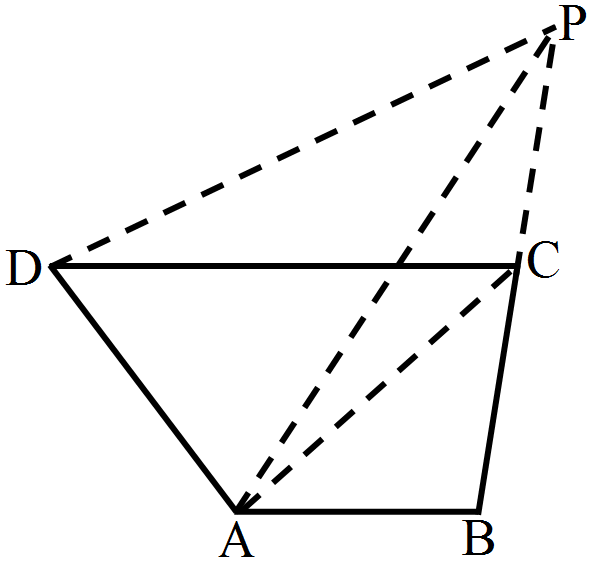
In the adjoining figure, $ABCD$ is a quadrilateral. A line through $D,$ parallel to $AC,$ meets $BC$ produced in $P.$ Prove that $\text{ar}(\triangle\text{ABP})=\text{ar}(\text{quadrilateral ABCD}).$
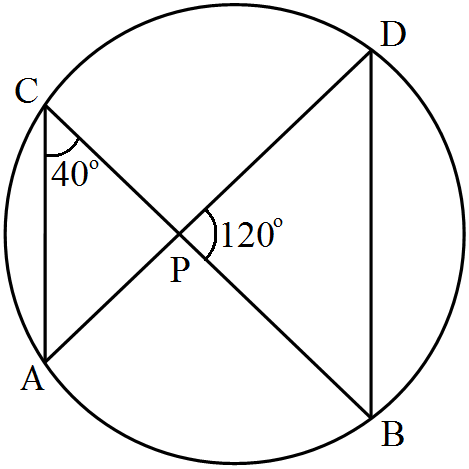
In figure, if $\angle\text{ACB} = 40^\circ, \angle\text{DPB} = 120^\circ,$ find $\angle\text{CBD}.$
Find the value of $x^3+y^3-12 x y+64$, when $x+y=-4$