Question
Factorise:$4x^4 + 25y^4 + 19x^2y^2$

Answer

$4x^4 + 25y^4 + 19x^2y^2$
$= 4x^4 + 25y^4 + 20x^2y^2 - x^2y^2$
$= (2x^2)^2 + (5y^2)^2 + 2 x (2x^2) x (5y^2) - x^2y^2$
$= [(2x^2)^2 + (5y^2) + 2 x (2x^2) x (5y^2)] -x^2y^2$
$= [2x^2 + 5y^2] - (xy)^2$
$= (2x^2 + 5y^2 - xy)(2x^2 - 5y + xy).$

Need a full question paper?

Generate a complete, print-ready paper with questions like this in minutes — across 16+ boards, with answer keys.
Start Generating Free

Similar questions

Calculate the median of the following sets of number:$1, 9, 10, 8, 2, 4, 4, 3, 9, 1, 5, 6, 2$ and $4.$
In right$-$angled $\triangle ABC; \angle B = 90^\circ .$ Find the magnitude of $\angle A$, if: $AB$ is $\sqrt{3}$ times of $BC.$
In an isosceles $\triangle ABC,$ sides $AB$ and $AC$ are equal. If point $D$ lies in base $BC$ and point $E$ lies on $BC$ produced $(BC$ being produced through vertex $C)$, prove that$:(i) AC > AD'(ii) AE > AC'(iii) AE > AD$
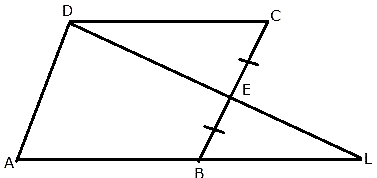
From the given diagram, in which $\text{ABCD}$ is a parallelogram, $\text{ABL}$ is a line segment and $\mathrm{E}$ is mid$-$point of $\mathrm{BC}$.Prove that:$(i) \triangle \mathrm{DCE} \cong \triangle \mathrm{LBE}(ii)\mathrm{AB}=\mathrm{BL}.(iii) \mathrm{AL}=2 \mathrm{DC}$

A metal wire, when bent in the form of an equilateral triangle of largest area, encloses an area of $484 \sqrt{3} \ cm^2$. If the same wire is bent into the form of a circle of largest area, find the area of this circle.
If (a + b + c) = 15 and (ab + bc + ca) = 74, find the value of (a2 +b2 +c2).
The dimensions of a solid metallic cuboid are $72 \ cm \times 30 \ cm \times 75 \ cm$. It is melted and recast into identical solid metal cubes with each edge $6 \ cm$. Find the number of cubes formed.Also, find the cost of polishing the surfaces of all the cubes formed at the rate $Rs. 150$ per $sq. m.$
In a shooting competition a marksman receives $Rs. 50$ if he hits the mark and pays $Rs. 20$ if he misses it. He tried $Rs. 100$ shots and was paid $Rs. 100.$ How many times did he hit the mark?
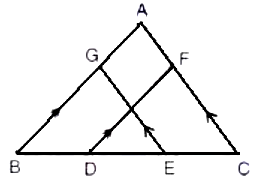
In the given figure: $A B \| F D, A C \| G E$ and $B D=C E$;
prove that: $(i)\mathrm{BG}=\mathrm{DF} \text { (ii) } \mathrm{CF}=\mathrm{EG}$
The radius of the base of a right circular cylinder is tripled and the height is doubled. What is the ratio of volume of the new cylinder to that of the original cylinder?