Question
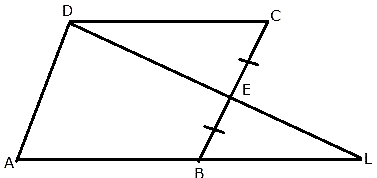
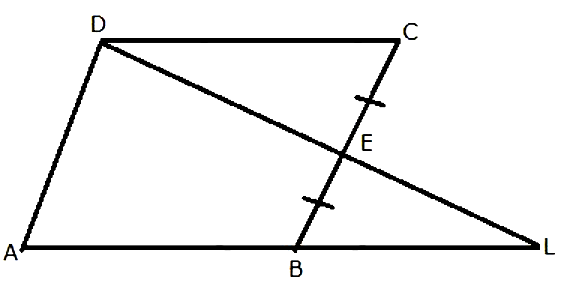
From the given diagram, in which $\text{ABCD}$ is a parallelogram, $\text{ABL}$ is a line segment and $\mathrm{E}$ is mid$-$point of $\mathrm{BC}$.Prove that:$(i) \triangle \mathrm{DCE} \cong \triangle \mathrm{LBE}(ii)\mathrm{AB}=\mathrm{BL}.(iii) \mathrm{AL}=2 \mathrm{DC}$
Answer

Given: $\text{ABCD}$ is a parallelogram in which is the mid$-$point of $B C$. We need to prove that
$(i) \triangle \mathrm{DCE} \cong \triangle \mathrm{LBE}$
$(ii) \mathrm{AB}=\mathrm{BL}$.
$(iii) \mathrm{AL}=2 \mathrm{DC}$

$(i)$ In $\triangle \mathrm{DCE}$ and $\triangle \mathrm{LBE}$
$\angle \mathrm{DCE}=\angle \mathrm{EBL} \ldots[\mathrm{DC} \| \mathrm{AB}$, alternate angels $]$
$\mathrm{CE}=\mathrm{EB} \ldots[\mathrm{E}$ is the midpoint of $\mathrm{BC}]$
$\angle \mathrm{DEC}=\angle \mathrm{LEB} \quad\dots...[$ vertically opposite angels$]$
$\therefore$ By Angel$-$SIde$-$Angel Criterion of congruence, we have,
$\triangle \mathrm{DCE} \cong \triangle \mathrm{LBE}$
The corresponding parts of the congruent triangles are congruent.
$\therefore \mathrm{DC}=\mathrm{LB} \ldots[\text{ c. p. c.t }]\ldots .(1)$
$(ii) \mathrm{DC}=\mathrm{AB} \ldots[$ opposite sides of a parallelogram$]\dots...(2)$
From $(1)$ and $(2), Ab = BL \ldots(3)$
$(iii) \mathrm{Al}=\mathrm{AB}+\mathrm{BL}\ldots(4)$
From $(3)$ and $(4), A l=A B+A B$
$\Rightarrow A L=2 A B$
$\Rightarrow \mathrm{AL}=2 \mathrm{DC}\dots...[$ From $(2) ]$

Need a full question paper?

Generate a complete, print-ready paper with questions like this in minutes — across 16+ boards, with answer keys.

Start Generating Free