Question
Factorize:
$ 28a^2+ 14a^2b^2- 21a^4$

Answer

The greatest common factor of the term
$28 a^2+14 a^2 b^2$ and $21 a^4$ of the expression
$28 a^2+14 a^2 b^2-21 a^4$ is $7 a^2$
Also, we can write $28 a^2=7 a^2 \cdot 4,14 a^2 b^2=7 a^2 \cdot 2 b^2$ and $21 a^4=7 a^2 \cdot 3 a^3$
Therefore, $28 a^2+14 a^2 b^2-21 a^4=7 a^2 \cdot 4+7 a^2 \cdot 2 b^2-7 a^2 \cdot 3 a^3$

Need a full question paper?

Generate a complete, print-ready paper with questions like this in minutes — across 16+ boards, with answer keys.
Start Generating Free

Similar questions

How many wooden cubical blocks of side $25\ cm$ can be cut from a log of wood of size $3\ m$ by $75\ cm$ by $50\ cm,$ assuming that there is no wastage$?$
Rearrange suitably and find the sum in each of the following
(i) $\frac{2}{3}+\frac{9}{2}+\frac{7}{4}+\left(\frac{-6}{3}\right)+\frac{-3}{2}$
(ii) $\frac{-5}{7}+\frac{5}{6}+\frac{1}{7}+3+\left(\frac{-13}{6}\right)$
Twenty-four is divided into two parts such that $7$ times the first part added to $5$ times the second part makes $146.$ Find each part.
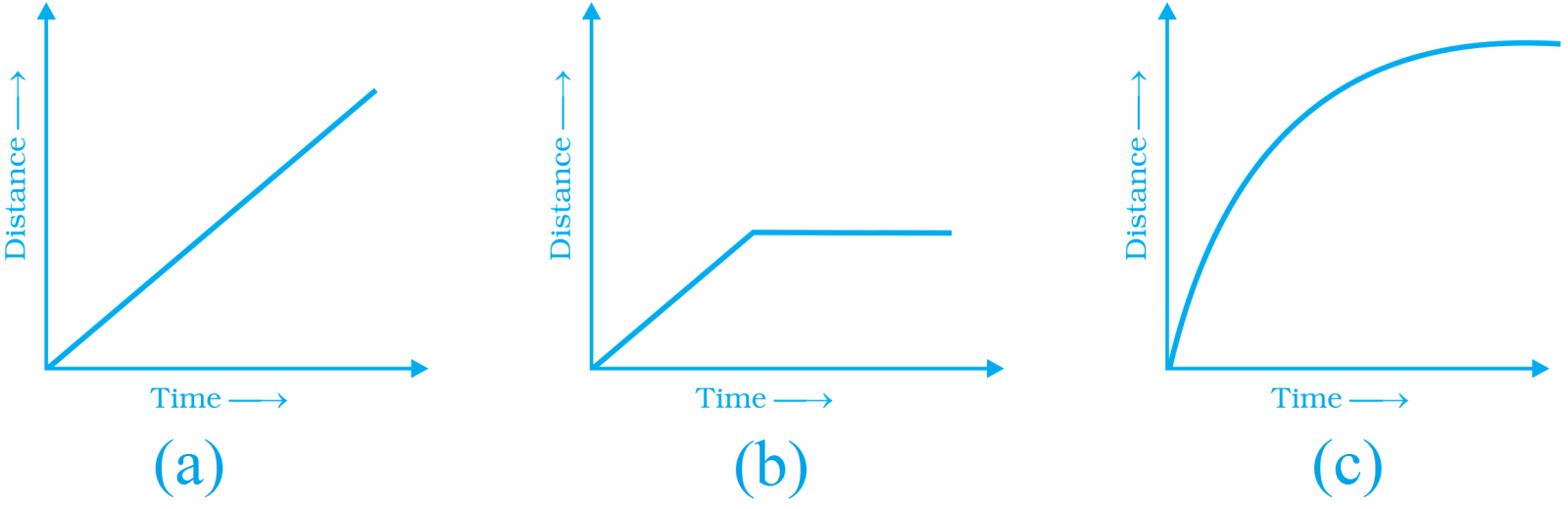
Explain the situations represented by the following distance$-$time graphs.
The difference between the $S.I.$ and $C.I.$ on a certain sum of money for $2$ years at $4\%$ per annum is $Rs. 20.$ Find the sum.
$\frac{2}{5}$ of total number of students of a school come by car while $\frac{1}{4}$ of students come by bus to school. All the other students walk to school of which $\frac{1}{3}$ walk on their own and the rest are escorted by their parents. If $224$ students come to school walking on their own, how many students study in that school?
Find the square root of the following by prime factorization. $529$
Pritam bought a plot of land for $Rs. 640000.$ Its value is increasing by $5\%$ of its previous value after every six months. What will be the value of the plot after $2$ years$?$
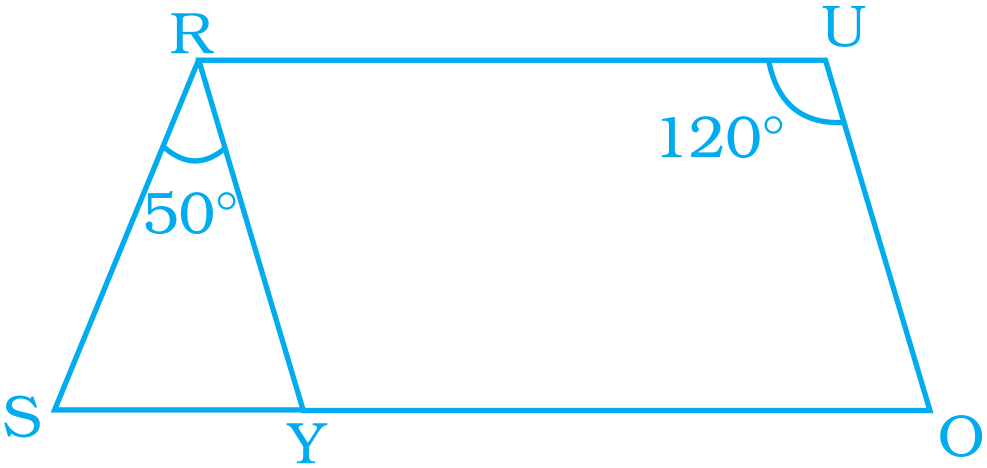
In the given parallelogram $YOUR$, $\angle\text{RUO}=120^\circ\text{and}\ \text{OY}$ is extended to point $S$ such that $\angle\text{SRY}=50^\circ.\text{Find}\angle\text{YSR}.$
Divide $150$ into three parts such that the second number is five-sixths the first and the third number is four-fifths the second.