Question
Prove that a cyclic parallelogram is a rectangle.
Answer

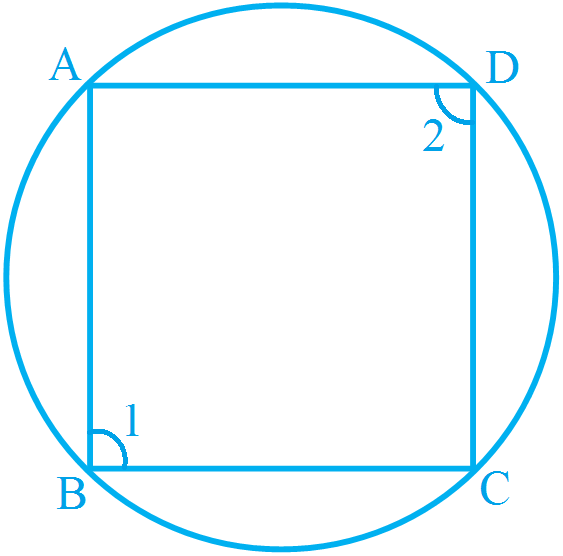
Given,

ABCD is a cyclic parallelogram.

To prove,

ABCD is rectangle.

Proof:

$\angle1+\angle2=180^\circ$ (Opposite angles of a cyclic parallelogram)

also, Opposite angles of a cyclic parallelogram are equal.

Thus,

$\angle1=\angle2$

$\Rightarrow\angle1+\angle1=180^\circ$

$\Rightarrow\angle1=90^\circ$

One of the interior angle of the parallelogram is right angled. Thus, ABCD is a rectangle.

Need a full question paper?

Generate a complete, print-ready paper with questions like this in minutes — across 16+ boards, with answer keys.

Start Generating Free

Similar questions

Given below is a table which shows the yearwise strength of a school. Represent this data by a bar graph.
Year
2012-13
2013-14
2014-15
2015-16
2016-17
Number of students
800
975
1100
1400
1625
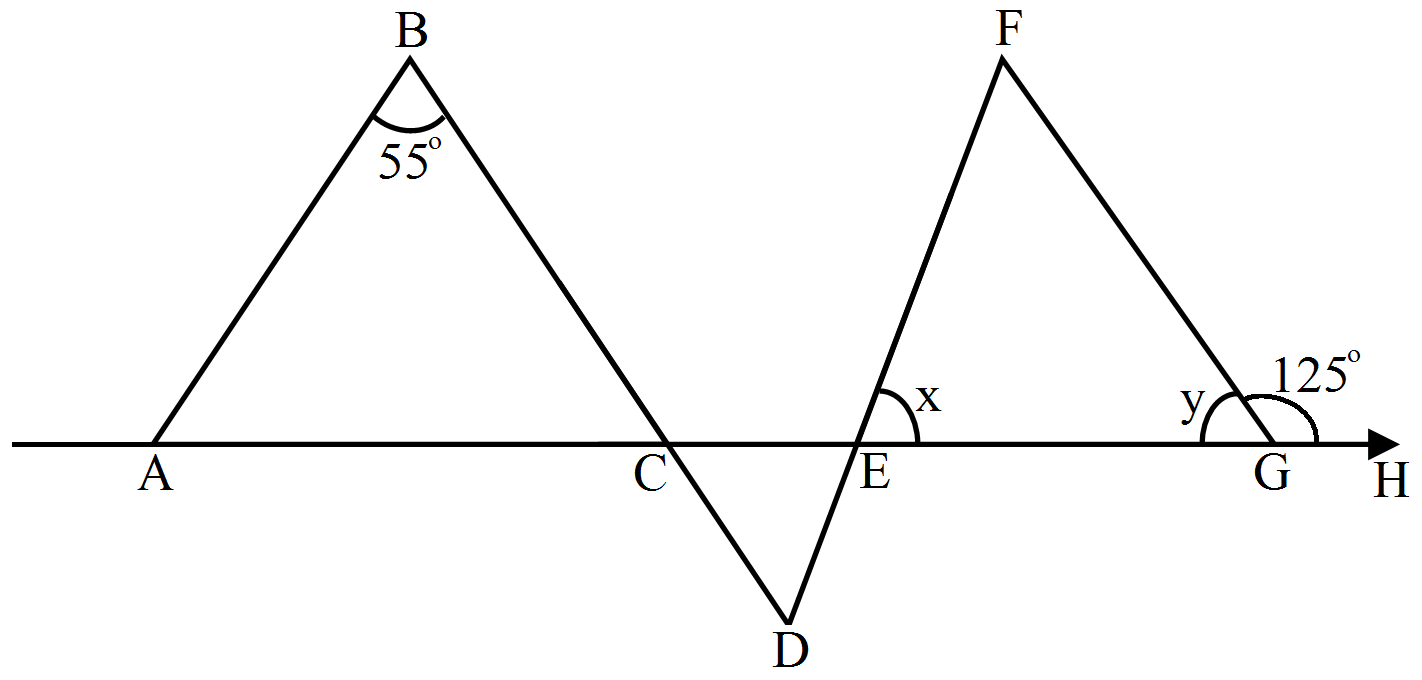
In the given figure, if $\text{AB }||\text{ DE}$ and $\text{BD }||\text{ FG}$ such that $\angle\text{FGH}=125^\circ$ and $\angle\text{B}=55^\circ,$ find x and y.

If $\text{x}^2+\frac{1}{\text{x}^2}=79,$ find the value of $\text{x}+\frac{1}{\text{x}}.$
In $\triangle\text{PQR},$ if $\angle\text{P}-\angle\text{Q}=42^\circ$ and $\angle\text{Q}+\angle\text{R}=21^\circ,$ find $\angle\text{P},\angle\text{Q}$ and $\angle\text{R}.$
Complete the following example using Nityasam.
$\begin{array}{c}(i)(2 a-7 b)^3=(2 a)^3+(-7 b)^3+3(2 a)(-7 b)(\_\_\_\_\_\_) \\ =\_\_\_\_\_\_+\left(-343 b^3\right)+(-42 a b)(2 a-7 b) \\ =8 a^3-\_\_\_\_\_\_\_-84 a^2 b+\_\_\_\_\_\_\end{array}$
$\begin{array}{c}(ii) 95 \times 105=(100+\_\_\_\_\_\_)\left(100-\_\_\_\_\_\_\right) \\ =(100)^2-(\_\_\_\_\_\_)^2 \\ =\_\_\_\_\_\_-\_\_\_\_\_\_\\=9975\end{array}$
The angle between two altitudes of a parallelogram through the vertex of an obtuse angle of the parallelogram is 60°. Find the angles of the parallelogram.
In a quadrilateral ABCD, bisectors of angles A and B intersect at O such that $\angle\text{AOB}=75^\circ,$ then write the value of $\angle\text{C}+\angle\text{D}.$
Prove that the line segment joining the mid-point of the hypotenuse of a right triangle to its opposite vertex is half of the hypotenuse.
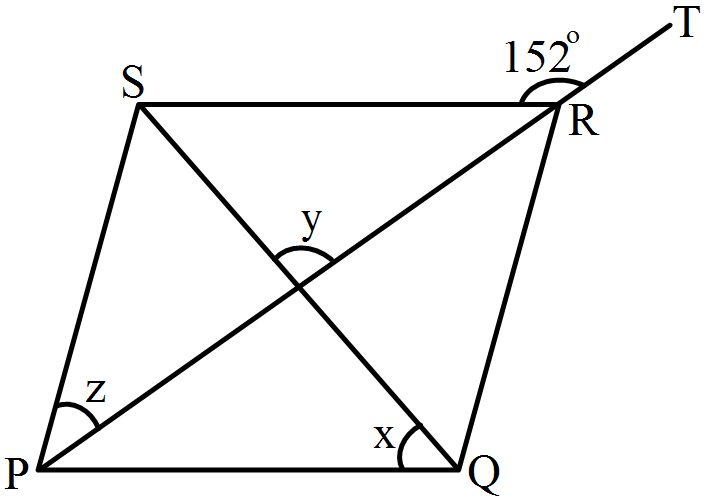
In the given figure, PQRS is a rhombus in which the diagonal PR is produced to T. If $\angle\text{SRT}=152^\circ, $ find x, y and z.

If non-parallel sides of a trapezium are equal, prove that it is cyclic.