- All of the above
Explanation:
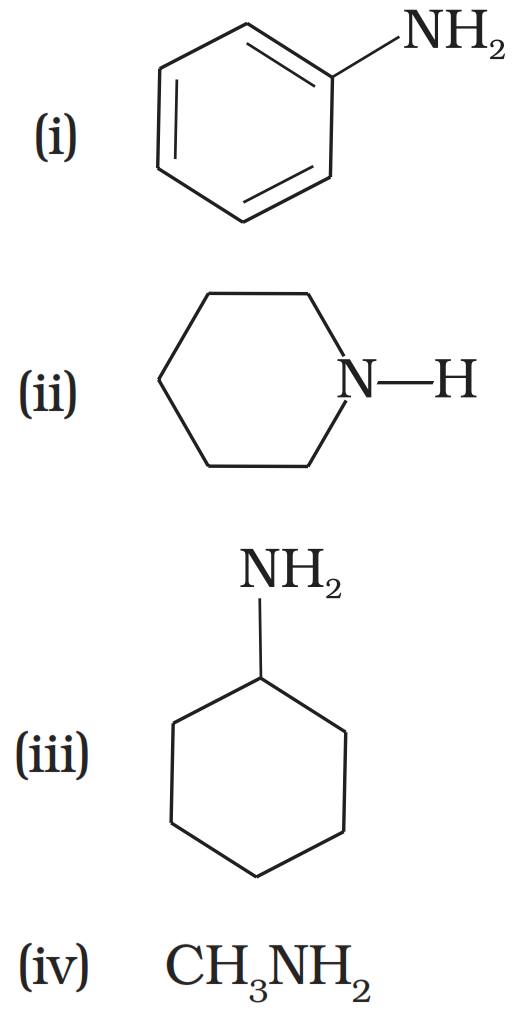
The basicity of amines depend upon its ability to donate the lone pair of electrons on nitrogen.
Order of basicity of amines in aqueous solution is,
NH3 < Primary amines(RNH2) < Tertiary amines(R3N) < Secondary amines(R2NH)
This is due to the combined effect of +I effect of alkyl group, steric hindrance caused by alkyl groups and solvation of amines through H - bonding.
The power to donate lone pair of electrons increases as the number of alkyl groups increase.
Therefore, making R3N most basic, followed by R2NH and RNH2.
But as the number of alkyl groups increase, the steric hindrance caused by them also increases.
Thus, decreasing the electron donating power of amines.
Hence, making RNH2 most basic followed by R2NH and R3N.
Solvation is the formation of protonated amines when they are dissolved in water.
As the number of H - atoms on nitrogen increases the possibility of H - bonding also increases, providing greater stability to the amine.
Thus, primary amine (RNH2) is more stable than secondary amine (R2NH), which is more stable than tertiary amine (R3N).
The combined effect of these three factors give the observed order of basicity of amines in aqueous solution.