Field at the centre of a circular coil of radius $r$, through which a current $I$ flows is
Easy


Download our appand get started for free
Experience the future of education. Simply download our apps or reach out to us for more information. Let's shape the future of learning together!No signup needed.*
Similar Questions
- 1Force on current carrying loop (Radius $= R$ ) in uniform magnetic $(B)$ field which is at an angle $30^{\circ}$ with the normal will beView Solution
- 2A fixed horizontal wire carries a current of $200\, A$. Another wire having a mass per unit length ${10^{ - 2}}\,kg/m$ is placed below the first wire at a distance of $2\, cm$ and parallel to it. How much current must be passed through the second wire if it floats in air without any support? What should be the direction of current in itView Solution
- 3A positively charged $(+ q)$ particle of mass $m$ has kinetic energy $K$ enters vertically downward in a horizontal field of magnetic induction $\overrightarrow B $ . The acceleration of the particle is :-View Solution
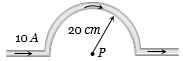
- 4A current of $10\,A$ is passing through a long wire which has semicircular loop of the radius $20\,cm$ as shown in the figure. Magnetic field produced at the centre of the loop isView Solution
- 5A deutron of kinetic energy $50\, keV$ is describing a circular orbit of radius $0.5$ $metre$ in a plane perpendicular to magnetic field $\overrightarrow B $. The kinetic energy of the proton that describes a circular orbit of radius $0.5$ $metre$ in the same plane with the same $\overrightarrow B $ is........$keV$View Solution
- 6The magnetic field is uniform for $y>0$ and points into the plane. The magnetic field is uniform and points out of the plane for $y<0$. A proton denoted by filled circle leaves $y=0$ in the $-y$-direction with some speed as shown below.Which of the following best denotes the trajectory of the proton?View Solution

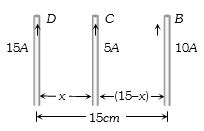
- 7Three long, straight and parallel wires carrying currents are arranged as shown in the figure. The wire $C$ which carries a current of $5.0\, amp$ is so placed that it experiences no force. The distance of wire $C$ from wire $D$ is thenView Solution
- 8Under the influence of a uniform magnetic field a charged particle is moving in a circle of radius $R$ with constant speed $v$. The time period of the motionView Solution
- 9Equal current $i$ is flowing in three infinitely long wires along positive $x, y$ and $z$ directions. The magnitude field at a point $(0, 0, -a)$ would be:View Solution
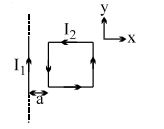
- 10A square loop of side $\lambda $ is placed in the neighbourhood of an infinitely long straight wire carrying a current $I_1.$ The loop carries a current $I_2$ as shown in figureView Solution