A deutron of kinetic energy $50\, keV$ is describing a circular orbit of radius $0.5$ $metre$ in a plane perpendicular to magnetic field $\overrightarrow B $. The kinetic energy of the proton that describes a circular orbit of radius $0.5$ $metre$ in the same plane with the same $\overrightarrow B $ is........$keV$
AIPMT 1991, Medium


Download our appand get started for free
Experience the future of education. Simply download our apps or reach out to us for more information. Let's shape the future of learning together!No signup needed.*
Similar Questions
- 1A current of $1.5\, {A}$ is flowing through a triangle, of side $9\, {cm}$ each. The magnetic field at the centroid of the triangle isView Solution
(Assume that the current is flowing in the clockwise direction.)
- 2An electron of charge $e$ moves in a circular orbitof radius $r$ around the nucleus at a frequency $v$. The magnetic moment associated with the orbital motion of the electron isView Solution
- 3An electron having charge $1.6 \times {10^{ - 19}}\,C$ and mass $9 \times {10^{ - 31}}\,kg$ is moving with $4 \times {10^6}\,m{s^{ - 1}}$ speed in a magnetic field $2 \times {10^{ - 1}}\,tesla$ in a circular orbit. The force acting on electron and the radius of the circular orbit will beView Solution
- 4A closely packed coil having $1000$ turns has an average radius of $62.8\,cm$. If current carried by the wire of the coil is $1\,A$, the value of magnetic field produced at the centre of the coil will be (permeability of free space $=4 \pi \times 10^{-7}\,H / m$ ) nearlyView Solution
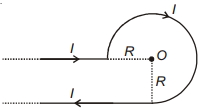
- 5The length of a steel wire is $L$ and its magnetic moment is $M$. On bending it into the shape of a semicircle, its’ magnetic moment will beView Solution
- 6A long straight wire along the $z$-axis carries a current $I$ in the negative $z$ direction. The magnetic vector field $\mathop B\limits^ \to $ at a point having coordinates $(x, y)$ in the $z = 0$ plane isView Solution
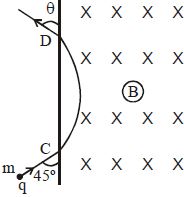
- 7A particle of mass $m = 1.67 \times 10^{-27}\, kg$ and charge $q = 1.6 \times 10^{-19} \, C$ enters a region of uniform magnetic field of strength $1$ $tesla$ along the direction shown in the figure. The speed of the particle is $10^7\, m/s.$ The magnetic field is directed along the inward normal to the plane of the paper. The particle enters the field at $C$ and leaves at $D.$ Then the angle $\theta$ must be :-.........$^o$View Solution
- 8If number of turns, area and current through a coil is given by $N, A$ and $I$ respectively then its magnetic moment will beView Solution
- 9A galvanmeter has a coil of resistance $200 \Omega$ with a full scale deflection at $20 \mu \mathrm{A}$. The value of resistance to be added to use it as an ammeter of range $(0-20) \mathrm{mA}$ is:View Solution
- 10Magnetic field at the centre $O$ due to the given structure isView Solution