MCQ
Field inside a solenoid is
  • A
    Directly proportional to its length
  • Directly proportional to current
  • C
    Inversely proportional to total number of turns
  • D
    Inversely proportional to current

Answer

Correct option: B.
Directly proportional to current
b
(b) $  B = {\mu _o}ni$

Need a full question paper?

Generate a complete, print-ready paper with questions like this in minutes — across 16+ boards, with answer keys.
Start Generating Free

Similar questions

An $A C$ voltage source of variable angular frequency $\omega$ and fixed amplitude $V_0$ is connected in series with a capacitance $\mathrm{C}$ and an electric bulb of resistance $\mathrm{R}$ (inductance zero). When $\omega$ is increased
Time period of oscillation of a magnetic needle is
A metallic rod of mass per unit length $0.5\; kg\; m^{-1}$ is lying horizontally on a smooth inclined plane which makes an angle of $30^o$ with the horizontal. The rod is not allowed to slide down by flowing a current through it when a magnetic field of induction $0.25\; T$ is acting on it in the vertical direction. The current flowing in the rod to keep it stationary is.....$A$
Cathode rays are produced when the pressure is of the order of
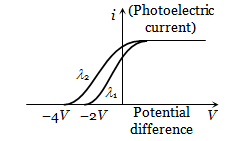
The maximum value of stopping potential in the following diagram is
With increase in frequency of an $A.C$. supply, the inductive reactance.
Two resistances are joined in parallel whose resultant is $\frac {6}{8}$ ohm. One of the resistance wire is broken and the effective resistance becomes 2Ω. Then the resistance in ohm of the wire that got broken was
In an experiment on photoelectric effect, the wavelength of the incident radiation is $\lambda $ . The wavelength of the incident radiation is reduced to $\frac {1}{3}$ of the initial value and the maximum kinetic energy of the photoelectron is observed to be $n$ times the previous value. The threshold wavelength for the metal plate is
A ray of light passes through an equilateral glass prism in such a manner that the angle of incidence is equal to the angle of emergence and each of these angles is equal to 3/4 of the angle of the prism. The angle of deviation is
An electron beam in an $X-$ ray tube is accelerated through a potential difference of $50000$ volts. These are then made to fall on a tungsten target. The shortest wavelength of the $X-$ ray emitted by the tube is