Fig. shows rough sketch of meter bridge. $(G)$ deflects zero at length $\ell \, cm$. Now $R_1$ and $R_2$ are interchanged then balancing length increases by $25\, cm$. Find $R_1/R_2$
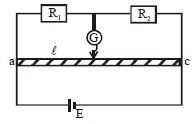
Medium


Download our appand get started for free
Experience the future of education. Simply download our apps or reach out to us for more information. Let's shape the future of learning together!No signup needed.*
Similar Questions
- 1How much energy in kilowatt hour is consumed in operating ten $50\, watt$ bulbs for $10$ hours per day in a month ($30$ days).View Solution
- 2A $60\, watt$ bulb carries a current of $0.5\, amp$. The total charge passing through it in $1$ hour is ............ $coulomb$View Solution
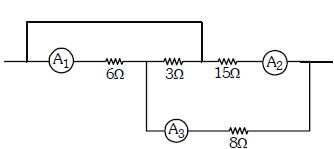
- 3A part of circuit is shown in figure. All the ammeters are ideal. If reading of ammeter $A_1$ is $1.0\ A$ , thenView Solution
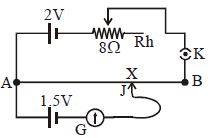
- 4In a potentiometer experiment shown here, for the position $X$ of the jockey $J,$ there occurs a null deflection in the galvanometer. Then the potential difference between points $A$ and $X$ is ................ $V$View Solution
- 5If the resistivity of a potentiometer wire be $\rho $ and area of cross-section be $A$, then what will be potential gradient along the wireView Solution
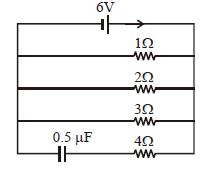
- 6View SolutionIn the given circuit diagram the current through the battery and the charge on the capacitor respectively in steady state are
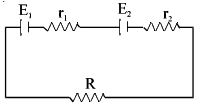
- 7Under what condition current passing through the resistance $R$ can be increased by short circuiting the battery of emf $E_2$. The internal resistances of the two batteries are $r_1$ and $r_2$ respectively.View Solution
- 8In a potentiometer experiment the balancing with a cell is at length $240\, cm$. On shunting the cell with a resistance of $2$ $\Omega$, the balancing length becomes $120\, cm$. The internal resistance of the cell is ................. $\Omega $View Solution
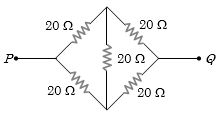
- 9The equivalent resistance between $P$ and $Q$ in the given figure, is ............... $\Omega$View Solution
- 10View SolutionOn increasing the temperature of a conductor, its resistance increases because