Question
✓
Answer
In simple harmonic motion,
acceleration $\quad a=-\omega^2 x\quad\quad...(1)$
$\quad$$\quad$(where $\omega$ is constant)
and velocity $\quad v=\frac{d x}{d t}\quad\quad...(2)$
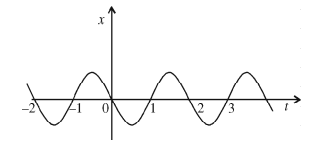
(i) When $t=0.3$ $sec$ and $x$ is negative.
The slope of the $x-t$ graph is negative from which $v$ is also negative.
From equation (1) the acceleration a is positive.
(ii) When $t =1.2$ $sec$ then $x$ is positive.
The slope of the $x-t$ graph is positive from which $v$ is also positive.
From equation (1) the acceleration a is negative.
(iii) when $t =-1.2$ $sec$ them $x$ is negative.
The slope of the $x-t$ graph is positive so that $v$ is positive.
From equation (1) the acceleration $a$ is positive.
acceleration $\quad a=-\omega^2 x\quad\quad...(1)$
$\quad$$\quad$(where $\omega$ is constant)
and velocity $\quad v=\frac{d x}{d t}\quad\quad...(2)$
(i) When $t=0.3$ $sec$ and $x$ is negative.
The slope of the $x-t$ graph is negative from which $v$ is also negative.
From equation (1) the acceleration a is positive.
(ii) When $t =1.2$ $sec$ then $x$ is positive.
The slope of the $x-t$ graph is positive from which $v$ is also positive.
From equation (1) the acceleration a is negative.
(iii) when $t =-1.2$ $sec$ them $x$ is negative.
The slope of the $x-t$ graph is positive so that $v$ is positive.
From equation (1) the acceleration $a$ is positive.
Need a full question paper?
Generate a complete, print-ready paper with questions like this in minutes — across 16+ boards, with answer keys.
Explore more
Similar questions
Glycerine flows steadily through a horizontal tube of length 1.5 m and radius 1.0 cm . If the amount of glycerine collected per second at one end is $4.0 \times 10^{-3} kgs ^{-1}$, what is the pressure difference between the two ends of the tube? (Density of glycerine $=1.3 \times 10^3 kgm ^{-3}$ and viscosity of glycerine $=0.83 Pa$ s). [You may also like to check if the assumption of laminar flow in the tube is correct].
→A man walking briskly in rain with speed v must slant his umbrella forward making an angle $\theta$ with the vertical. A student derives the following relation between $\theta$ and v: $\tan \theta = \text{v}$ and checks that the relation has a correct limit: as $\text{v}\rightarrow 0,\ \theta \rightarrow0,$ as expected. (We are assuming there is no strong wind and that the rain falls vertically for a stationary man). Do you think this relation can be correct? If not, guess the correct relation.
→Three moles of a diatomic gas is mixed with two moles of monoatomic gas. What will be the molecular specific heat of the mixture at constant volume? [given, R = 8.31J-mol-1K-1]
A soap bubble of radius 4 cm and surface tension 30 dyne $cm ^{-1}$ is blown at the end of a tube of length 10 cm and internal radius 0.20 cm . If the viscosity of air is $1.89 \times 10^{-4}$ poise, find the time taken by the bubble to be reduced to a radius of 2 cm .
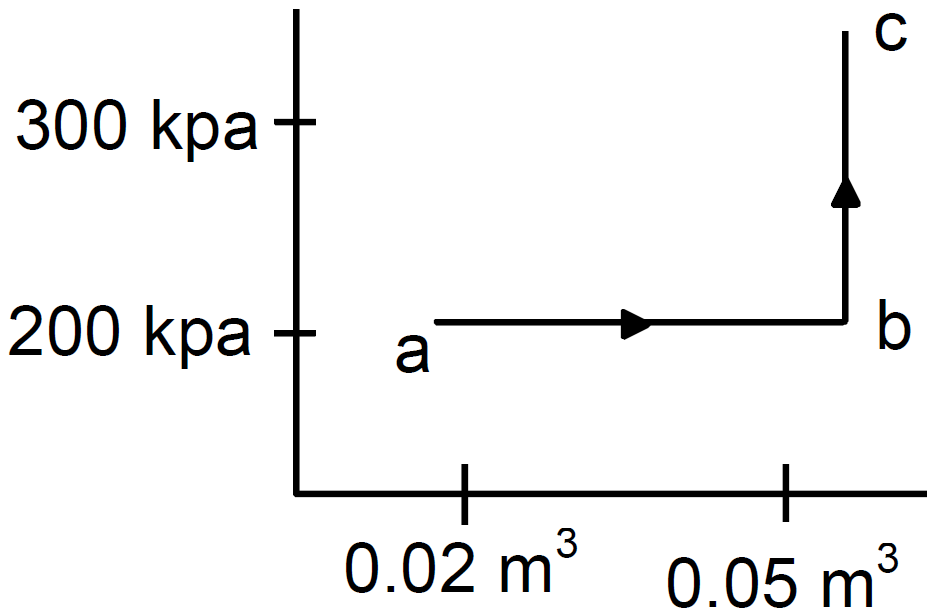
→A substance is taken through the process abc as shown in figure. If the internal energy of the substance increases by 5000J and a heat of 2625cal is given to the system, calculate the value of J.
Given below are some examples of wave motion. State in each case if the motion is transverse, longitudinal or a combination of both.
- Motion of a kink in a long coil spring produced by displacing one end of the spring sideways.
- Wave produced in a cylinder containing water by moving its piston back and forth.
- Wave produced by a motorboat sailing in water.
- Ultrasonic waves in air produced by a vibrating crystal.
When an object cools down, heat is withdrawn from it. Does the entropy of the object decrease in this process? If yes, is it a violation of the second law of thermodynamics stated in terms of increase in entropy?
A mass m displaces in a straight line, guided by a machine delivering constant power. Prove that the displacement (x) is proportional to $\text{t}^\frac{3}{2}$
→A uniform U-tube has a liquid of density $\rho$ and a length L. The cross-sectional area is A. If it is made to oscillate, show that it will be S.H.M. and find its frequency.
→An adult weighing 600N raises the centre of gravity of his body by 0.25m while taking each step of 1m length in jogging. If he jogs for 6km, calculate the energy utilised by him in jogging assuming that there is no energy loss due to friction of ground and air. Assuming that the body of the adult is capable of converting 10% of energy intake in the form of food, calculate the energy equivalents of food that would be required to compensate energy utilised for jogging.