A particle of mass $m$ and charge $q$, accelerated by a potential difference $V$ enters a region of a uniform transverse magnetic field $B$. If $d$ is the thickness of the region of $B$, the angle $\theta$ through which the particle deviates from the initial direction on leaving the region is given by
Diffcult
Download our app for free and get started
Refer to Fig. Let $v$ be the velocity of the particle.Its kinetic energy is
$\frac{1}{2} \mathrm{mv}^{2}=\mathrm{qV}$ or $\mathrm{v}=\left(\frac{2 \mathrm{q} \mathrm{V}}{\mathrm{m}}\right)^{1 / 2}.........(1)$
The particle follows a circular path from $A$ to $\mathrm{B}$ of radius $\mathrm{r}$ which is given by
$\frac{\mathrm{mv}^{2}}{\mathrm{r}}=\mathrm{q} \mathrm{VB}$ or $\mathrm{r}=\frac{\mathrm{mv}}{\mathrm{qB}}.........(2)$
Using $( 1)$ and $(2),$ we have
$\mathrm{r}=\frac{\mathrm{m}}{\mathrm{qB}}\left(\frac{2 \mathrm{qV}}{\mathrm{m}}\right)^{1 / 2}=\frac{1}{\mathrm{B}}\left(\frac{2 \mathrm{mV}}{\mathrm{q}}\right)^{1 / 2}$
In triangle $\mathrm{BCD}, \sin \theta=\frac{\mathrm{BD}}{\mathrm{BC}}=\frac{\mathrm{d}}{\mathrm{r}} \cdot$ Therefore
$\sin \theta=\operatorname{Bd}\left(\frac{\mathrm{q}}{2 \mathrm{mV}}\right)^{1 / 2},$ which is choice $(a)$.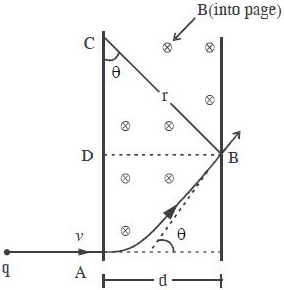

Download our appand get started for free
Experience the future of education. Simply download our apps or reach out to us for more information. Let's shape the future of learning together!No signup needed.*
Similar Questions
- 1An electron is travelling along the $x$-direction. It encounters a magnetic field in the $y$-direction. Its subsequent motion will beView Solution
- 2Two charged particles traverse identical helical paths in a completely opposite sense in a uniform magnetic field $B$ = $B_0\hat{k}$View Solution
- 3A moving coil galvanometer has $100$ turns and each turn has an area of $2.0 \mathrm{~cm}^2$. The magnetic field produced by the magnet is $0.01 \mathrm{~T}$ and the deflection in the coil is $0.05$ radian when a current of $10 \mathrm{~mA}$ is passed through it. The torsional constant of the suspension wire is $\mathrm{x} \times 10^{-5} \mathrm{~N}-\mathrm{m} / \mathrm{rad}$. The value of $\mathrm{x}$ is____.View Solution
- 4A circular coil of $30$ turns and radius $8.0\, cm$ carrying a current of $6.0\, A$ is suspended vertically in a uniform horizontal magnetic field of magnitude $1.0\, T$. The field lines make an angle of $60^o$ with the normal of the coil. Calculate the magnitude of the counter torque that must be applied to prevent the coil from turning.....$Nm$View Solution
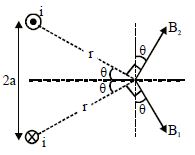
- 5Two parallel wires situated at a distance $2a$ are carrying equal currents $‘i’$ in opposite direction as shown in figure. The value of magnetic filed at a point $P$ situated at equal distances from both the wires will beView Solution
- 6A current of $1.5\, {A}$ is flowing through a triangle, of side $9\, {cm}$ each. The magnetic field at the centroid of the triangle isView Solution
(Assume that the current is flowing in the clockwise direction.)
- 7Two straight long conductors $AOB$ and $COD$ are perpendicular to each other and carry currents ${i_1}$ and ${i_2}$. The magnitude of the magnetic induction at a point $ P$ at a distance a from the point $O$ in a direction perpendicular to the plane $ACBD$ isView Solution
- 8Two coaxial solenoids of different radii carry current $I$ in the same direction. Let $\;{\overrightarrow {\;F} _1}$ be the magnetic force on the inner solenoid due to the outer one and $\;{\overrightarrow {\;F} _2}$ be the magnetic force on the outer solenoid due to the inner one. ThenView Solution
- 9A coil is placed in $y-z$ plane making an angle of $30^{\circ}$ with $x$ -axis. The current through coil is $I,$ and number of turns are $N$. If a magnetic field of strength $'B'$ is applied in positive $x-$direction, then find the torque experienced by the coil (Radius of coil is $R$) (in $N \cdot m$)View Solution
$\left(N=100, I=1 A, R=2\, m, B=\frac{1}{\pi} T\right)$
- 10View SolutionIf the radius of a coil is halved and the number of turns doubled, then the magnetic field at the centre of the coil, for the same current will