Question
Figure shows a conducting loop being pulled out of a magnetic field with a speed u. Which of the four plots shown in figure may represent the power delivered by the pulling agent as a function of the speed u?
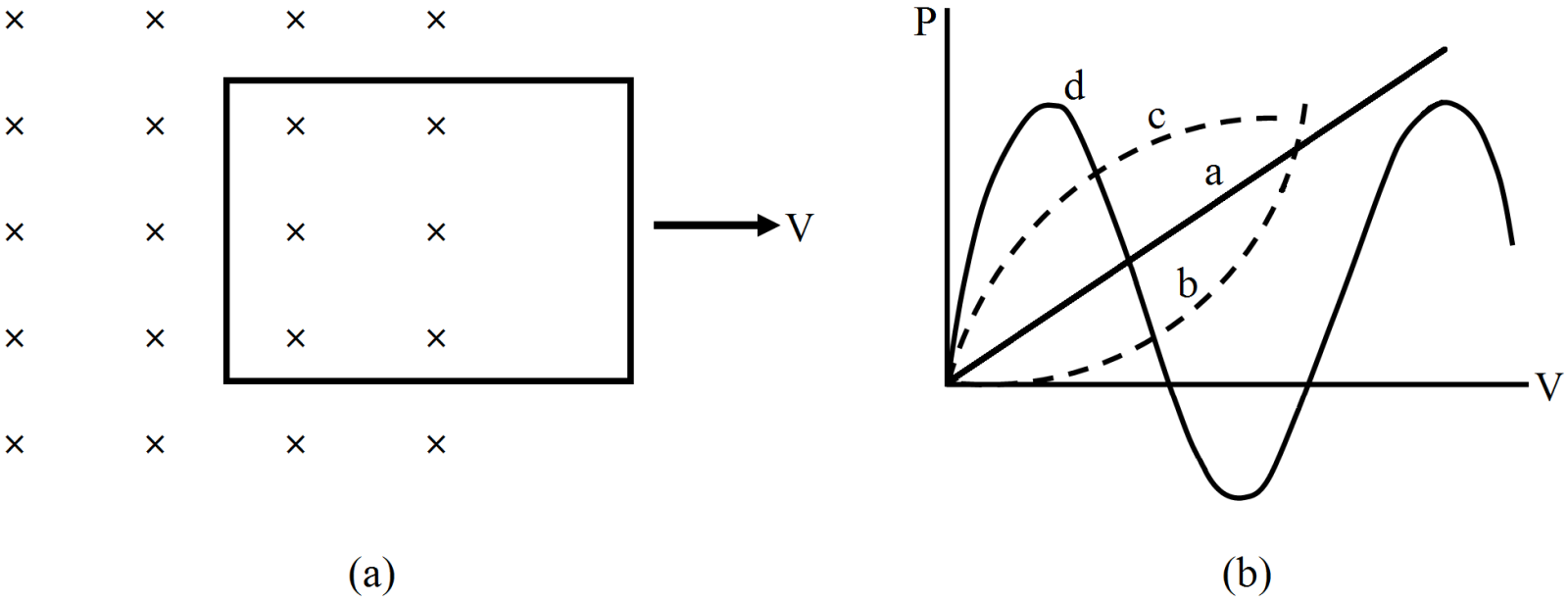
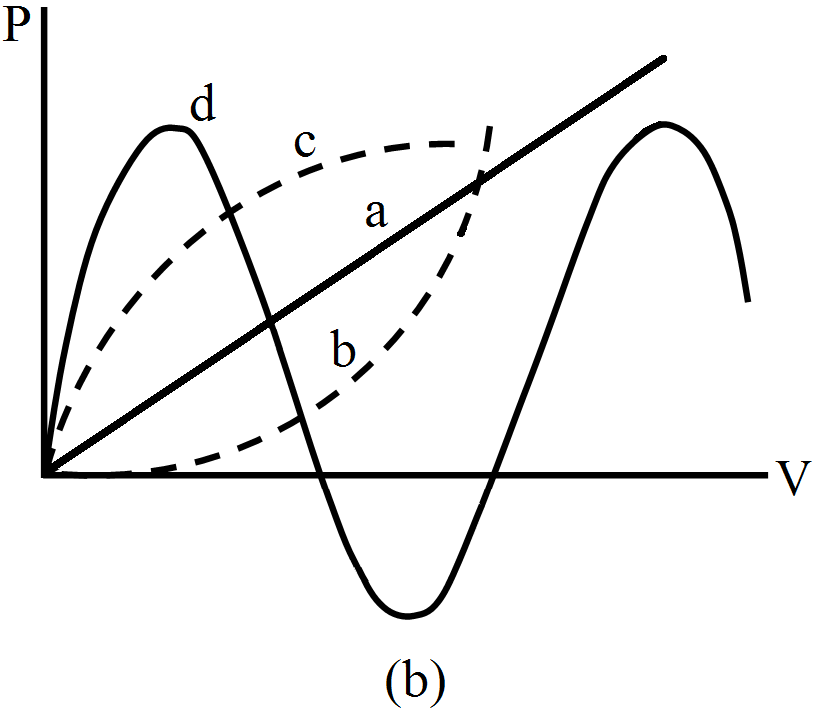
Explanation:
$\in=\text{Bvl}$
Power $=\frac{\text{v}^2}{\text{R}}=\frac{\in^2}{\text{R}}=\frac{\text{B}^2\text{v}^2\text{l}^2}{\text{R}}$
P → Power
v → velocity
B → Magnetic field
Here, $\text{P}\times\text{v}^2$
Generate a complete, print-ready paper with questions like this in minutes — across 16+ boards, with answer keys.
Four charges +Q, -Q, +Q, -Q are placed at the corners of a square taken in order. At the centre of the square
|
(a) E = 0, V = 0 |
(b) E = 0, V ≠ 0 |
(c) E ≠ 0, V = 0 |
(d) E = 0, V ≠ 0 |
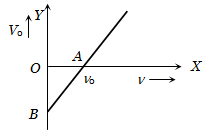
In an experiment on photoelectric effect the frequency f of the incident light is plotted against the stopping potential  . The work function of the photoelectric surface is given by (e is electronic charge)
|
(a) OB × e in eV |
(b) OB in volt |
|
(c) OA in eV |
(d) The slope of the line AB |
The magnetic potential at a point on the axial line of a bar magnet of dipole moment M is V. What is the magnetic potential due to a bar magnet of dipole moment  at the same point
| (a) 4V | (b) 2V |
(c) 
|
(d) 
|
The energy of a photon of light of wavelength 450 nm is
|
(a) 4.4 |
(b) 2.5 |
(c) 1.25 |
(d) 2.5 |
According to modern astronomers into how many constellations, the whole sky is divided
|
(a) 1011 |
(b) 88 |
(c) 880 |
(d) 5000 |

