MCQ
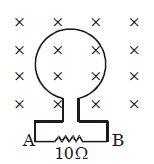
Figure shows a conducting loop placed in magnetic field. The flux through the loop changes due to change in magnetic field according to the equation $\phi  = 5t - 10{t^2}$. What is direction and magnitude of induced current at $t = 0.25\, s$ ?
  • A
    $0.5\,A,\, A\to B$
  • B
    $0.5\,A,\, B\to A$
  • C
    $1.5\,A,\, A\to B$
  • Zero

Answer

Correct option: D.
Zero
d
$\mathrm{Emf}=\frac{-\mathrm{d} \phi}{\mathrm{dt}}=-[5-20 \mathrm{t}]=-\left[5-20 \times \frac{1}{4}\right]=0$

Induced current $=0$

Need a full question paper?

Generate a complete, print-ready paper with questions like this in minutes — across 16+ boards, with answer keys.

Start Generating Free

Similar questions

A vibration magnetometer consists of two identical bar magnets placed one over the other such that they are perpendicular and bisect each other. The time period of oscillation in a horizontal magnetic field is $2^{5 / 4}$ seconds. One of the magnets is removed and if the other magnet oscillates in the same field, then the time period in seconds is
In an amplitude modulated wave for audio frequency of $500 \,cycle/second,$ the appropriate carrier frequency will be........$cycles/sec$
When a metal surface is illuminated by light of wavelengths $400\; nm$ and $250\; nm$, the maximum velocities of the photoelectrons ejected are $v$ and $2v$ respectively. The work function of the metal is $(h =$ Planck’s constant, $c =$ velocity of light in air)
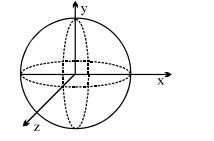
Three rings, each having equal radius $R,$ are placed mutually perpendicular to each other and each having its centre at the origin of co-ordinate system. If current $I$ is flowing thriugh each ring then the magnitude of the magnetic field at the common centre is
A particle of mass $m$ and charge $q$ moves with a constant velocity $v$ along the positive $x$ direction. It enters a region containing a uniform magnetic field $B$ directed along the negative $z$ direction, extending from $x = a$ to $x = b$. The minimum value of $v$ required so that the particle can just enter the region $x > b$ is
An atomic nucleus $_{90}T{h^{232}}$ emits several $\alpha$ and $\beta$ radiations and finally reduces to $_{82}P{b^{208}}$. It must have emitted
The $X-Y$ plane be taken as the boundary between two transparent media $M _{1}$ and $M _{2} . M _{1}$ in $Z \geq 0$ has a refractive index of $\sqrt{2}$ and $M _{2}$ with $Z <0$ has a refractive index of $\sqrt{3}$. A ray of light travelling in $M_{1}$ along the direction given by the vector $\overrightarrow{ A }=4 \sqrt{3 i }-3 \sqrt{3 \hat{j}}-5 \hat{ k }$, is incident on the plane of separation. The value of difference between the angle of incident in $M _{1}$ and the angle of refraction in $M _{2}$ will be $....$ degree.
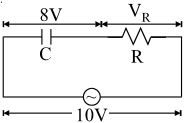
In a series $CR$ circuit shown in figure, the applied voltage is $10\, V$ and the voltage across capacitor is found to be $8V$. Then the voltage across $R$, and the phase difference between current and the applied voltage will respectively be
Huygen’s principle of secondary wavelets may be used to
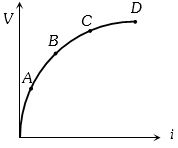
Variation of current passing through a conductor as the voltage applied across its ends as varied is shown in the adjoining diagram. If the resistance $(R)$ is determined at the points $A$, $B$, $C$ and $D$, we will find that