Question
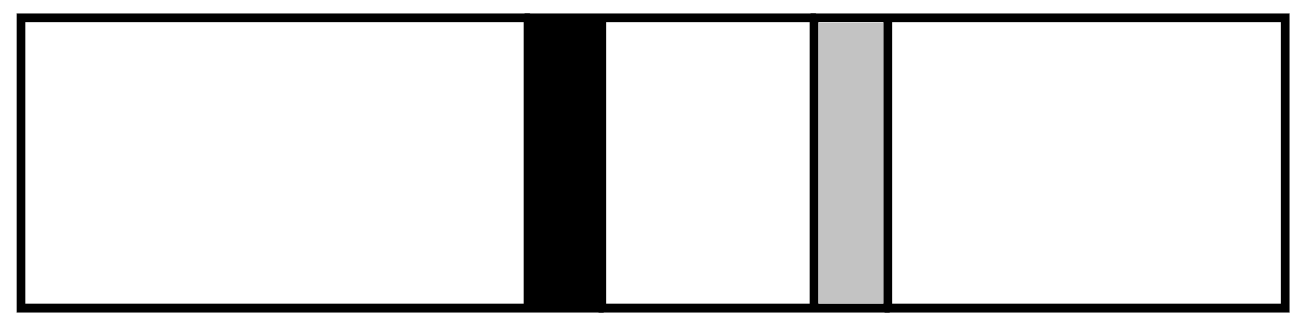
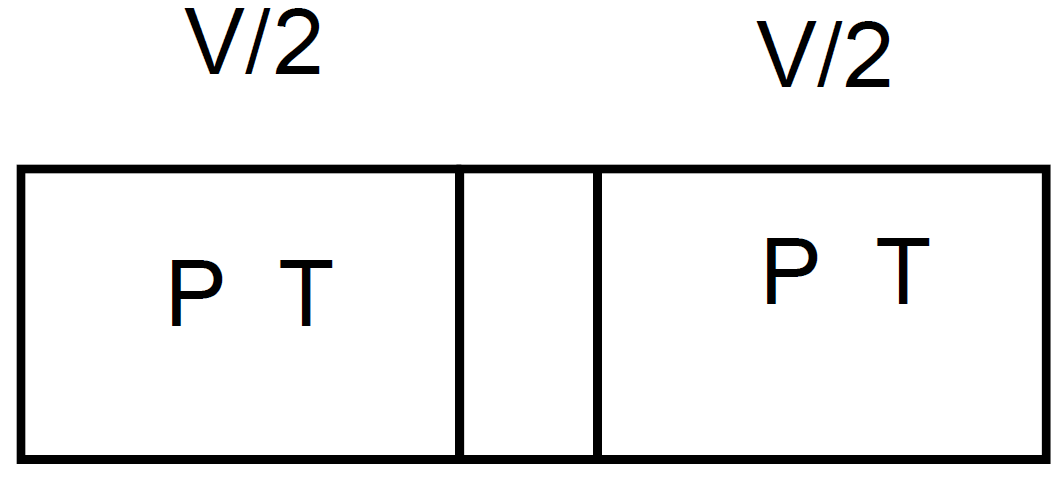
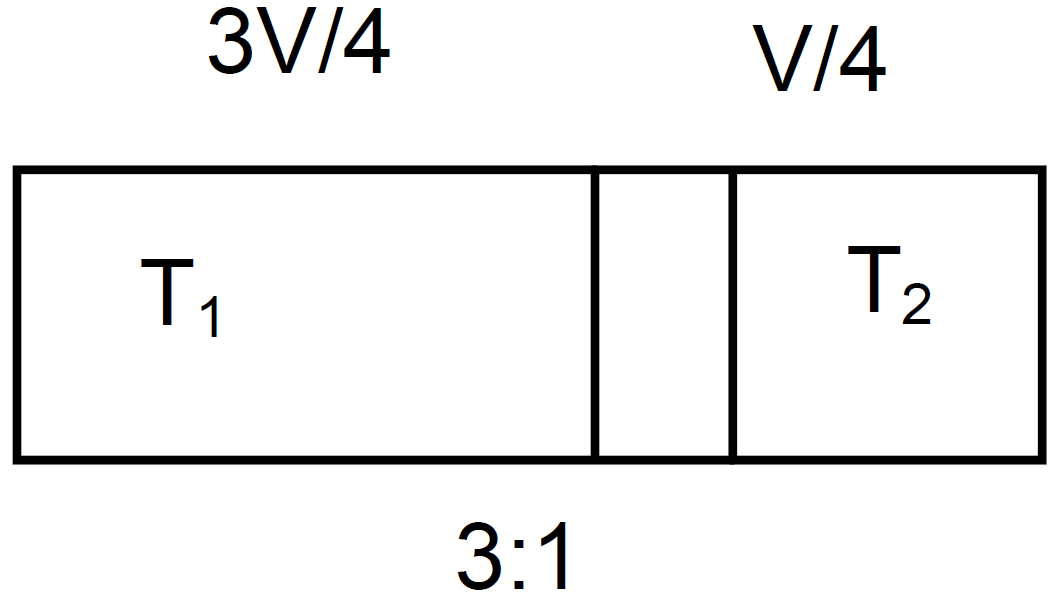
Figure shows a cylindrical tube with adiabatic walls and fitted with an adiabatic separator. The separator can be slid into the tube by an external mechanism. An ideal gas $(\gamma=1.5)$ is injected in the two sides at equal pressures and temperatures. The separator remains in equilibrium at the middle. It is now slid to a position where it divides the tube in the ratio 1 : 3. Find the ratio of the temperatures in the two parts of the vessel.
Answer


Given,
$\gamma=1.5$
We know fro adiabatic process $\text{TV}^{\gamma-1}=\text{Const}.$
So, $\text{T}_1\text{V}_1^{\gamma-1}=\text{T}_2\text{V}_2^{\gamma-1}\ \dots(1)$
As, it is an adiabatic process and all the other conditions are same. Hence the above equation can be applied.
So, $\text{T}_1\times\Big(\frac{3\text{V}}{4}\Big)^{1.5-1}=\text{T}_2\times\Big(\frac{\text{V}}{4}\Big)^{1.5-1}$
$\Rightarrow\text{T}_1\times\Big(\frac{3\text{V}}{4}\Big)^{0.5}=\text{T}_2\times\Big(\frac{\text{V}}{4}\Big)^{0.5}$
$\Rightarrow\frac{\text{T}_1}{\text{T}_2}=\Big(\frac{\text{V}}{4}\Big)^{0.5}\times\Big(\frac{4}{3\text{V}}\Big)^{0.5}=\frac{1}{\sqrt3}$
So, $\text{T}_1:\text{T}_2=1:\sqrt3$

Need a full question paper?

Generate a complete, print-ready paper with questions like this in minutes — across 16+ boards, with answer keys.

Start Generating Free

Similar questions

A stone of mass m is tied to an elastic string of negligble mass and spring constant k. The unstretched length of the string is L and has negligible mass. The other end of the string is fixed to a nail at a point P. Initially the stone is at the same level as the point P. The stone is dropped vertically from point P.
  1. Find the distance y from the top when the mass comes to rest for an instant, for the first time.
  2. What is the maximum velocity attained by the stone in this drop?
  3. What shall be the nature of the motion after the stone has reached its lowest point?
The motion of a particle executing simple harmonic motion is described by the displacement function, $x ( t )= A$ $\cos \left(\omega_t+\omega\right)$.
If the initial $(t=0)$ position of the particle is 1 cm and its initial velocity is $\omega cm / s$, what are its amplitude and initial phase angle? The angular frequency of the particle is $\pi s ^{-1}$. If instead of the cosine function, we choose the sine function to describe the $SHM : x = B \sin (\omega t+a)$, what are the amplitude and initial phase of the particle with the above initial conditions.
A block of mass M is kept on a rough horizontal surface. The coefficient of static friction between the block and the surface is $\mu.$ The block is to be pulled by applying a force to it. What minimum force is needed to slide the block? In which direction should this force act?
A ball is dropped from a height of $5m$ onto a sandy floor and penetrates the sand up to $10cm$ before coming to rest. Find the retardation of the ball in sand assuming it to be uniform.
Differentiate the following:
  1. Wave velocity and particle velocity.
  2. Harmonics and overtones.
Add vectors $\overrightarrow{\text{A}},\overrightarrow{\text{B}}$ and $\overrightarrow{\text{C}}$ each having magnitude of 100 unit and inclined to the X-axis at angles 45°, 135° and 315° respectively.
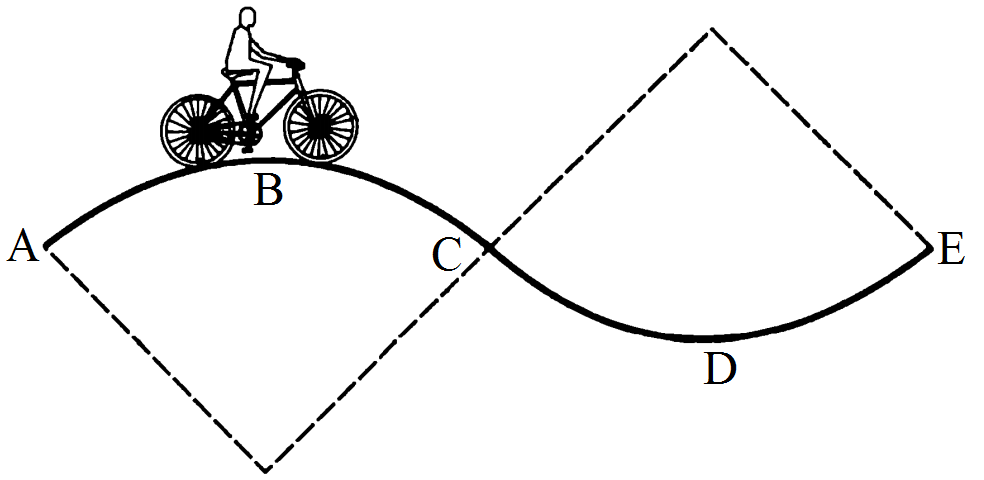
A track consists of two circular parts ABC and CDE of equal radius 100m and joined smoothly as shown in figure. Each part subtends a right angle at its centre. A cycle weighing 100 kg together with the rider travels at a constant speed of 18km/h on the track.
  1. Find the normal contact force by the road on the cycle when it is at B and at D.
  2. Find the force of friction exerted by the track on the tyres when the cycle is at B, C and D.
  3. Find the normal force between the road and the cycle just before and just after the cycle crosses C.
  4. What should be the minimum friction coefficient between the road and the tyre, which will ensure that the cyclist can move with constant speed? Take g= 10m/s$^2$.
Establish the following vector inequalities:
i. $|\vec{a}+\vec{b}| \leq|\vec{a}|+|\vec{b}|$
ii. $|\vec{a}-\vec{b}| \leq|\vec{a}|+|\vec{b}|$
When does the equality sign apply?
A spaceship is stationed on Mars. How much energy must be expended on the spaceship to launch it out of the solar system? Mass of the space ship $=1000 \mathrm{~kg}$; mass of the sun $=2 \times 10^{30} \mathrm{~kg}$; mass of mars $=6.4 \times 10^{23} \mathrm{~kg}$; radius of mars $=3395 \mathrm{~km}$; radius of the orbit of mars $=2.28 \times 10^8 \mathrm{~km} ; G=6.67 \times 10^{-11} \mathrm{~N} \mathrm{~m}^2 \mathrm{~kg}^{-2}$.
The third overtone of a closed organ pipe is found to be in unison with the first overtone of an open pipe. Find the ratio of the lengths of the pipes.