Question
(a) For circuits used for transporting electric power, a low power factor implies large power loss in transmission. Explain.
(b) Power factor can often be improved by the use of a capacitor of appropriate capacitance in the circuit. Explain.
Answer

(a) We know that $P=I V \cos \phi$ where $\cos \phi$ is the power factor. To supply a given power at a given voltage, if $\cos \phi$ is small, we have to increase current accordingly. But this will lead to large power loss $\left(I^2 R\right)$ in transmission.
(b)Suppose in a circuit, current $I$ lags the voltage by an angle $\phi$. Then power factor $\cos \phi=R / Z$.
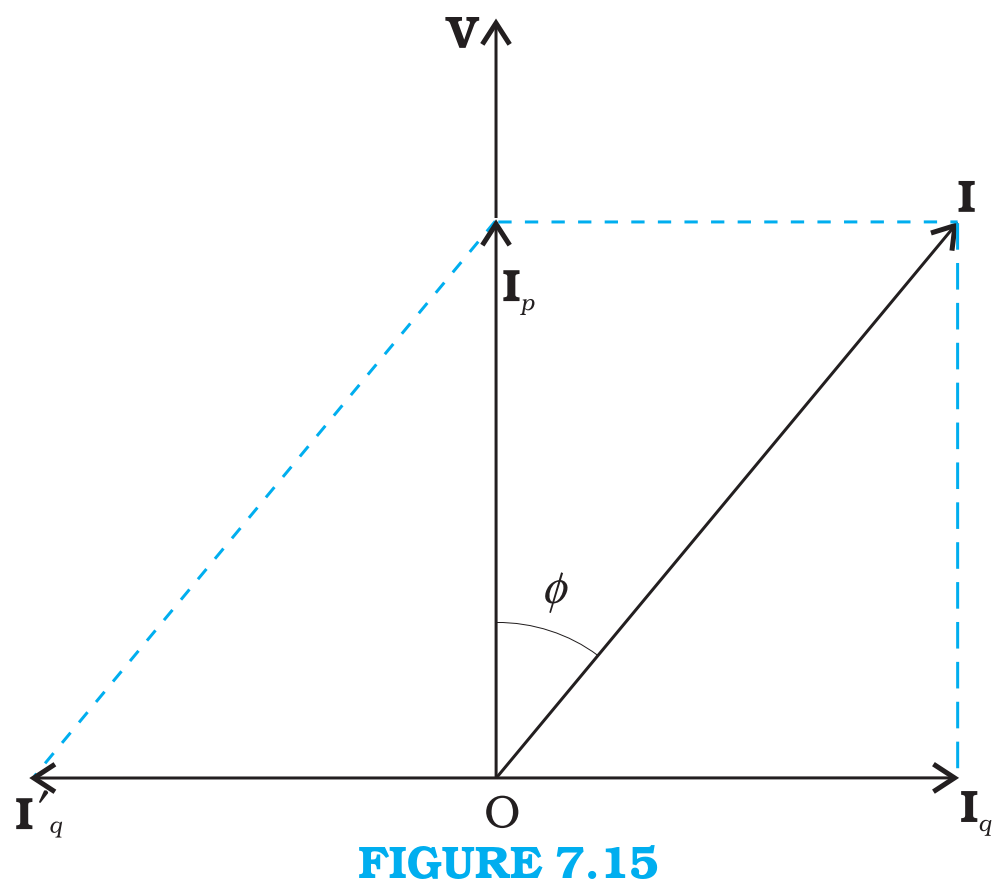
We can improve the power factor (tending to 1) by making $Z$ tend to $R$. Let us understand, with the help of a phasor diagram (Fig. 7.15)
Image
how this can be achieved. Let us resolve $I$ into two components. $I _p$ along the applied voltage $V$ and $I _q$ perpendicular to the applied voltage. $I _q$ as you have learnt in Section 7.7, is called the wattless component since corresponding to this component of current, there is no power loss. $I _{ p }$ is known as the power component because it is in phase with the voltage and corresponds to power loss in the circuit. It's clear from this analysis that if we want to improve power factor, we must completely neutralize the lagging wattless current $I _{ q }$ by an equal leading wattless current $I _q^{\prime}$. This can be done by connecting a capacitor of appropriate value in parallel so that $I _{ q }$ and $I _{ q }^{\prime}$ cancel each other and $P$ is effectively $I_{ p } V$.

Need a full question paper?

Generate a complete, print-ready paper with questions like this in minutes — across 16+ boards, with answer keys.

Start Generating Free

Similar questions

If the nucleons of a nucleus are separated from each other, the total mass is increased. Where does this mass come from?
Find the potential difference between the points $A$ and $B$ and between the points $B$ and $C$ of the figure. in steady state.
A card sheet divided into squares each of size $1 \ mm^2$ is being viewed at a distance of $9 \ cm$ through a magnifying glass $(a$ converging lens of focal length $9 \ cm)$ held close to the eye.
  1. What is the magnification produced by the lens ? How much is the area of each square in the virtual image?
  2. What is the angular magnification (magnifying power) of the lens?
  3. Is the magnification in $(a)$ equal to the magnifying power in $(b)$? Explain.
For the $\beta^{+} ($positron$)$ emission from a nucleus, there is another competing process known as electron capture $($electron from an inner orbit, say, the $K–$ shell, is captured by the nucleus and a neutrino is emitted$).$
$\text{e}^{+}+^{\text{A}}_{\text{Z}}\text{X}\rightarrow\ ^{\text{A}}_{\text{Z}-1}\text{Y}+\text{v}$
Show that if $\beta^{+}$ emission is energetically allowed, electron capture is necessarily allowed but not vice $–$ versa.
A uniform chain of mass M and length L is held vertically in such a way that its lower end just touches the horizontal floor. The chain is released from rest in this position. Any portion that strikes the floor comes to rest. Assuming that the chain does not form a heap on the floor, calculate the force exerted by it on the floor when a length x has reached the floor.
Let $m_1 = 1\ kg, m_2 = 2\ kg$ and $m_3 = 3\ kg$ in figure. Find the accelerations of $m_1, m_2$ and $m_3$. The string from the upper pulley to $m_1$ is $20\ cm$ when the system is released from rest. How long will it take before $m,$ strikes the pulley?
An electron is emitted with negligible speed from the negative plate of a parallel$-$plate capacitor charged to a potential difference $V$. The separation between the plates is $d$ and $a$ magnetic field Bexists in the space, as shown in the figure. Show that the electron will fail to strike the upper plates if $\text{d} > \Big(\frac{2\text{m}_\text{e}\text{v}}{\text{eB}^2}\Big)^{\frac{1}{2}}.$
How is $p-n$ junction diode is used as an half wave rectifier? Explain its action with proper circuit diagram. Show the input and output waveform also.
A mica strip and a polysterene strip are fitted on the two slits of a double slit apparatus. The thickness of the strips is $0.50\ mm$ and the separation between the slits is $0.12\ cm$. The refractive index of mica and polysterene are $1.58$ and $1.55$ respectively for the light of wavelength $590\ nm$ which is used in the experiment. The interference is observed on a screen a distance one meter away.
  1. What would be the fringe-width?
  2. At what distance from the centre will the first maximum be located?
A parallel$-$plate capacitor has plate area $100\ cm^2$ and plate separation $1.0\ cm.$ A glass plate $($dielectric constant $6.0)$ of thickness $6.0\ mm$ and an ebonite plate $($dielectric constant $4.0)$ are inserted one over the other to fill the space between the plates of the capacitor. Find the new capacitance.