Question
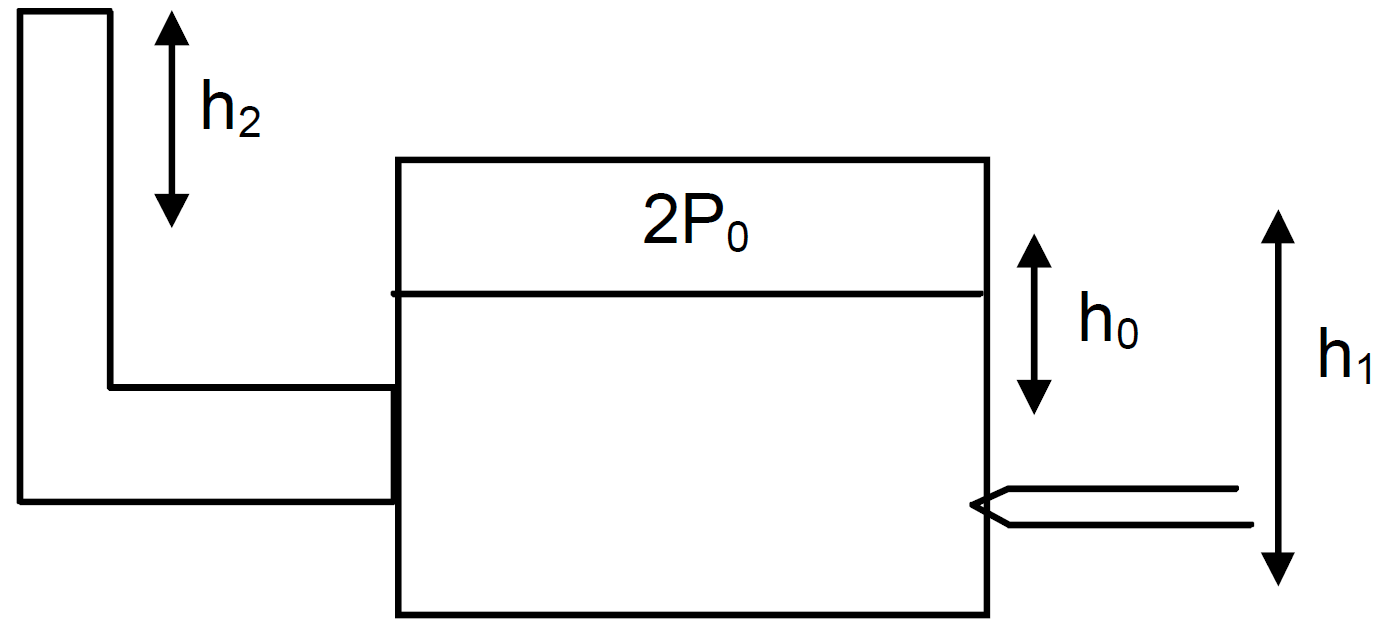
Figure. shows a large closed cylindrical tank containing water. Initially the air trapped above the water surface has a height $h_0$ and pressure $2p_0$ where $p_0$ is the atmospheric pressure. There is a hole in the wall of the tank at a depth $h_1$ below the top from which water comes out. A long vertical tube is connected as shown.
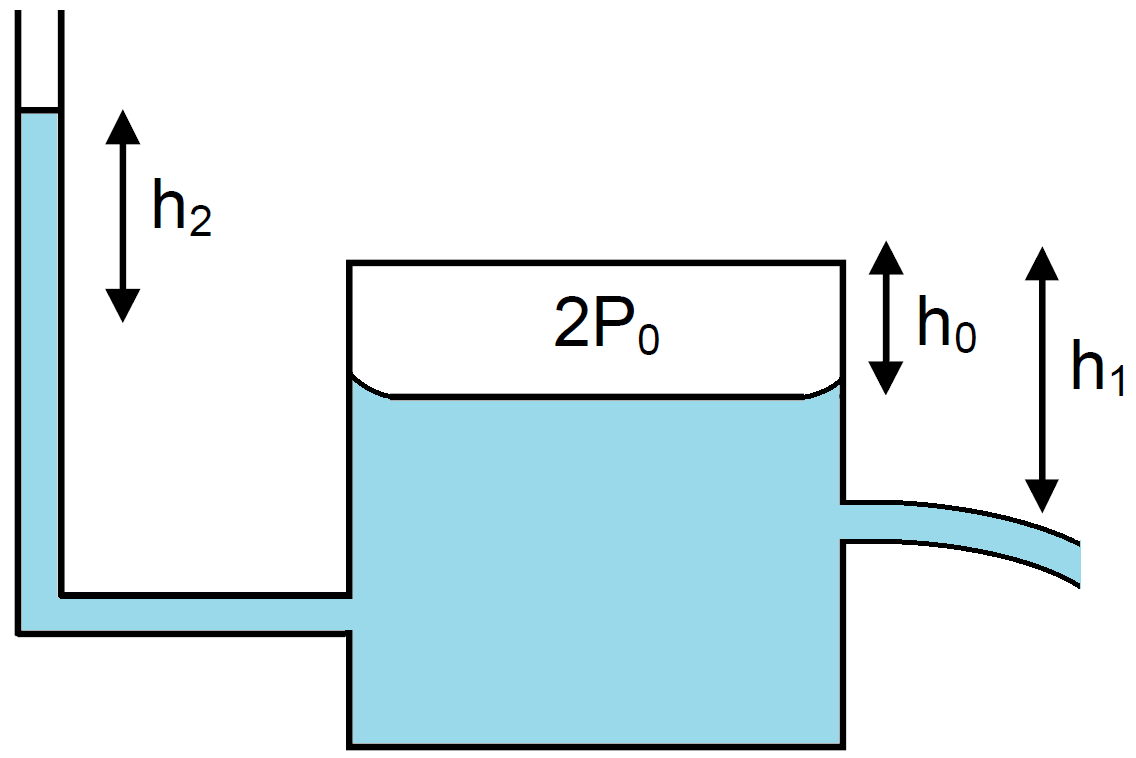
  1. Find the height $h_2$ of the water in the long tube above the top initially.
  2. Find the speed with which water comes out of the hole.
  3. Find the height of the water in the long tube above the top when the water stops coming out of the hole.
Answer


  1. $2\text{P}_0\text{x} = (\text{h}_2 + \text{h}_0)\text{fg}$ [$\therefore$ Since liquid at the same level have same pressure]
$\Rightarrow2\text{P}_0 = \text{h}_2\text{fg} + \text{h}_0\text{fg}$
$\Rightarrow \text{h}_2\text{fg} = 2\text{P}_0 - \text{h}_0\text{fg}$
$\text{h}_2=\frac{2\text{P}_0}{\text{fg}}-\frac{\text{h}_0\text{fg}}{\text{fg}}=\frac{2\text{P}_0}{\text{fg}}-\text{h}_0$
  1. K.E. of the water = Pressure energy of the water at that layer
$\Rightarrow\frac{1}{2}\text{mV}^2=\text{m}\times\frac{\text{P}}{\text{f}}$
$\Rightarrow\text{V}^2=\frac{2\text{P}}{\text{f}}=\Big[\frac{2}{\text{f}(\text{P}_0+\text{fg})(\text{h}_1-\text{h}_0)}\Big]$
$\Rightarrow\text{V}=\Big[\frac{2}{\text{f}(\text{P}_0+\text{fg})(\text{h}_1-\text{h}_0)}\Big]^{\frac{1}{2}}$
  1. $(\text{x} + \text{P}_0)\text{fh} = 2\text{P}_0$
$\therefore2\text{P}_0 + \text{fg (h} - \text{h}_0)= \text{P}_0 + \text{fgx}$
$\therefore\text{X}=\frac{\text{P}_0}{\text{fg}+\text{h}_1-\text{h}_0}=\text{h}_2+\text{h}_1$
$\therefore$ i.e. x is $h_1$ meter below the top
⇒ x is $-h_1$ above the top

Need a full question paper?

Generate a complete, print-ready paper with questions like this in minutes — across 16+ boards, with answer keys.

Start Generating Free

Similar questions

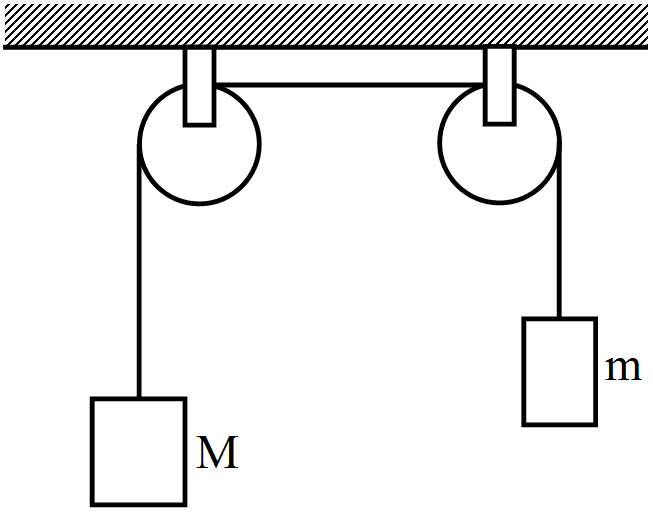
The pulleys in figure are identical, each having a radius $R$ and moment of inertia $I$. Find the acceleration of the block $M$.
The transverse displacement of a string (clamped at its both ends) is given by
$\text{y}(\text{x, t})=0.06\sin\Big(\frac{2\pi}{3}\text{x}\Big)\cos(120\pi\text{ t})$
where x and y are in m and t in s. The length of the string is $1.5m$ and its mass is $3.0 \times 10^{–2}kg$.
Answer the following:
Interpret the wave as a superposition of two waves travelling in opposite directions. What is the wavelength, frequency, and speed of each wave?
The time constant of an LR circuit is 40ms. The circuit is connected at t = 10 and the steady-state current is found to be 2.0A. Find the current at:
  1. t = 10ms
  2. t = 20ms
  3. t = 100ms
  4. t = 1s.
An object starts from rest and covers a total distance X in the following manner: It first has a uniform acceleration $a_1$ for some time $t_1$, moves with the speed acquired at the end of $t_1$ for some distance and is then given a uniform retardation $a_2$ so that it is again at rest at the end of the journey. Show that the journey is covered in least time if the body is accelerated for a time of $\Big[\frac{2\text{X a}_2}{\text{a}_1(\text{a}_1+\text{a}_2)}\Big]^{\frac{1}{2}}$ and this minimum time is $\Bigg[2\text{X}\Big(\frac{1}{\text{a}_1}+\frac{1}{\text{a}_2}\Big)\Bigg]^{\frac{1}{2}}.$
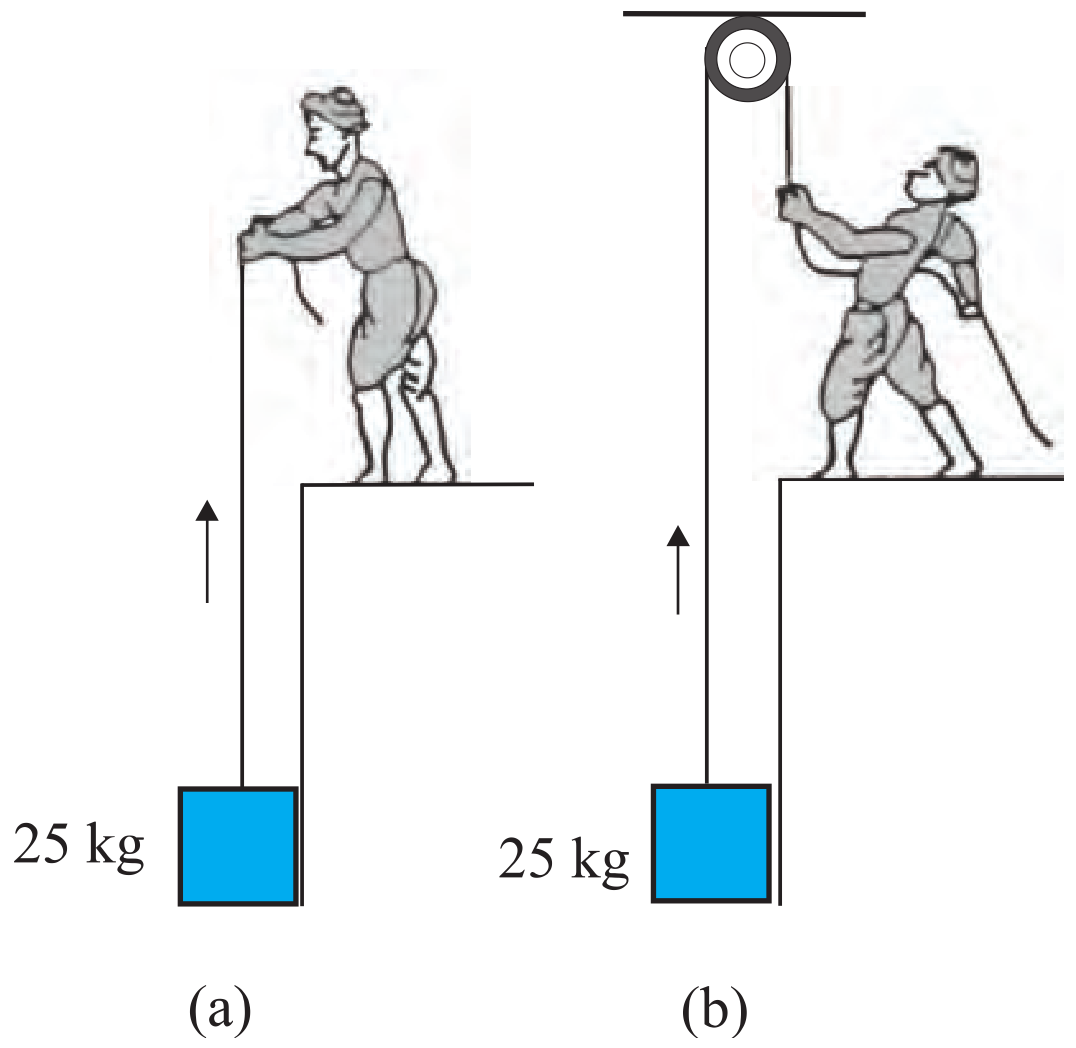
A block of mass $25kg$ is raised by a $50kg$ man in two different ways as shown in Fig. What is the action on the floor by the man in the two cases? If the floor yields to a normal force of $700N$, which mode should the man adopt to lift the block without the floor yielding?
A rocket is fired ‘vertically’ from the surface of mars with a speed of $2km\ s^{-1}$. If $20\%$ of its initial energy is lost due to martian atmospheric resistance, how far will the rocket go from the surface of mars before returning to it? Mass of mars $= 6.4 \times 10^{23}kg;$ radius of mars $= 3395km;\ G = 6.67 \times 10^{-11}N\ m^2\ kg^{-2}.$
Describe the behavior of gases.
State Newton's law of motion and explain their importance by giving examples. Or Mention Newton's law of motion and explain them in detail.
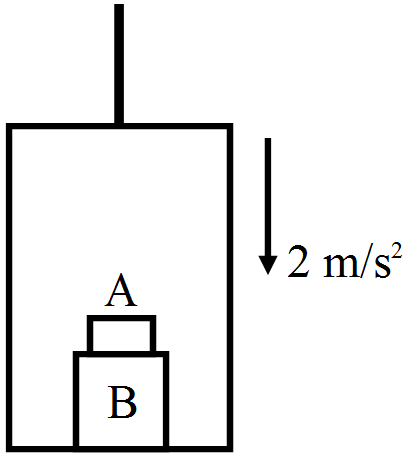
The elevator shown in figure is descending with an acceleration of $2m/s^2$. The mass of the block A is 0.5kg. What force is exerted by the block A on the block B?
Two narrow bores of diameters 3.0 mm and 6.0 mm are joined together to form a U-tube open at both ends. If the Utube contains water, what is the difference in its levels in the two limbs of the tube ? Surface tension of water at the temperature of the experiment is $7.3 \times 10^{-2} \mathrm{~N} \mathrm{~m}^{-1}$. Take the angle of contact to be zero and density of water to be $1.0 \times 103 \mathrm{~kg} / \mathrm{m}^{-3}\left(\mathrm{~g}=9.8 \mathrm{~m} / \mathrm{s}^{-2}\right)$.