Question
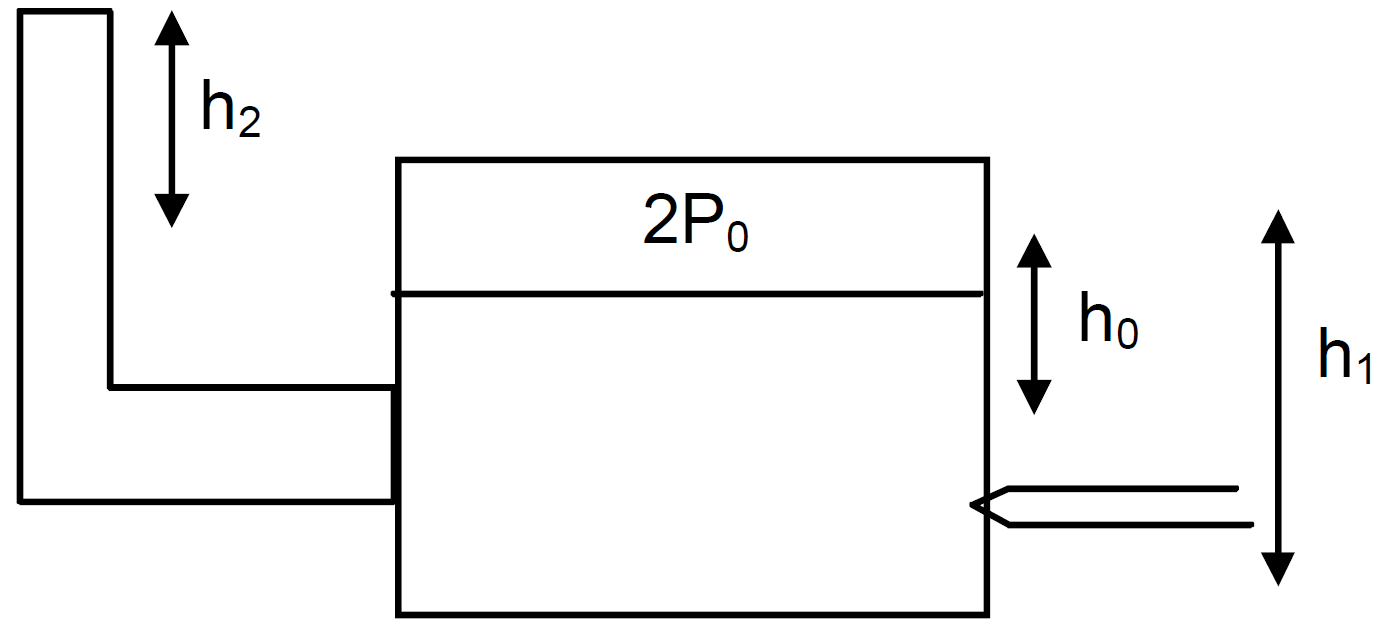
Figure. shows a large closed cylindrical tank containing water. Initially the air trapped above the water surface has a height h0 and pressure 2p0 where p0 is the atmospheric pressure. There is a hole in the wall of the tank at a depth h1 below the top from which water comes out. A long vertical tube is connected as shown.
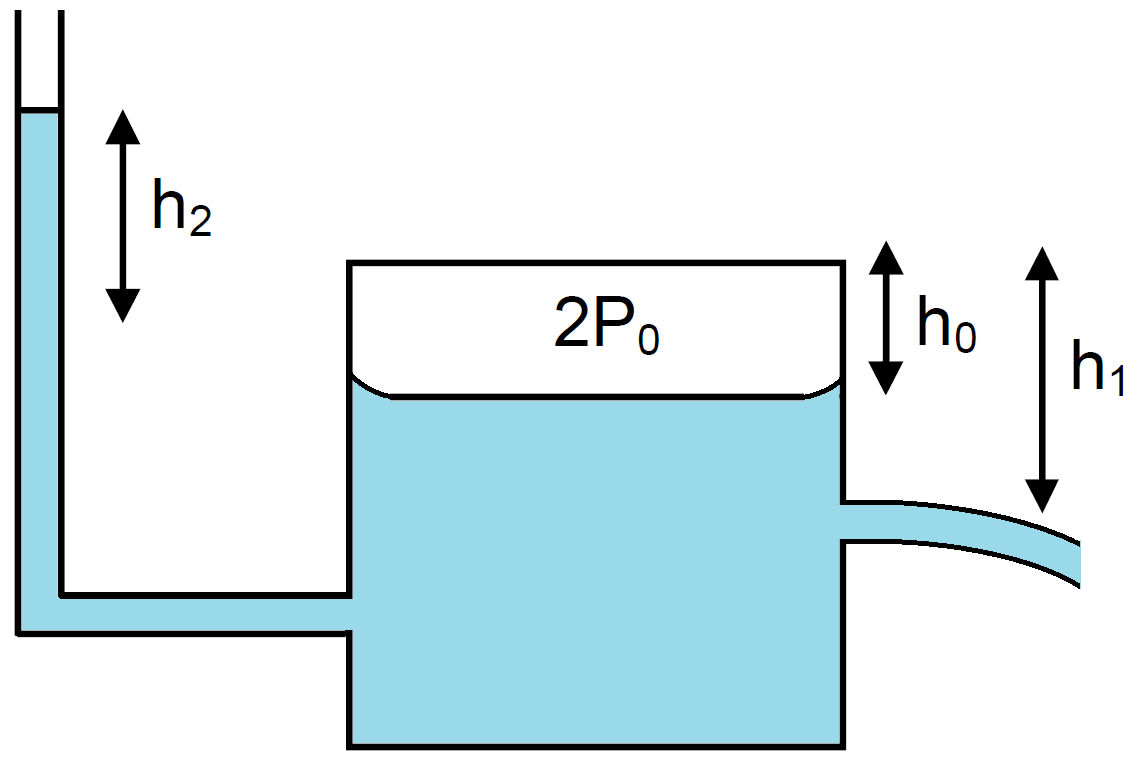
  1. Find the height h2 of the water in the long tube above the top initially.
  2. Find the speed with which water comes out of the hole.
  3. Find the height of the water in the long tube above the top when the water stops coming out of the hole.
Answer


  1. $2\text{P}_0\text{x} = (\text{h}_2 + \text{h}_0)\text{fg}$ [$\therefore$ Since liquid at the same level have same pressure]

$\Rightarrow2\text{P}_0 = \text{h}_2\text{fg} + \text{h}_0\text{fg}$

$\Rightarrow \text{h}_2\text{fg} = 2\text{P}_0 - \text{h}_0\text{fg}$

$\text{h}_2=\frac{2\text{P}_0}{\text{fg}}-\frac{\text{h}_0\text{fg}}{\text{fg}}=\frac{2\text{P}_0}{\text{fg}}-\text{h}_0$

  1. K.E. of the water = Pressure energy of the water at that layer

$\Rightarrow\frac{1}{2}\text{mV}^2=\text{m}\times\frac{\text{P}}{\text{f}}$

$\Rightarrow\text{V}^2=\frac{2\text{P}}{\text{f}}=\Big[\frac{2}{\text{f}(\text{P}_0+\text{fg})(\text{h}_1-\text{h}_0)}\Big]$

$\Rightarrow\text{V}=\Big[\frac{2}{\text{f}(\text{P}_0+\text{fg})(\text{h}_1-\text{h}_0)}\Big]^{\frac{1}{2}}$

  1. $(\text{x} + \text{P}_0)\text{fh} = 2\text{P}_0$

$\therefore2\text{P}_0 + \text{fg (h} - \text{h}_0)= \text{P}_0 + \text{fgx}$

$\therefore\text{X}=\frac{\text{P}_0}{\text{fg}+\text{h}_1-\text{h}_0}=\text{h}_2+\text{h}_1$

$\therefore$ i.e. x is h1 meter below the top

⇒ x is -h1 above the top

Need a full question paper?

Generate a complete, print-ready paper with questions like this in minutes — across 16+ boards, with answer keys.

Start Generating Free

Similar questions

A hole of radius r1 is made centrally in a uniform circular disc of thickness d and radius r2. The inner surface (a cylinder of length d and radius r1) is maintained at a temperature $\theta_1$ and the outer surface (a cylinder of length d and radius r2) is maintained at a temperature $\theta_2(\theta_1>\theta_2).$ The thermal conductivity of the material of the disc is K. Calculate the heat flowing per unit time through the disc.
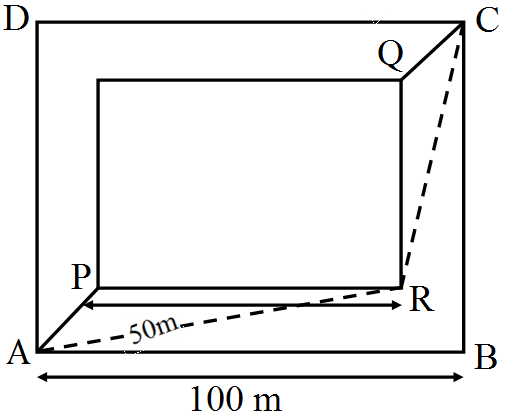
A man wants to reach from A to the opposite corner of the square C Fig. The sides of the square are 100m. A central square of 50m × 50m is filled with sand. Outside this square, he can walk at a speed 1m/ s. In the central square, he can walk only at a speed of $\upsilon\text{m/ s}(\upsilon<1)$. What is smallest value of v for which he can reach faster via a straight path through the sand than any path in the square outside the sand?

What is gravitational potential? Derive the formula for gravitational potential due to a ponit mass and also draw the graph.
Prove the result that the velocity v of translation of a rolling body (like a ring, disc, cylinder or sphere) at the bottom of an inclined plane of height h given by
$\text{v}^2=\frac{2\text{gh}}{\big(1+\frac{\text{K}^2}{\text{R}^2}\big)}$
using dynamical consideration. Note K is the radius of gyration of the body about its symmetry axis, and R is the radius of the body. The body starts from rest at the top of the plane.
The speed of a motor launch w.r.t still water is 7ms-1 and the speed of the stream is 3ms-1. When the launch began travelling upstream, a float was dropped from it. The launch travelled 4.2km upstream, turned about and caught up with the float. How long is it, before the launch reached the float?
If 28 × 1023 molecules of a gas strike a surface of area 14cm2 normally per second with velocity of 500 ms-1 and rebound in the opposite direction with the same speed find the pressure exerted by the gas on the surface if mass of each molecule is 5 × 10-23 g.
Oxygen is filled in a closed metal jar of volume 1.0 × 10⁻³m3 at a pressure of 1.5 × 10⁵Pa and temperature 400K. The jar has a small leak in it. The atmospheric pressure is 1.0 × 10⁵Pa and the atmospheric temperature is 300K Find the mass of the gas that leaks out by the time the pressure and the temperature inside the jar equalise with the surrounding.
Given below are densities of some solids and liquids. Give rough estimates of the size of their atoms:
Substance
Atomic Mass(u)
Density (103kgm-3)
Carbon (diamond)
Gold
Nitrogen (liquid)
Lithium
Fluorine (liquid)
12.01
197.00
14.01
6.94
19.00
2.22
19.32
1.00
0.53
1.14
$\big[$Hint: Assume the atoms to be ‘tightly packed’ in a solid or liquid phase, and use the known value of Avogadro’s number. You should, however, not take the actual numbers you obtain for various atomic sizes too literally. Because of the crudeness of the tight packing approximation, the results only indicate that atomic sizes are in the range of a few $\mathring{\text{A}}\big].$
A coil having an inductance L and a resistance R is connected to a battery of emf $\in.$ Find the time taken for the magnetic energy stored in the circuit to change from one fourth of the steady-state value to half of the steady-state value.
Two absolute scales A and B have triple points of water defined to be 200A and 350B. What is the relation between TA and TB?