Question types

Kinetic Theory question types

507 questions across 7 question groups — pick any mix to generate a Physics paper with step-by-step answer keys.

507
Questions
7
Question groups
5
Question types
Sample Questions

Kinetic Theory questions

One sample from each question group in this chapter. Select any group above to see the full set with answer keys.
A rigid container of negligible heat capacity contains one mole of an ideal gas. The temperature of the gas increases by 1°C if 3.0cal of heat is added to it. The gas may be:
  • A
    Helium.
  • B
    Argon.
  • C
    Oxygen.
  • D
    Carbon dioxide.
View full solution
The quantity $\frac{\text{PV}}{\text{kT}}$ represents:
  • A
    Mass of the gas.
  • B
    Kinetic energy of the gas.
  • C
    Number of moles of the gas.
  • D
    Number of molecules in the gas.
View full solution
Diatomic molecules like hydrogen have energies due to both translational as well as rotational motion. From the equation in kinetic theory $\text{PV} = \frac{2}{3}$ E,E is:
  • A
    The total energy per unit volume.
  • B
    Only the translational part of energy because rotational energy is very small compared to the translational energy.
  • C
    Only the translational part of the energy because during collisions with the wall pressure relates to change in linear momentum.
  • D
    The translational part of the energy because rotational energies of molecules can be of either sign and its average over all the molecules is zero.
View full solution
The density of water is 1000 $kg m ^{-3}$. The density of water vapour at $100^{\circ} C$ and $1 atm$ pressure is $0.6 kg m ^{-3}$. The volume of a molecule multiplied by the total number gives , what is called, molecular volume. The ratio (or fraction) of the molecular volume to the total volume occupied by the water vapour under the above conditions of temperature and pressure is $6 \times 10^{-4}$. The volume of a water molecule is $3 \times 10^{-29} m ^3$. What is the average distance between atoms (interatomic distance) in water?
View full solution
The density of water is 1000 $kg m ^{-3}$. The density of water vapour at $100^{\circ} C$ and $1 atm$ pressure is $0.6 kg m ^{-3}$. The volume of a molecule multiplied by the total number gives , what is called, molecular volume. Estimate the ratio (or fraction) of the molecular volume to the total volume occupied by the water vapour under the above conditions of temperature and pressure.
View full solution
If it were possible for a gas in a container to reach the temperature 0K, its pressure would be zero. Would the molecules not collide with the walls? Would they not transfer momentum to the walls?
View full solution
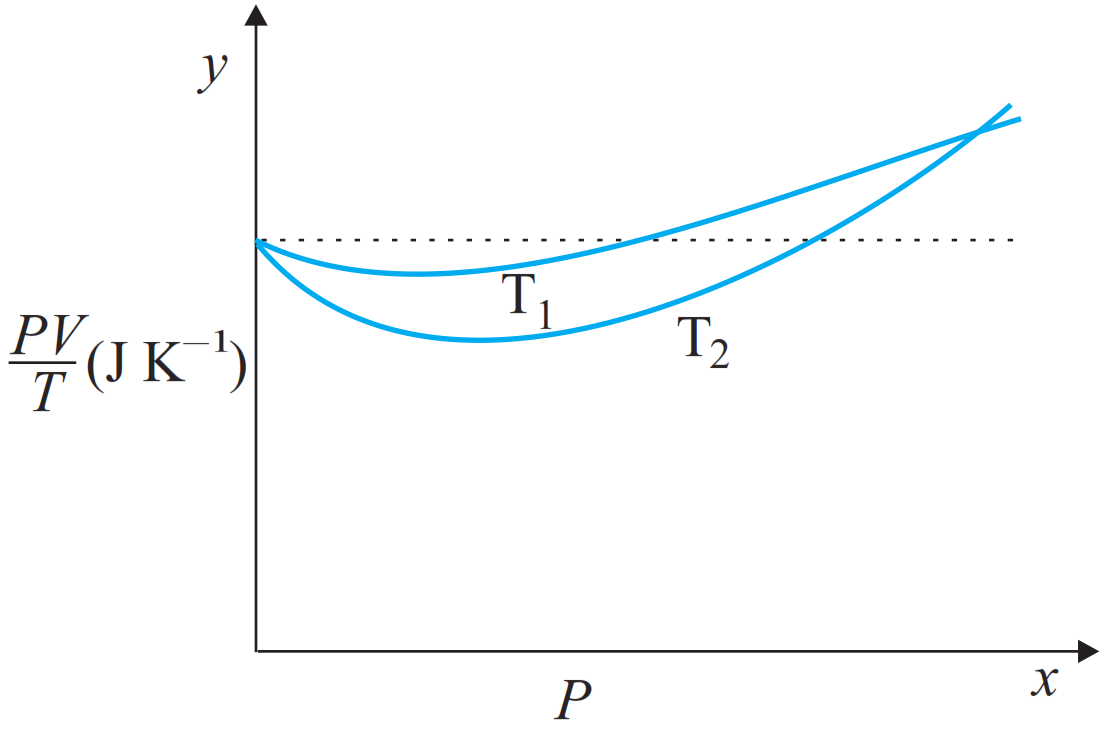
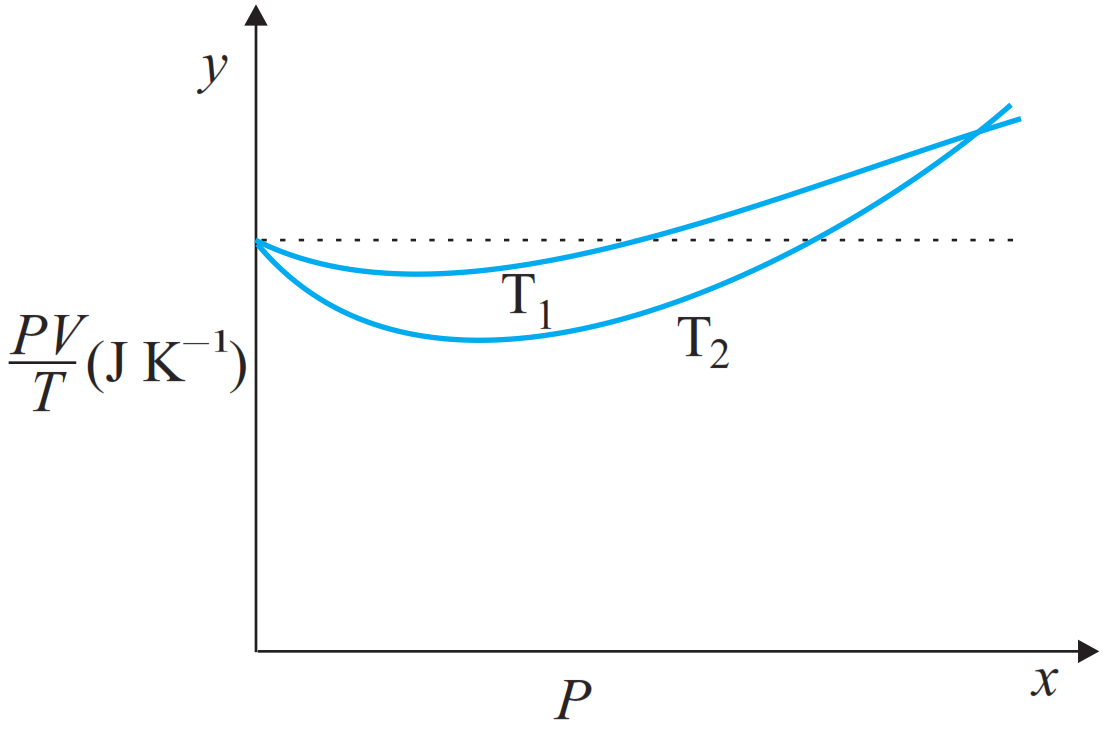
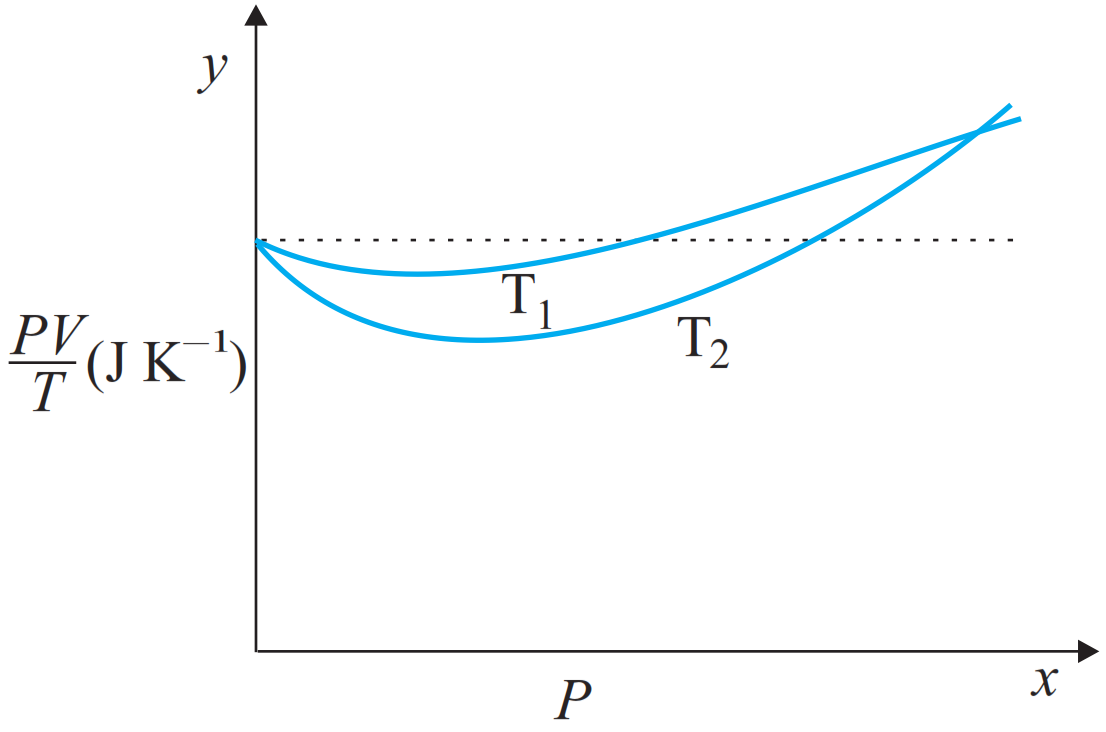
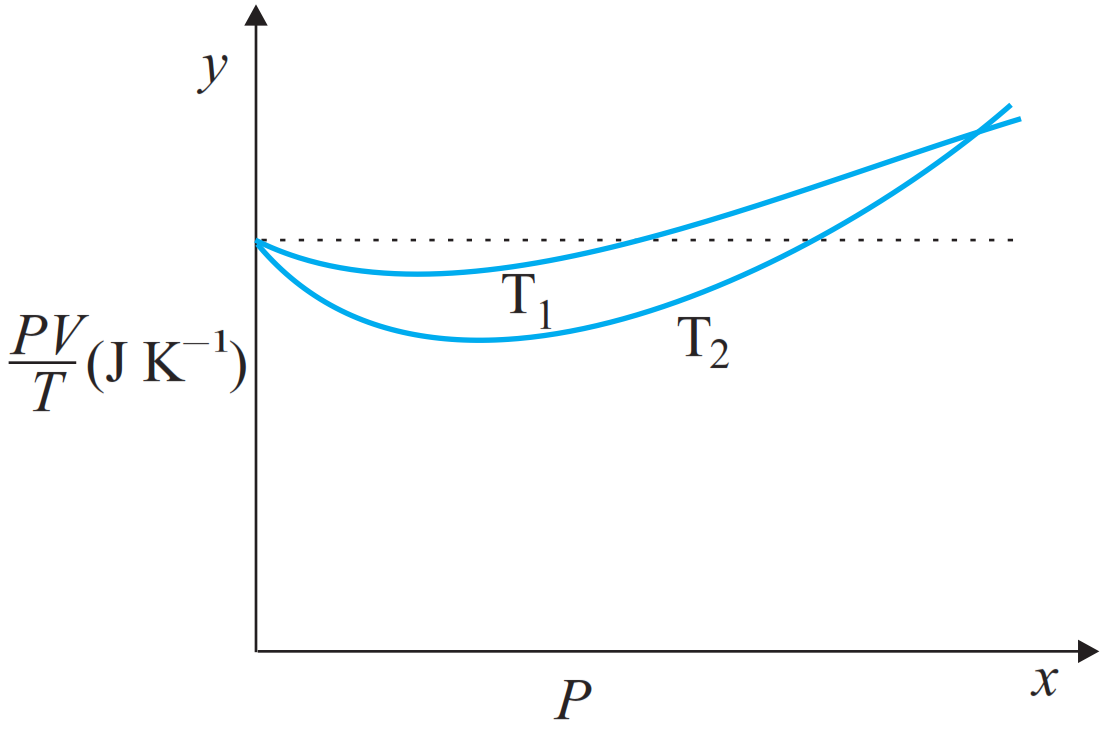
Shows plot of $\frac{\text{PV}}{\text{T}}$ versus P for 1.00 × 10⁻³kg of oxygen gas at two different temperatures.
What does the dotted plot signify?

View full solution
Shows plot of $\frac{\text{PV}}{\text{T}}$ versus P for 1.00 × 10⁻³kg of oxygen gas at two different temperatures:
Which is true, T1 > T2 or T1 < T2?

View full solution
A cylinder of fixed capacity 44.8 litres contains helium gas at standard temperature and pressure. What is the amount of heat needed to raise the temperature of the gas in the cylinder by $15.0^{\circ} C ?\left(R=8.31 J mol ^{-1} K ^{-1}\right)$.
View full solution
A diatomic gas is heated in a vessel to a temperature of 10000K. If each molecule possess an average energy E1. After sometime, a few molecule escape into the atmosphere at 300 K. Due to which, their energy changes to E2. Calculate the ratio of $\frac{\text{E}_1}{\text{E}_2}.$
View full solution
Shows plot of $\frac{\text{PV}}{\text{T}}$ versus P for 1.00 × 10⁻³kg of oxygen gas at two different temperatures.
What does the dotted plot signify?

View full solution
Q 213 Marks Question3 Marks
Estimate the total number of air molecules (inclusive of oxygen, nitrogen, water vapour and other constituents) in a room of capacity 25.0m3 at a temperature of 27°C and 1 atm pressure.
View full solution
Q 223 Marks Question3 Marks
Molar volume is the volume occupied by 1mol of any (ideal) gas at standard temperature and pressure:
(STP: 1 atmospheric pressure, 0°C). Show that it is 22.4 litres.
View full solution
Q 233 Marks Question3 Marks
Uranium has two isotopes of masses 235 and 238 units. If both are present in Uranium hexafluoride gas which would have the larger average speed ? If atomic mass of fluorine is 19 units, estimate the percentage difference in speeds at any temperature.
View full solution
Q 243 Marks Question3 Marks
A flask contains argon and chlorine in the ratio of $2: 1$ by mass. The temperature of the mixture is $27 C$. Obtain the ratio of (i) average kinetic energy per molecule, and (ii) root mean square speed $V_{\text {rms }}$ of the molecules of the two gases. Atomic mass of argon $=39.9 u$; Molecular mass of chlorine $=70.9 u$.
View full solution
Q 253 Marks Question3 Marks
A vessel contains two nonreactive gases : neon (monatomic) and oxygen (diatomic). The ratio of their partial pressures is 3:2. Estimate the ratio of (i) number of molecules and (ii) mass density of neon and oxygen in the vessel. Atomic mass of Ne = 20.2 u, molecular mass of O2 = 32.0 u.
View full solution
Q 264 Marks Question4 Marks
50cc of oxygen is collected in an inverted gas jar over water. The atmospheric pressure is 99.4kPa and the room temperature is 27°C. The water level in the jar is same as the level outside. The saturation vapour pressure at 27°C is 3.4kPa. Calculate the number of moles of oxygen collected in the jar.
View full solution
Q 274 Marks Question4 Marks
On a winter day, the outside temperature is 0°C and relative humidity 40%. The air from outside comes into a room and is heated to 20°C. What is the relative humidity in the room? The saturation vapour pressure at 0°C is 4.6mm of mercury and at 20°C it is 18mm of mercury.
View full solution
Q 284 Marks Question4 Marks
Read the passage given below and answer the following questions from (i) to (v).

Monatomic Gases: The molecule of a monatomic gas has only three translational degrees of freedom. Thus, the average energy of a molecule at temperature T is $\frac{3}{2}\text{K}_\text{b}\text{T}$. The total internal energy of a mole of such a gas is $\text{U}=(\frac{3}{2})\text{RT}$.

The molar specific heat at constant volume cv is given by

$\text{C}_{\text{v}}=\frac{\text{Du}}{\text{Dt}}=(\frac{3}{2})\text{R}$

For an ideal gas,

Cp - Cv = R

Where Cp is the molar specific heat at constant pressure. Thus, $\text{C}_\text{P} =(\frac{5}{2})\text{R}$

The ratio of specific heats IS $\gamma=\frac{\text{cp}}{\text{cv}}=\frac{5}{3}$

Diatomic Gases: a diatomic molecule treated as a rigid rotator, like a dumbbell, has 5 degrees of freedom: 3 translational and 2 rotational. Using the law of equipartition of energy, the total internal energy of a mole of such a gas is $\text{U}=\frac{5}{2}\text{RT}$

The molar specific heat at constant volume cv is given by

$\text{Cv}=\frac{\text{DU}}{\text{DT}}=(\frac{5}{2})\text{R}$

For an ideal gas,

Cp – C= R

Where Cp is the molar specific heat at constant pressure. Thus, $\text{C}_\text{P} =(\frac{7}{2})\text{R}$

The ratio of specific heats IS  $γ( \text{for rigid diatomic)}=\frac{\text{C}_\text{P}}{\text{C}_\text{v}} =(\frac{7}{5})\text{R}$

For non rigid diatomic molecules they have additional mode of vibrations therefore

$\gamma=\frac{\text{C}_\text{p}}{\text{C}_\text{v}}=\frac{9}{7}$

Polyatomic Gases: In general a polyatomic molecule has 3 translational, 3 rotational degrees of freedom and a certain number (f) of vibrational modes. According to the law of equipartition of energy, it is easily seen that one mole of such a gas has

C= (3 + f) R and C= (4 + f) R and $\gamma=\frac{(4 + \text{f})}{(3+\text{f})}$

  1. For monatomic molecules ratio of specific heats is $\gamma$
  1. $\frac{5}{3}$

  2. $\frac{7}{5}$

  3. $\frac{9}{5}$

  4. None of these

  1. For diatomic rigid molecules ratio of specific heats is γ
  1. $\frac{5}{3}$

  2. $\frac{7}{5}$

  3. $\frac{9}{7}$

  4. None of these

  1. For diatomic non rigid molecules ratio of specific heats is γ
  1. $\frac{5}{3}$
  2. $\frac{7}{5}$
  3. $\frac{9}{7}$
  4. None of these
  1. Give cp and cv values and ratio of specific heat for monatomic gas molecules.
  2. Give cp and cv values and ratio of specific heat for polyatomic gas molecules
View full solution
Q 294 Marks Question4 Marks
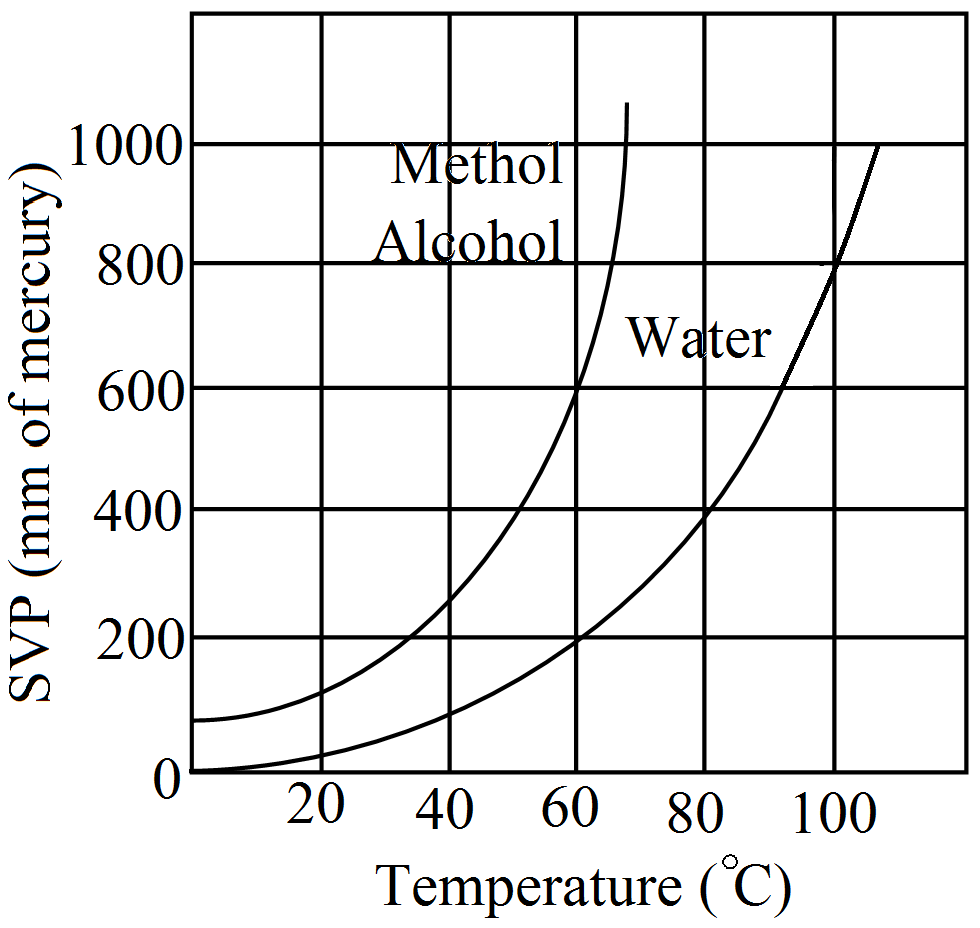
The human body has an average temperature of 98°F. Assume that the vapour pressure of the blood in the veins behaves like that of pure water. Find the minimum atmospheric pressure which is necessary to prevent the blood from boiling. Use figure. of the text for the vapour pressures.


View full solution
Q 304 Marks Question4 Marks
Read the passage given below and answer the following questions from (i) to (v).
Root mean square velocity (RMS value)is the square root of the mean of squares of the velocity of individual gas molecules and the Average velocity is the arithmetic mean of the velocities of different molecules of a gas at a given temperature.

  1. Moon has no atmosphere because:-
    1. It is far away from the surface of the earth
    2. Its surface temperature is 10°C
    3. The r.m.s. velocity of all the gas molecules is more than the escape velocity of the moon’s surface
    4. The escape velocity of the moon’s surface is more than the r.m.s velocity of all molecules
  2. For an ideal gas, CPCV is
    1. >1
    2. <1
    3. ≤1
    4. none of these
  3. The root mean square velocity of hydrogen is 5 times than that of nitrogen. If T is the temperature of the gas then:
    1. T(H2) = T(N2)
    2. T(H2) < T(N2)
    3. T(H2) > T(N2)
    4. none of these
  4. Suppose the temperature of the gas is tripled and N2 molecules dissociate into an atom. Then what will be the rms speed of atom:
    1. v06
    2. v0
    3. v03
    4. none of these
  5. The velocities of the molecules are v, 2v, 3v, 4v & 5v. The rms speed will be:
    1.  11 v
    2.  v(11)12
    3.  v
    4.  v(12)11
View full solution
Estimate the fraction of molecular volume to the actual volume occupied by oxygen gas at STP. Take the diameter of an oxygen molecule to be $3\mathring{\text{A}}$ 
View full solution
Given below are densities of some solids and liquids. Give rough estimates of the size of their atoms:
Substance
Atomic Mass(u)
Density (103kgm-3)
Carbon (diamond)
Gold
Nitrogen (liquid)
Lithium
Fluorine (liquid)
12.01
197.00
14.01
6.94
19.00
2.22
19.32
1.00
0.53
1.14
$\big[$Hint: Assume the atoms to be ‘tightly packed’ in a solid or liquid phase, and use the known value of Avogadro’s number. You should, however, not take the actual numbers you obtain for various atomic sizes too literally. Because of the crudeness of the tight packing approximation, the results only indicate that atomic sizes are in the range of a few $\mathring{\text{A}}\big].$
View full solution
From a certain apparatus, the diffusion rate of hydrogen has an average value of 28.7cm3 s-1. The diffusion of another gas under the same conditions is measured to have an average rate of 7.2cm3 s-1. Identify the gas.
[Hint: Use Graham’s law of diffusion $\frac{\text{R}_1}{\text{R}_2}=\Big(\frac{\text{M}_2}{\text{M}_1}\Big)^{\frac{1}{2}},$ where R1 , R2 are diffusion rates of gases 1 and 2, and M1 and M2 their respective molecular masses. The law is a simple consequence of kinetic theory]
View full solution
Shows plot of $\frac{\text{PV}}{\text{T}}$ versus P for 1.00 × 10⁻³kg of oxygen gas at two different temperatures:

If we obtained similar plots for 1.00 × 10⁻³kg of hydrogen, would we get the same value of $\frac{\text{PV}}{\text{T}}$ at the point where the curves meet on the y-axis? If not, what mass of hydrogen yields the same value of $\frac{\text{PV}}{\text{T}}$ (for low pressure high temperature region of the plot)? (Molecular mass of H2 = 2.02u, of O2 = 32.0u, R = 8.31J mo1-1K-1).

View full solution
Shows plot of $\frac{\text{PV}}{\text{T}}$ versus P for 1.00 × 10⁻³kg of oxygen gas at two different temperatures:

What is the value of $\frac{\text{PV}}{\text{T}}$ where the curves meet on the y-axis?

View full solution

Generate a Kinetic Theory paper free

Pick question groups from the list above, set marks and difficulty, and export a branded PDF with step-by-step answer keys. First 3 chapters free — no signup.
Download App