Question
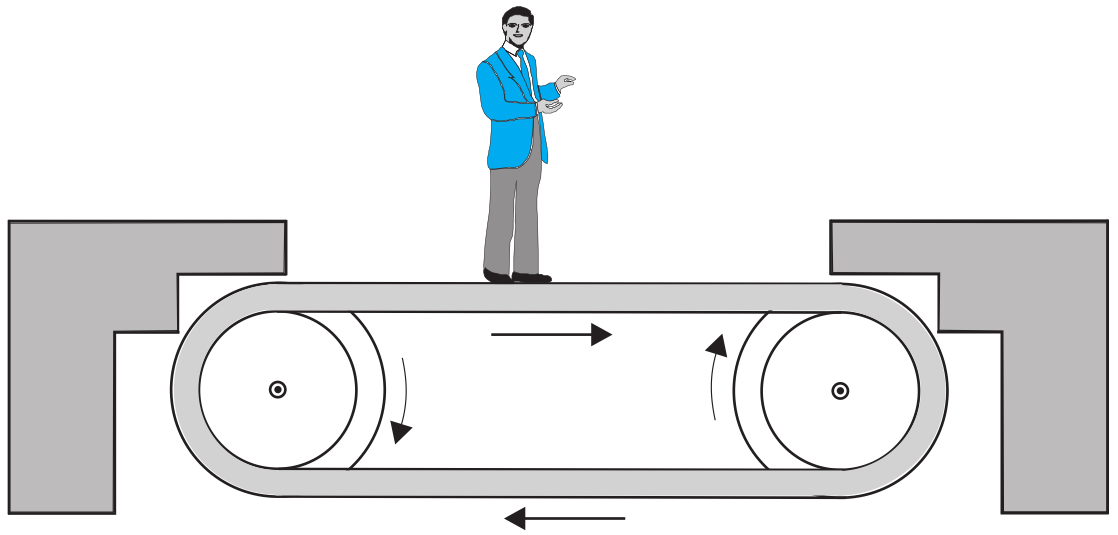
Figure. shows a man standing stationary with respect to a horizontal conveyor belt that is accelerating with $1ms^{-2}$. What is the net force on the man? If the coefficient of static friction between the man’s shoes and the belt is $0.2$, up to what acceleration of the belt can the man continue to be stationary relative to the belt? (Mass of the man = $65kg$.)
Answer

Mass of the man, m = 65kg Acceleration of the belt, $a = 1m/s^2$ Coefficient of static friction, μ = 0.2 The net force F, acting on the man is given by Newton’s second law of motion as: $F_{net} = ma = 65 × 1 = 65N$ The man will continue to be stationary with respect to the conveyor belt until the net force on the man is less than or equal to the frictional force fs, exerted by the belt, i.e., $F’_{net} = f_s ma’ = \mu mg $
​​​​​​​$\therefore a‘ = 0.2 \times 10 = 2m/s^2$ Therefore, the maximum acceleration of the belt up to which the man can stand stationary is $2m/s^2$.

Need a full question paper?

Generate a complete, print-ready paper with questions like this in minutes — across 16+ boards, with answer keys.

Start Generating Free

Similar questions

Two billiard balls each of mass $0.05kg$ moving in opposite directions with speed $6ms^{-1}$ collide and rebound with the same speed. What is the impulse imparted to each ball due to the other?
The potential energy of a spring when stretched through a distance x is 25J. What is the amount of work done on the same spring so as to stretch it by an additional distance 5x ?
A glass surface is coated by an oil film of uniform thickness $1.00 \times 10^{-4}cm$. The index of refraction of the oil is $1.25$ and that of the glass is $1.50$. Find the wavelengths of light in the visible region ($400nm - 750nm$) which are completely transmitted by the oil film under normal incidence.
  1. Define moment of inertia. Write the parallel and perpendicular axis theorem.
  2. Derive an expression for moment of inertia of a disc of radius r, mass m about an axis along its diameter.
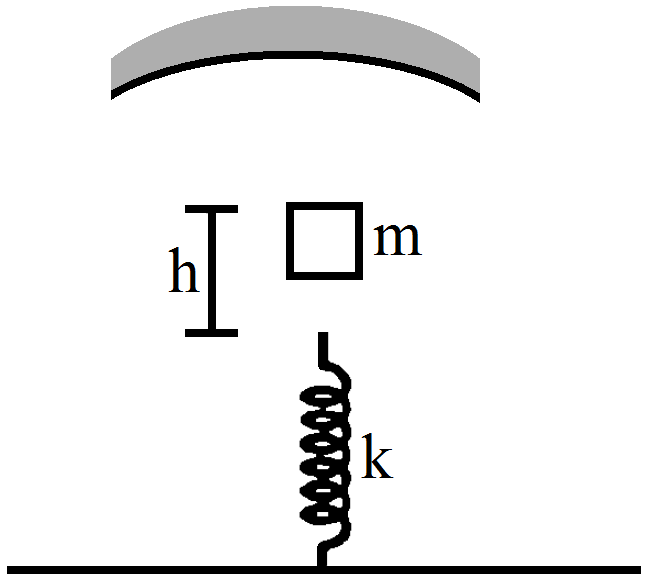
A mass $m = 50g$ is dropped on a vertical spring of spring constant $500N/m$ from a height $h = 10cm$ as shown in figure. The mass sticks to the spring and executes simple harmonic oscillations after that. A concave mirror of focal length $12cm$ facing the mass is fixed with its principal axis coinciding with the line of motion of the mass, its pole being at a distance of $30cm$ from the free end of the spring. Find the length in which the image of the mass oscillates.
Explain the reason for capillarity and mention some practical examples based on capillarity.
The time constant of an LR circuit is 40ms. The circuit is connected at t = 10 and the steady-state current is found to be 2.0A. Find the current at:
  1. t = 10ms
  2. t = 20ms
  3. t = 100ms
  4. t = 1s.
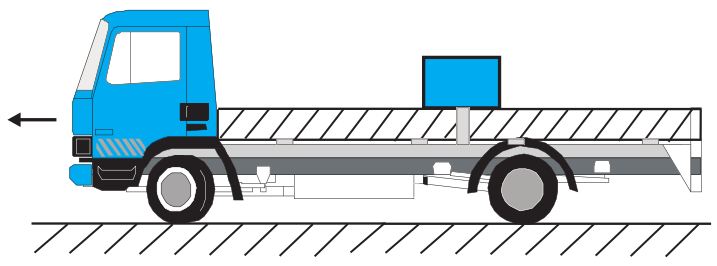
The rear side of a truck is open and a box of $40kg$ mass is placed 5m away from the open end as shown in Fig. The coefficient of friction between the box and the surface below it is $0.15$. On a straight road, the truck starts from rest and accelerates with $2ms^{-2}$. At what distance from the starting point does the box fall off the truck? (Ignore the size of the box).
A body weighs 63N on the surface of the earth. What is the gravitational force on it due to the earth at a height equal to half the radius of the earth?
Suppose the ceiling in the previous problem is that of an elevator which is going up with an acceleration of $2.0m/s^2$. Find the elongations.