- Define moment of inertia. Write the parallel and perpendicular axis theorem.
- Derive an expression for moment of inertia of a disc of radius r, mass m about an axis along its diameter.
Download our app for free and get started
- Moment of inertia is inertial equivalent in rotational motion. Moment of inertia of a rigid body is defined as the sum of the products of the constituent masses and the squares of the perpendicular distance from the axis of rotation. If $m_1, m_2...m_n,$ are the masses at perpendicular distances $r_1, r_2...,r_n$ then, moment of inertia
$=\sum\limits_{\text{i}=\text{l}}^\limits{\text{n}}\text{m}_{\text{i}}\text{r}^2_{\text{i}}$
It is measured in $kgm^2$ and has the dimensions of $ML_2$.
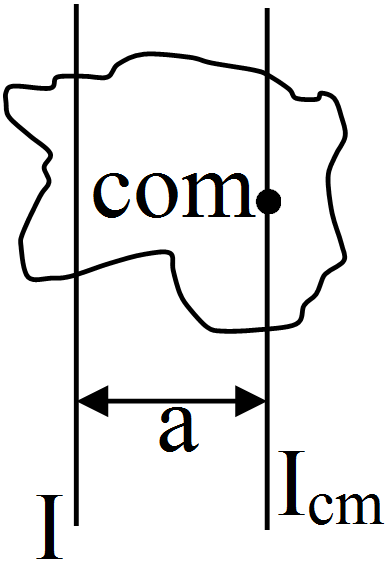
Parallel Axis theorem: The moment of inertia about passing parallel to the axis through the centre of mass of a rigid body is the sum of the moment of inertia $(I_{cm}.)$ of the body about the axis through centre of mass and the product of its mass M and square of the separation $(a^2)$ between the parallel axis. i.e., $I = I_{cm} + Ma^2$
Perpendicular Axis theorem: If $I_x$ and $I_y$ are the moment of inertia about the x and y-axis of any rigid mass, then the moment of inertia I_z about z-axis is the sum of $I_x$ and $I_y$.
$I_z = I_x + I_y$
- Moment of intertia of a uniform circular disc about its diameter:
$\text{i.e.,}2\text{I}_{\text{d}}=\frac{1}{2}\text{MR}^2\text{ or }\text{I}_{\text{d}}=\frac{1}{4}\text{MR}^2$

Download our appand get started for free
Experience the future of education. Simply download our apps or reach out to us for more information. Let's shape the future of learning together!No signup needed.*
Similar Questions
- 1Locate the centre of mass of a system of particles of mass $m_1 = 1kg, m_2 = 2kg$ and $m_3 = 3kg$, situated at the corners of an equilateral triangle of side 1.0 metre.View Solution
- 2Two masses $M_1$ and $M_2$ are separated by a distance r. Find the moment of inertia of this arrangement about an axis passing through the centre of mass and perpendicular to the line joining them.View Solution
- 3Two discs of moments of inertia $I_1$ and $I_2$ about their respective axes (normal to the disc and passing through the centre), and rotating with angular speeds $\omega_1$ and $\omega_2$ are brought into contact face to face with their axes of rotation coincident.View Solution
- What is the angular speed of the two-disc system?
- Show that the kinetic energy of the combined system is less than the sum of the initial kinetic energies of the two discs. How do you account for this loss in energy? Take $\omega_1\neq\omega_2$
- 4A disc of mass $5kg$ and radius $50cm$ rolls on the ground at the rate of $10ms^{-1}$. Calculate the K.E. of the disc. $\Big(\text{Given}:\text{I}=\frac{1}{2}\text{MR}^2\Big)$View Solution
- 5Separation of Motion of a system of particles into motion of the centre of mass and motion about the centre of mass: Show $\text{L}=\text{L}'+\text{R}\times\text{MV}$ where $\text{L}'=\sum\text{r}'_\text{i}\times\text{p}'_\text{i}$ is the angular momentum of the system about the centre of mass with velocities taken relative to the centre of mass. Remember $\text{r}'_\text{i}=\text{r}_\text{i}-\text{R},$ rest of the notation is the standard notation used in the chapter.View Solution
Note: $\text{L}'$ and $\text{MR}\times\text{V}$ can be said to be angular momenta, respectively, about and of the centre of mass of the system of particles. - 6View SolutionA body is in translational equilibrium under the action of coplanar forces. If the torque of these forces is zero about a point, is it necessary that it will also be zero about any other point?
- 7View SolutionTwo particles, each of mass m and speed v, travel in opposite directions along parallel lines separated by a distance d. Show that the angular momentum vector of the two particle system is the same whatever be the point about which the angular momentum is taken.
- 8Two discs of moments of inertia $I_1$ and $I_2$ about their respective axes (normal to the disc and passing through the centre), and rotating with angular speeds $\omega_1$ and $\omega_2$ are brought into contact face to face with their axes of rotation coincident.View Solution
- What is the angular speed of the two-disc system?
- Show that the kinetic energy of the combined system is less than the sum of the initial kinetic energies of the two discs. How do you account for this loss in energy? Take $\omega_1\neq\omega_2$
- 9View SolutionA solid sphere rolls down two different inclined planes of the same heights but different angles of inclination.
- Will it reach the bottom with the same speed in each case?
- Will it take longer to roll down one plane than the other?
- If so, which one and why?
- 10Establish the relation $\theta=\omega_0\text{t}+\frac{1}{2}\alpha\text{t}^2$ where the letters have their usual meanings.View Solution