Question
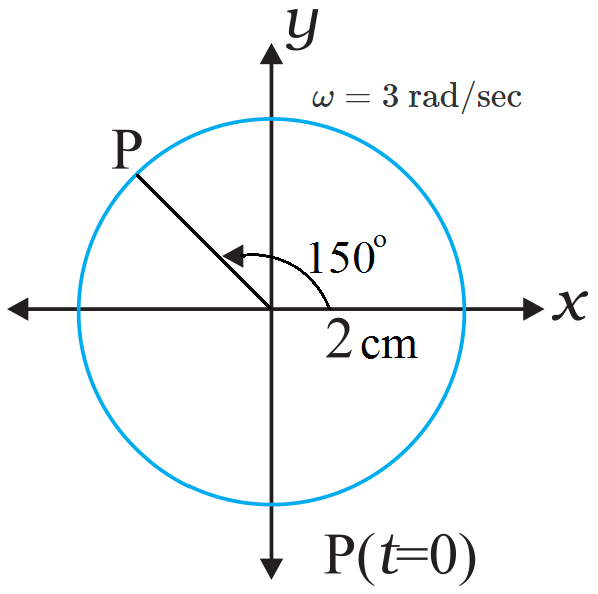
Plot the corresponding reference circle for each of the following simple harmonic motions. Indicate the initial (t = 0) position of the particle, the radius of the circle, and the angular speed of the rotating particle. For simplicity, the sense of rotation may be fixed to be anticlockwise in every case: (x is in cm and t is in s).$\text{x}=-2\sin\Big(3\text{t}+\frac{\pi}{3}\Big)$
Answer

$\text{x}=-2\sin\Big(3\text{t}+\frac{\pi}{3}\Big)=+2\cos\Big(3\text{t}+\frac{\pi}{3}+\frac{\pi}{2}\Big)$$=2\cos\Big(3\text{t}+\frac{5\pi}{6}\Big)$
If this equation is compared with the standard SHM equation $\text{x}=\text{A}\cos\bigg(\Big(\frac{2\pi}{\text{T}}\Big)\text{t}+\phi\bigg),$ then we get:
Amplitude, A = 2cm
Phase angle, $\phi=\frac{5\pi}{6}=150^\circ$
Angular velocity, $\omega=\frac{2\pi}{\text{T}}=3\text{rad/sec.}$
The motion of the particle can be plotted as shown in the following figure.

Need a full question paper?

Generate a complete, print-ready paper with questions like this in minutes — across 16+ boards, with answer keys.

Start Generating Free

Similar questions

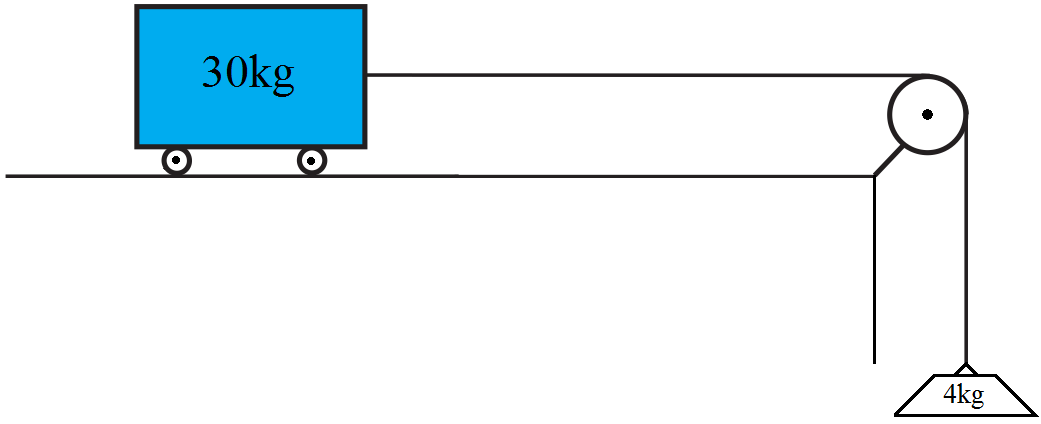
Compute the acceleration of the block and trolley system as shown. If the coefficient of kinetic friction between the trolley and the surface is $0.04$, what is the tension in the string? [Take $g = 10ms^{-2}]$
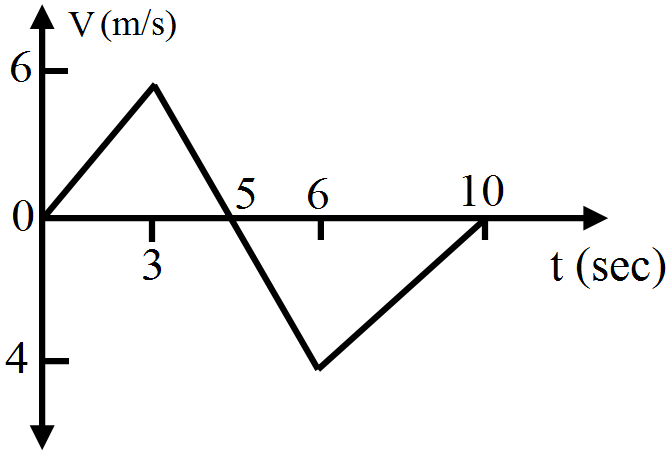
Find the displacement and distance travelled by a body in 10 seconds, using the v - t graph given below:
A uranium reactor develops thermal energy at a rate of 300MW. Calculate the amount of $^{235}U$ being consumed every second. Average released per fission is 200MeV.
A hydrogen atom in state $n = 6$ makes two successive transitions and reaches the ground state. In the first transition a photon of $1.13eV$ is emitted. $(a)$ Find the energy of the photon emitted in the second transition $(b)$ What is the value of n in the intermediate state?
Let AE denote the energy gap between the valence band and the conduction band. The population of conduction electrons (and of the holes) is roughly proportional to $\text{e}^{\frac{-\Delta\text{E}}{2\text{kT}}}.$ Find the ratio of the concentration of condu.ction electrons in diamond to that in silicon at room temperature 300K. $\Delta\text{E}$ for silicon is 1.1eV and for diamond is 6.0eV. How many conduction electrons are likely to be in one cubic metre of diamond?
A wire having linear density of $0.05 gcm ^{-1}$ is stretched between two rigid supports with a tension of $4.5 \times 10^7$ dynes. It is observed that me wire resonates at a frequency of $420 Hz$ . The next higher frequency at which the wire resonates is 490 Hz . Find the length of the wire.
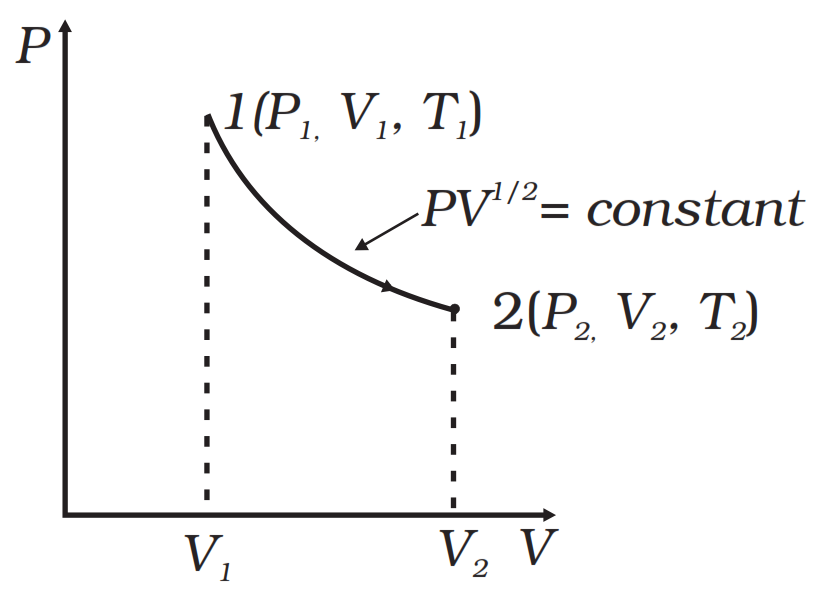
Consider a P-V diagram in which the path followed by one mole of perfect gas in a cylindrical container is shown in Fig.

Given the internal energy for one mole of gas at temperature T is (3/2) RT, find the heat supplied to the gas when it is taken from state (1) to (2) with $V_2 = 2V_{1.}$​​​​​​​
Using $\text{B}=\mu_0\text{H},$ find the ratio $\frac{\text{E}_0}{\text{H}_0}$ for a plane electromagnetic wave propagating through vacuum. Show that it has the dimensions of electric resistance. This ratio is a universal constant called the impedance of free space.
State the law of conservation of momentum. Establish the same for a 'n' body system.
A particle of mass $0.1kg$ is held between two rigid supports by two springs of force constants $8N/ m$ and $2N/ m$. If the particle is displaced along the direction of the length of the springs, calculate its frequency of vibration.