Question
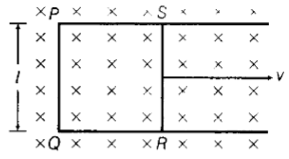
Figure shows a rectangular conducting loop $\text{PQRS}$ in which arm $RS$ of length I is movable. The loop is kept in a uniform magnetic field $B$ directed downward perpendicular to the plane of the loop. The arm $RS$ is moved with a uniform speed $v$.
Image

Deduce an expression for
$i$. the emf induced across the arm $RS$
$ii.$  the external force required to move the arm and
$iii.$ the power dissipated as heat.
Answer

$i.$ Let $RS$ moves with speed $v$ rightward and also $R S$ is at distances $x_1$ and $x_2$ from $PQ$ at instants $t_1$ and $t_2$, respectively.
Change in flux $, d \phi=\phi_2-\phi_1=B l\left(x_2-x_1\right)\left[\because \text { magnetic flux, } \phi=\vec{B} \cdot \vec{A}=B A \cos 0^0=B l x\right]$
$\Rightarrow d \phi=B l d x$
$ \Rightarrow \frac{d \phi}{d t}=B l \frac{d x}{d t}=B l v \quad\left[\because v=\frac{d x}{d t}\right]$
If resistance of loop is $R,$ then $I=\frac{v B I}{R}$
$ ii.$ Magnetic force $=B I l \sin 90^{\circ}$
$=\left(\frac{v B l}{R}\right) B l=\frac{v B^2 l^2}{R}$
Now, External force must be equal to magnetic force
$\therefore$ External force $=\frac{v B^2 l^2}{R}$
$\text { iii. As, } P=I^2 R=\left(\frac{ v B}{R}\right)^2 \times R=\frac{ v ^2 B^2 l^2}{R^2} \times R$
$\therefore P=\frac{ v ^2 B^2 l^2}{R}$

Need a full question paper?

Generate a complete, print-ready paper with questions like this in minutes — across 16+ boards, with answer keys.

Start Generating Free

Similar questions

$\text{ }^{197}_{80}\text{Hg}$ decay to $\text{ }^{197}_{79}\text{Au}$ through electron capture with a decay constant of 0.257 per day.
  1. What other particle or particles are emitted in the decay?
  2. Assume that the electron is captured from the K shell. Use Moseley's law $\sqrt{\text{v}}=\text{a(Z}-\text{b})$ with $\text{a}=4.95\times10^7\text{s}^{-\frac{1}{2}}$ and b = 1 to find the wavelength of the $\text{K}_{\alpha}$ X-ray emitted following the electron capture.
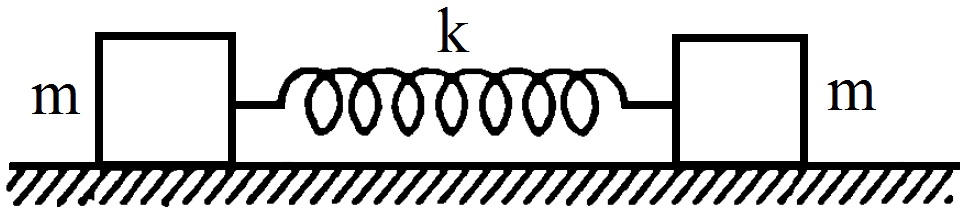
Consider the situation shown in figure Show that if the blocks are displaced slightly in opposite directions and released, they will execute simple harmonic motion. Calculate the time period.
The horn of a car emits sound with a dominant frequency of 2400Hz. What will be the apparent dominant frequency heard by a person standing on the road in front of the car if the car is approaching at 18.0km/h? Speed of sound in air = 340m/s.
  1. Draw a neat labelled ray diagram of an astronomical telescope in normal adjustment. Explain briefly its working.
  2. An astronomical telescope uses two lenses of powers 10 D and 1 D. What is its magnifying power in normal adjustment?
Two neutral particles are kept $1m$ apart. Suppose by some mechanism some charge is transferred from one particle to the other and the electric potential energy lost is completely converted into a photon. Calculate the longest and the next smaller wavelength of the photon possible.
State the principle of a cyclotron. Show that the time period of revolution of particles in a cyclotron is independent of their speeds. Why is this property necessary for the operation of a cyclotron?
$a.$ Write the relationship between mobility and drift velocity in a current carrying conductor.
$b.$ Two aluminium wires have their lengths in the ratio $2 : 3$ and radii in the ratio $1 : 3.$ These are connected in parallel across a battery of $emf \ E$ and of negligible internal resistance. Find the ratio of drift velocities of the electrons in the two wires.
A long, straight wire carries a current. Is Ampere's law valid for a loop that does not enclose the wire? That encloses the wire but is not circular?
Draw the intensity distributions for (i) the fringes produced in interference, and (ii) the diffraction bands produced due to single slit. Write two points of difference between the phenomena of interference and diffraction.
Define critical angle and write the conditions of total internal reflection.