Questions

3 Marks Question

Take a timed test

8 questions · self-marked practice — reveal the answer and mark yourself.

Question 13 Marks
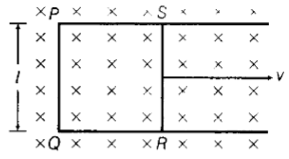
Figure shows a rectangular conducting loop $\text{PQRS}$ in which arm $RS$ of length I is movable. The loop is kept in a uniform magnetic field $B$ directed downward perpendicular to the plane of the loop. The arm $RS$ is moved with a uniform speed $v$.
Image

Deduce an expression for
$i$. the emf induced across the arm $RS$
$ii.$  the external force required to move the arm and
$iii.$ the power dissipated as heat.
Answer
$i.$ Let $RS$ moves with speed $v$ rightward and also $R S$ is at distances $x_1$ and $x_2$ from $PQ$ at instants $t_1$ and $t_2$, respectively.
Change in flux $, d \phi=\phi_2-\phi_1=B l\left(x_2-x_1\right)\left[\because \text { magnetic flux, } \phi=\vec{B} \cdot \vec{A}=B A \cos 0^0=B l x\right]$
$\Rightarrow d \phi=B l d x$
$ \Rightarrow \frac{d \phi}{d t}=B l \frac{d x}{d t}=B l v \quad\left[\because v=\frac{d x}{d t}\right]$
If resistance of loop is $R,$ then $I=\frac{v B I}{R}$
$ ii.$ Magnetic force $=B I l \sin 90^{\circ}$
$=\left(\frac{v B l}{R}\right) B l=\frac{v B^2 l^2}{R}$
Now, External force must be equal to magnetic force
$\therefore$ External force $=\frac{v B^2 l^2}{R}$
$\text { iii. As, } P=I^2 R=\left(\frac{ v B}{R}\right)^2 \times R=\frac{ v ^2 B^2 l^2}{R^2} \times R$
$\therefore P=\frac{ v ^2 B^2 l^2}{R}$
View full question & answer
Question 23 Marks
We are given the following atomic masses:
${ }_{92}^{238} U=238.05079 u$
${ }_2^4 H e=4.00260 u$
${ }_{90}^{234} Th =234.04363 u$
${ }_1^1 H=1.00783 u$
${ }_{91}^{237} Pa=237.05121 u $
Here the symbol $Pa$ is for the element protactinium $(Z = 91).$
$i.$ Calculate the energy released during the alpha decay of ${ }_{92}^{238} U$.
$ii.$ Calculate the kinetic energy of the emitted $\alpha-$particles.
$iii.$ Show that ${ }_{92}^{238} U$ can not spontaneously emit a proton.
Answer
$i.$ The alpha decay of ${ }_{92}^{238} U$. The energy released in this process is given by:-
The $Q$ for this process to happen is
$=\left( M _{ U }- M _{ Pa }- M _{ H }\right) c ^2$
$=(238.05079-237.05121-1.00783) u \times c ^2$
$=(-0.00825 u ) c ^2$
$=-(0.00825 u )(931.5 MeV / u )$
$=-7.68 MeV $
Thus, the $Q$ of the process is negative and therefore it cannot proceed spontaneously.
We will have to supply an energy of $7.68\ MeV$ to a ${ }_{92}^{238} U$ nucleus to make it emit a proton.
View full question & answer
Question 33 Marks
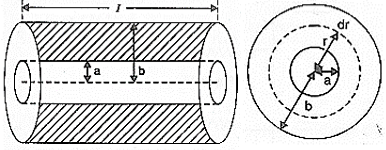
A homogeneous poorly conducting medium of resistivity fills up the space between two thin coaxial ideally conducting cylinders. The radii of the cylinders are equal to a and b with a < b, the length of each cylinder is l. Neglecting the edge effects, find the resistance of the medium between the cylinders.
Answer
The current will be conducted radially outwards from the inner conductor (say) to the outer. The area of cross section for the conduction of the current is, therefore, the area of an elementary cylindrical shell and which varies with radius. The length of the conducting shell is measured radially from radius a to radius bImage

Consider an elementary cylindrical shell of radius r and thickness dr. Its area of cross section (normal to flow of current) $=2 \pi r l$ and its length $= dr$.
Hence, the resistance of the elementary cylindrical shell of the medium is
$d R=\frac{\rho d r}{2 \pi r l}=\frac{\rho}{2 \pi l}\left[\frac{d r}{r}\right]$
The resistance of the medium is obtained by integrating for $r$ from $a$ to $b$.
Hence required resistance
$R=\frac{\rho}{2 \pi l} \int_a^b \frac{d r}{r}=\frac{\rho}{2 \pi l}\left[\log _e\right]_a^b=\left(\frac{\rho}{2 \pi l}\right) \log _e \frac{b}{a}$
View full question & answer
Question 43 Marks
Define the term self$-$inductance of a solenoid. Obtain the expression for the magnetic energy stored in an inductor of self$-$inductance $L$ to build up a current I through it.
Answer
Using formula, $|-\varepsilon|=L \frac{d I}{d t}$
If $\frac{d I}{d t}=1 A / s$, then $L =|-\varepsilon|$
Self inductance of the coil is equal to the magnitude of induced emf produced in the coil itself when the current varies at rate $1 A/s.$
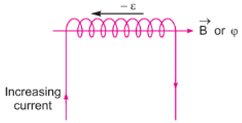
Expression for magnetic energy:
Image
When a time varying current flows through the coil, back emf $(−ε)$ produces, which opposes the growth of the current flow.
It means some work needs to be done against induced emf in establishing a current $I.$
​​​​​​​This work done will be stored as magnetic potential energy.
For the current $I$ at any instant, the rate of work done is
$\frac{d W}{d t}=(-\varepsilon) I$
Only for inductive effect of the coil $|-\varepsilon|=L \frac{d I}{d t}$
$\therefore \frac{d W}{d t}=L\left(\frac{d I}{d t}\right) I$
$\Rightarrow d W=L I d I$
From work$-$energy theorem,
$ dU = LIdI$
$\therefore U=\int_0^I L I d I=\frac{1}{2} L I^2$
View full question & answer
Question 53 Marks
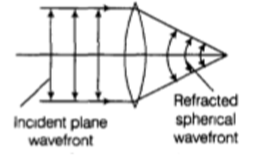
Define the term wavefront. State Huygen's principle. Consider a plane wavefront incident on a thin convex lens. Draw a proper diagram to show how the incident wavefront traverses through the lens and after refraction focusses on the focal point of the lens, giving the shape of the emergent wavefront.
Answer
When light is emitted from a source, then the particles present around it begins to vibrate. The locus of all such particles which are vibrating in the same phase is termed as wavefront. 
Huygens' principle: Every point on a wave-front may be considered a source of secondary spherical wavelets which spread out in the forward direction at the speed of light. The new wave-front is the tangential surface to all of these secondary wavelets. Now when a plane wavefront (parallel rays) is incident on a thin convex lens, the emergent rays are focused on the focal point of the lens. Thus the shape of emerging wavefront is spherical. 
Image
View full question & answer
Question 63 Marks
$a.$ Using the Bohr's model, calculate the speed of the electron in a hydrogen atom in the $n = 1, 2$ and $3$ levels.
$b$. Calculate the orbital period in each of these levels.
Answer
$a$ .Now, $v=\frac{c}{n} \alpha$,
where $\alpha=\frac{2 \pi K e^2}{c h}=0.0073$
$v_1=\frac{3 \times 10^8}{1} \times 0.0073$
$=2.19 \times 10^6 m / s$
$v_2=\frac{3 \times 10^8}{3} \times 0.0073$
$=1.095 \times 10^6 m / s$
$v_3=\frac{3 \times 10^8}{3} \times 0.0073$
$=7.3 \times 10^5 m / s $
$b.$ Orbital period, $T=\frac{2 \pi r}{v}$
$\text { As } r_1=0.53 \times 10^{-10} m$
$T_1=\frac{2 \pi \times 0.53 \times 10^{-10}}{2.19 \times 10^6}$
$=1.52 \times 10^{-16} s$
$ As _2=4 r _1 $ and $ v_2=\frac{1}{2} v_1$
$T_2=8 T_1=8 \times 1.52 \times 10^{-16} s$
$=1.216 \times 10^{-15} s$
$ As _3=9 r _1 \text { and } v_3=\frac{1}{3} v_1$
$\therefore T_3=27 T_1=27 \times 1.52 \times 10^{-16} s$
$=4.1 \times 10^{-15} s$
View full question & answer
Question 73 Marks
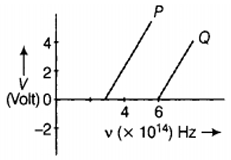
In the study of a photoelectric effect, the graph between the stopping potential $V$ and frequency of the incident radiation on two different metals $P$ and $Q$ is shown below.
Image
$i$. Which one of the two metals has higher threshold frequency?
$ii.$ Determine the work function of the metal which has greater value.
Answer
$i$. Einstein's photoelectric equation is given by,
$h \nu=\phi+eV$
$V=\frac{h \nu}{e}-\frac{\phi}{v} ........(i)$
Eq. $(1)$ represents a straight line given by line $P$ and $Q, \frac{\phi}{e}$ represents negative intercept on the $Y-$ axis.
Since $Q$ has greater negative intercept, it will have greater $\phi \ ($work function$)$ and hence higher threshold frequency.
$ii$. To know work function of $Q,$
we put $V = 0$ in $(i),$
$0=\frac{h \nu}{e}-\frac{\phi}{e} $
$\Rightarrow \phi=h \nu$
$\therefore \phi=6.6 \times 10^{-34} \times 6 \times 10^{14} J$
$=\frac{6.6 \times 6 \times 10^{-20}}{1.6 \times 10^{-19}} eV $
$=25 eV $
View full question & answer
Question 83 Marks
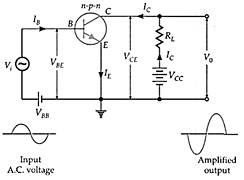
Draw a circuit diagram of a transistor amplifier in CE configuration. Under what condition does the transistor act as an amplifier?
Define the terms:
i. Input resistance and
ii. Current amplification factor. How are these determined using typical input and output characteristics?
Answer
Image

Condition: For a transistor to act as an amplifier, it must be operated close to the centre of its active region.
Input resitance:
$R _{ i }=\left[\frac{\Delta V_{B E}}{\Delta I_B}\right]_{V_{O E}=\text { constant }}$
Its value is determined from the slope of $I_B$ versus $V_{B E}$ curve at constant $V_{C E}$.
Current amplification factor,
$\beta_{a c}=\left[\frac{\Delta I_C}{\Delta I_B}\right]_{V_{C E}=\text { constant }}$
Its value is determined from the $I _{ C } vs . V _{ CE }$ curves plotted with different values of $I _{ B }$.

View full question & answer