Question
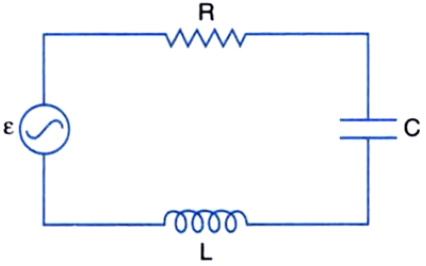
Figure shows a series LCR circuit connected to a variable frequency 230V source. L = 5.0H, C = 80μF, R = 40Ω.

  1. Determine the source frequency which drives the circuit in resonance
  2. Obtain the impedance of the circuit and the amplitude of current at the resonating frequency.
  3. Determine the rms potential drops across the three elements of the circuit. Show that the potential drop across the LC combination is zero at the resonating frequency.

Answer

Here, we are given a LCR circuit.

Inductance, L = 5.0H

Resistance, $\text{R}=40\Omega$

Capacitance, C = 80μF = 80 × 10-6F

Effective voltage, Ev = 230volt

$\Rightarrow\ \text{Peak voltage},\ \text{E}_0=\sqrt{2}\text{E}_{\text{v}}=\sqrt{2}\times230\text{V}$

  1. Resonance angular frequency is given by

$\omega_{\text{r}}=\frac{1}{\sqrt{\text{LC}}}$

$=\frac{1}{\sqrt{5\times80\times10^{-6}}}$

$=\frac{1}{2\times10^{-2}}$

= 50rad/sec.

  1. Impedance of the circuit,

$\text{Z}=\sqrt{\text{R}^2+\big(\omega\text{L}-\frac{1}{\omega\text{C}}\big)^2}$

At resonance, $\omega\text{L}=\frac{1}{\omega\text{C}}$

Therefore,

$\text{Z}=\sqrt{\text{R}^2}=\text{R}=40\Omega$

Amplitude of current at resonating frequency

Peak value of current, $\text{I}_0=\frac{\text{E}_0}{\text{z}}=\frac{\sqrt{2}\times230}{40}=8.13\text{A}$

Rms value of current, $\text{I}_{\text{v}}=\frac{\text{I}_0}{\sqrt{2}}=\frac{8.13}{\sqrt{2}}=5.75\text{A}$

  1. Potential drop across L

$\text{V}_{\text{L rms}}=\text{I}_\text{v}\omega_{\text{r}}\text{L}$

= 5.75 × 50 × 5.0

= 1437.5V

Potential drop across R

VR rms = Iv × R

= 5.75 × 40

= 230volts

Potential drop across C

$\text{V}_{\text{C rms}}=\text{I}_{\text{v}}\Big(\frac{1}{\omega_{\text{r}}\text{C}}\Big)$

$=5.75\times\frac{1}{50\times80\times10^{-6}}$

$=\frac{5.75}{4}\times10^3$

= 1437.5V

Therefore,

Potential drop across LC circuit

VLC rms = VL rms - VC rms = 0

Thus, the potential drop across the LC combination is zero at the resonating frequency.
Need a full question paper?

Generate a complete, print-ready paper with questions like this in minutes — across 16+ boards, with answer keys.

Start Generating Free

Similar questions

  1. Derive an expression for the force between two long parallel current carrying conductors.
  2. Use this expression to define S.I. unit of current.
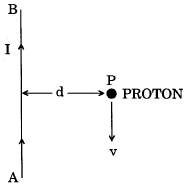
  3. A long straight wire AB carries a current I. A proton P travels with a speed v, parallel to the wire, at a distance d from it in a direction opposite to the current as shown in the figure. What is the force experienced by the proton and what is its direction?

Two charges 2.0 × 10-6C and 1.0 × 10-6C are placed at a separation of 10cm. Where should a third charge be placed such that it experiences no net force due to these charges?
A 250g block slides on a rough horizontal table. Find the work done by the frictional force in bringing the block to rest if it is initially moving at a speed of 40cm/s. If the friction coefficient between the table and the block is 0.1, how far does the block move before coming to rest?
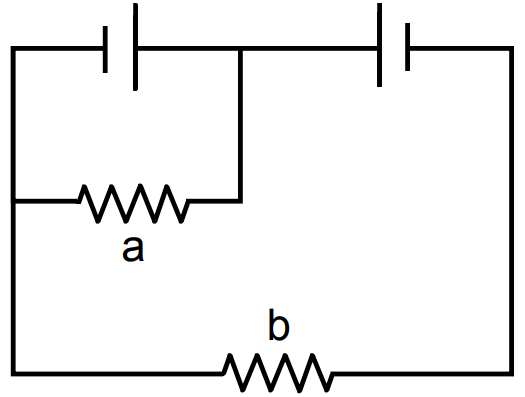
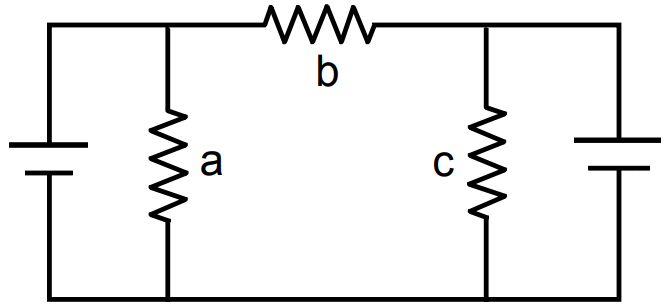
Each of the resistors shown in figure. has a resistance of $10\Omega$ and each of the batteries has an emf of 10V. Find the currents through the resistors a and b in the two circuits.


A convex lens has a focal length of 10cm. Find the location and nature of the image if a point object is placed on the principal axis at a distance of:
  1. 9.8cm
  2. 10.2cm from the lens.
Calculate the smallest wavelength of radiation that may be emitted by (a) hydrogen, (b) He+ and (c) Li++
A small plane area is rotated in an electric field. In which orientation of the area is the flux of electric field through the area maximum? In which orientation is it zero?
Two masses m1 and m2 are connected by a spring of spring constant k and are placed on a frictionless horizontal surface. Initially the spring is stretched through a distance x0 when the system is released from rest. Find the distance moved by the two masses before they again come to rest.
Two wires are kept tight between the same pair of supports. The tensions in the wires are in the ratio 2 : 1, the radii are in the ratio 3 : 1 and the densities are in the ratio 1 :2. Find the ratio of their fundamental frequencies.
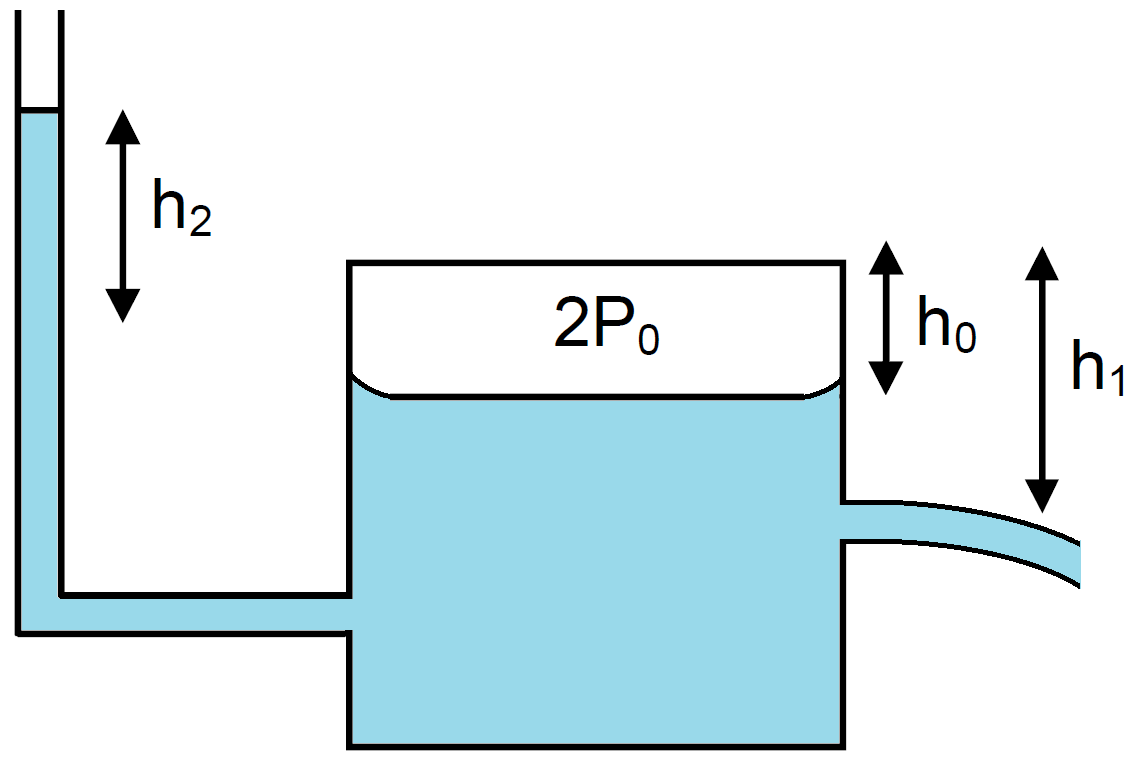
Figure. shows a large closed cylindrical tank containing water. Initially the air trapped above the water surface has a height h0 and pressure 2p0 where p0 is the atmospheric pressure. There is a hole in the wall of the tank at a depth h1 below the top from which water comes out. A long vertical tube is connected as shown.
  1. Find the height h2 of the water in the long tube above the top initially.
  2. Find the speed with which water comes out of the hole.
  3. Find the height of the water in the long tube above the top when the water stops coming out of the hole.