MCQ
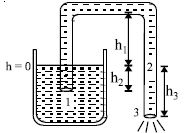
Figure shows a siphon. Choose the wrong statement:

($P_0$ = atmospheric pressure)
  • A
    Siphon works when $h_3 > 0$
  • B
    Pressure at point $2$ is $P_2 = P_0 - \rho gh_3$
  • C
    Pressure at point $3$ is $P_0$
  • None of the above 

Answer

Correct option: D.
None of the above 
d
By Bernoulli equation

$\mathrm{P}_{0}+\rho \mathrm{gh}_{3}=\mathrm{P}_{0}+1 / 2 \rho \mathrm{v}^{2}$

$1 / 2 \rho v^{2}=\rho g h_{3}$

$\mathrm{P}_{0}=\mathrm{P}_{2}+1 / 2 \rho \mathrm{v}^{2}$

$\mathrm{P}_{2}=\mathrm{P}_{0}-\rho \mathrm{gh}_{3}$

Need a full question paper?

Generate a complete, print-ready paper with questions like this in minutes — across 16+ boards, with answer keys.

Start Generating Free

Similar questions

If $L$ denotes the inductance of an inductor through which a current $i$ is flowing, the dimensions of $L{I^2}$ are
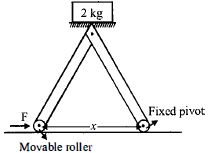
The machine as shown has $2$ rods of length $1\, m$ connected by a pivot at the top. The end of one rod is connected to the floor by a stationary pivot and the end of the other rod has a roller that rolls along the floor  in a slot As the roller goes back and forth, a $2\, kg$ weight moves up and down. If the roller is moving towards right at a constant speed, the weight moves up with a
Consider two containers $A$ and $B$ containing identical gases at the same pressure, volume and temperature. The gas in container $A$ is compressed to half of its original volume isothermally while the gas in container $B$ is compressed to half of its original value adiabatically. The ratio of final pressure of gas in $B$ to that of gas in $A$ is
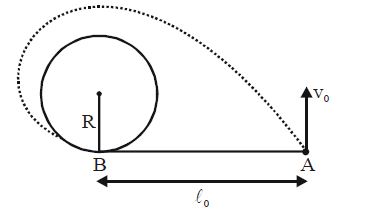
A horizontal plane supports a stationary vertical cylinder of radius $R = 1\ m$ and a disc $A$ attached to the cylinder by a horizontal thread $AB$ of length $l_0 = 2\ m$ (seen in figure, top view). An intial velocity ($v_0 = 1\ m/s$) is imparted $AB$ to the disc as shown in figure. .......... $\sec$ long will it move along the plane until it strikes against the cylinder ? (All surface are assumed to be smooth)
Two vectors $\overrightarrow{ A }$ and $\overrightarrow{ B }$ have equal magnitudes. If magnitude of $\overrightarrow{ A }+\overrightarrow{ B }$ is equal to two times the magnitude of $\overrightarrow{ A }-\overrightarrow{ B }$, then the angle between $\overrightarrow{ A }$ and $\overrightarrow{ B }$ will be .......................
A force $\vec{F}=(2 \hat{i}+3 \hat{j}-5 \hat{k}) \,N$ acts at a point $\vec{r}_1=(2 \hat{i}+4 \hat{j}+7 \hat{k}) \,m$. The torque of the force about the point $\vec{r}_2=(\hat{i}+2 \hat{j}+3 \hat{k}) \,m$ is ............. $Nm$
In a car race on straight road, car $A$ takes a time $t$ less than car $B$ at the finish and passes finishing point with a speed $v$ more than that of car $B.$ Both the cars start from rest and travel with constant acceleration $a_1$ and $a_2$ respectively. Then $v$ is equal to
If the sum of two unit vectors is a unit vector, then magnitude of difference is
$ABCDEF$ is a regular hexagon and forces represented in magnitude and direction by  $AB, AC,AD, AE$ and $AF$ act at $A$. Their resultant is :
Which of the following quantities increase when wavelength is increased? Consider only the magnitudes.
  1. The power of a converging lens.
  2. The focal length of a converging lens.
  3. The power of a diverging lens.
  4. The focal length of a diverging lens.