Question
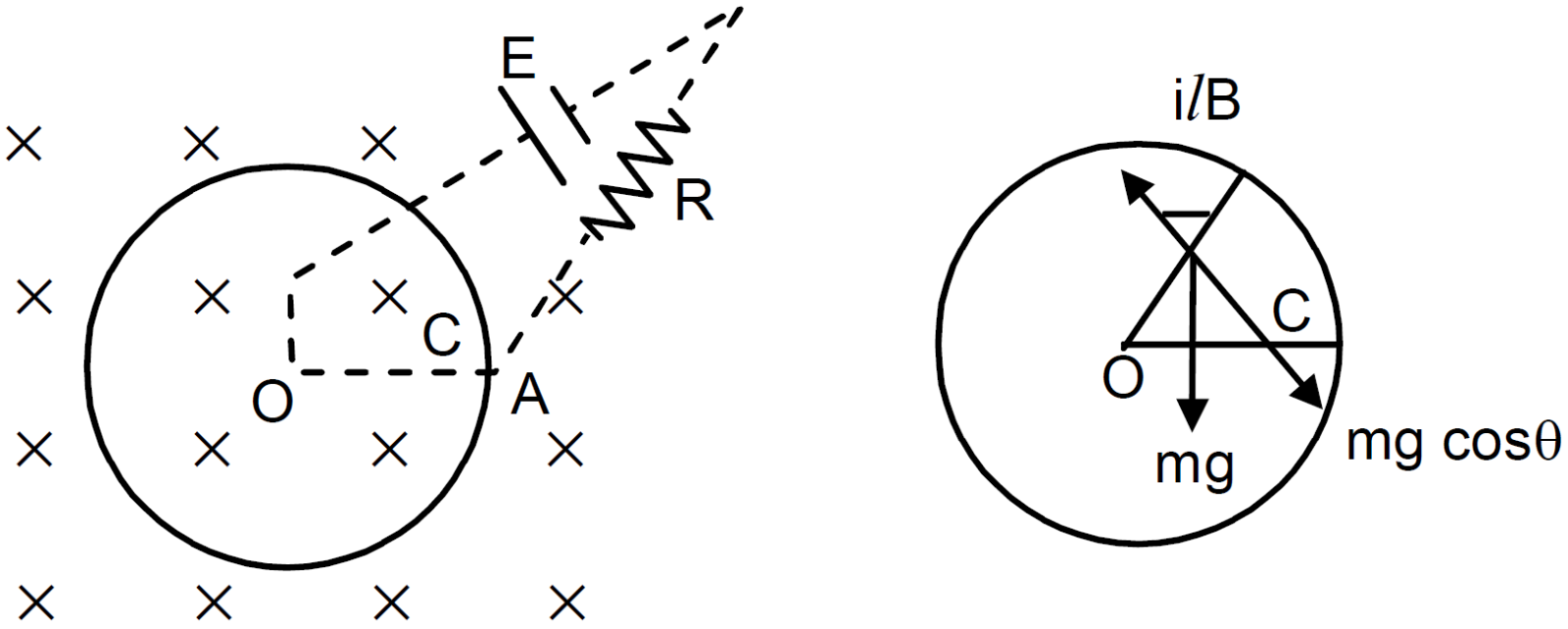
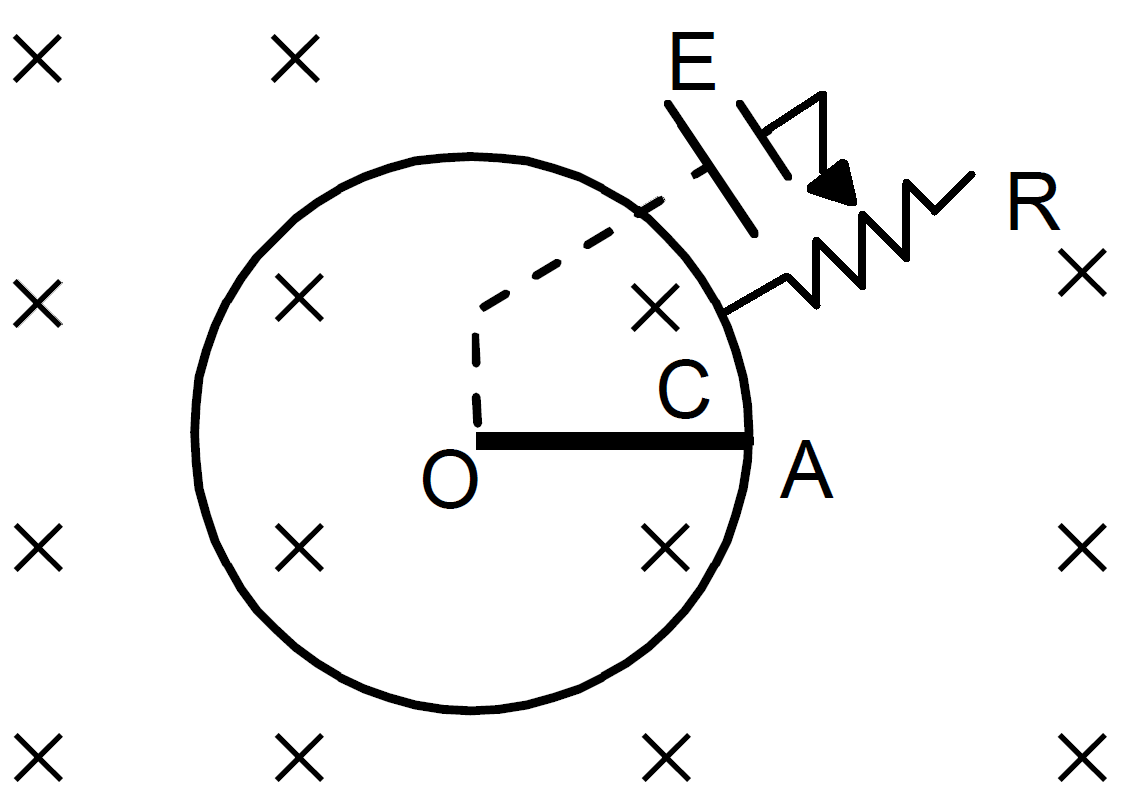
Figure shows a situation similar to the previous problem. All parameters are the same except that a battery of emf $\in$ and a variable resistance R are connected between O and C. The connecting wires have zero resistance. No external force is applied on the rod (except gravity, forces by the magnetic field and by the pivot). In what way should the resistance R be changed so that the rod may rotate with uniform angular velocity in the clockwise direction? Express your answer in terms of the given quantities and the angle $\theta$ made by the rod OA with the horizontal.
Answer


$\text{emf}=\frac{1}{2}\text{B}\omega\text{a}^2$ [from previous problem]

Current $= \frac{\text{e}+\text{E}}{\text{R}}=\frac{\frac{1}{2}\times\text{B}\omega\text{a}^2+\text{E}}{\text{R}}$

$=\frac{\text{B}\omega\text{a}^2 +2\text{E}}{2\text{R}}$

$\Rightarrow \text{mg} \cos \theta =\text{ilB}$ [Net force acting on the rod is O]

$\Rightarrow \text{mg}\cos\theta =\frac{\text{B}\omega\text{a}^2+2\text{E}}{2\text{R}}\text{a}\times\text{B}$

$\Rightarrow \text{R}=\frac{\big(\text{B}\omega\text{a}^2+2\text{E}\big)\text{ab}}{2\text{mg}\cos\theta}$

Need a full question paper?

Generate a complete, print-ready paper with questions like this in minutes — across 16+ boards, with answer keys.

Start Generating Free

Similar questions

The $\text{K}_\beta$ X-rays from certain elements are given below. Draw a Moseley-type plot of $\sqrt{\text{v}}$ versus Z for $\text{K}_\beta$ radiation.
Element
Ne
P
Ca
Mn
Zn
Br
Energy (keV)
0.858
2.14
4.02
6.51
9.57
13.3
An astronomical telescope is to be designed to have a magnifying power of 50 in normal adjustment. If the length of the tube is 102cm, find the powers of the objective and the eyepiece.
Find the magnitude of the electric field at the point P in the configuration shown in figure for d >> a. Take 2qa = p.

Assume that a tunnel is dug along a chord of the earth, at a perpendicular distance $\frac{\text{R}}{2}$ from the earth's centre where R is the radius of the earth. The wall of the tunnel is frictionless.
  1. Find the gravitational force exerted by the earth on a particle of mass m placed in the tunnel at a distance x from the centre of the tunnel.
  2. Find the component of this force along the tunnel and perpendicular to the tunnel.
  3. Find the normal force exerted by the wall on the particle.
  4. Find the resultant force on the particle.
  5. Show that the motion of the particle in the tunnel is simple harmonic and find the time period.
Suppose there is a circuit consisting of only resistances and batteries. Suppose one is to double (or increase it to n-times) all voltages and all resistances. Show that currents are unaltered.
The $\text{K}_\alpha$ and $\text{K}_\beta$ X-rays of molybdenum have wavelengths 0.71A and 0.63A respectively. Find the wavelength of $\text{L}_\alpha$ X-ray of molybdenum.
A block of weight 100N is slowly slid up on a smooth incline of inclination 37° by a person. Calculate the work done by the person in moving the block through a distance of 2.0m, if the driving force is:
  1. Parallel to the incline.
  2. In the horizontal direction.
A light beam of wavelength 400 run is incident on a metal plate of work function 2.2eV.
  1. A particular electron absorbs a photon and makes two collisions before coming out of the metal. Assuming that 10% of the extra energy is lost to the metal in each collision, find the kinetic energy of this electron as it comes out of the metal.
  2. Under the same assumptions, find the maximum number of collisions the electron can suffer before it becomes unable to come out of the metal.
A capacitor of capacitance $10\mu\text{F}$ is connected to an oscillator with output voltage $\in=(10\text{V})\sin\omega\text{t}.$ Find the peak currents in the circuit for $\omega=10\text{s}^{-1},100\text{s}^{-1},500\text{s}^{-1},1000\text{s}^{-1}.$
Is the formula you employ in (a) valid for calculating radius of the path of a 20 MeV electron beam? If not, in what way is it modified?