Question
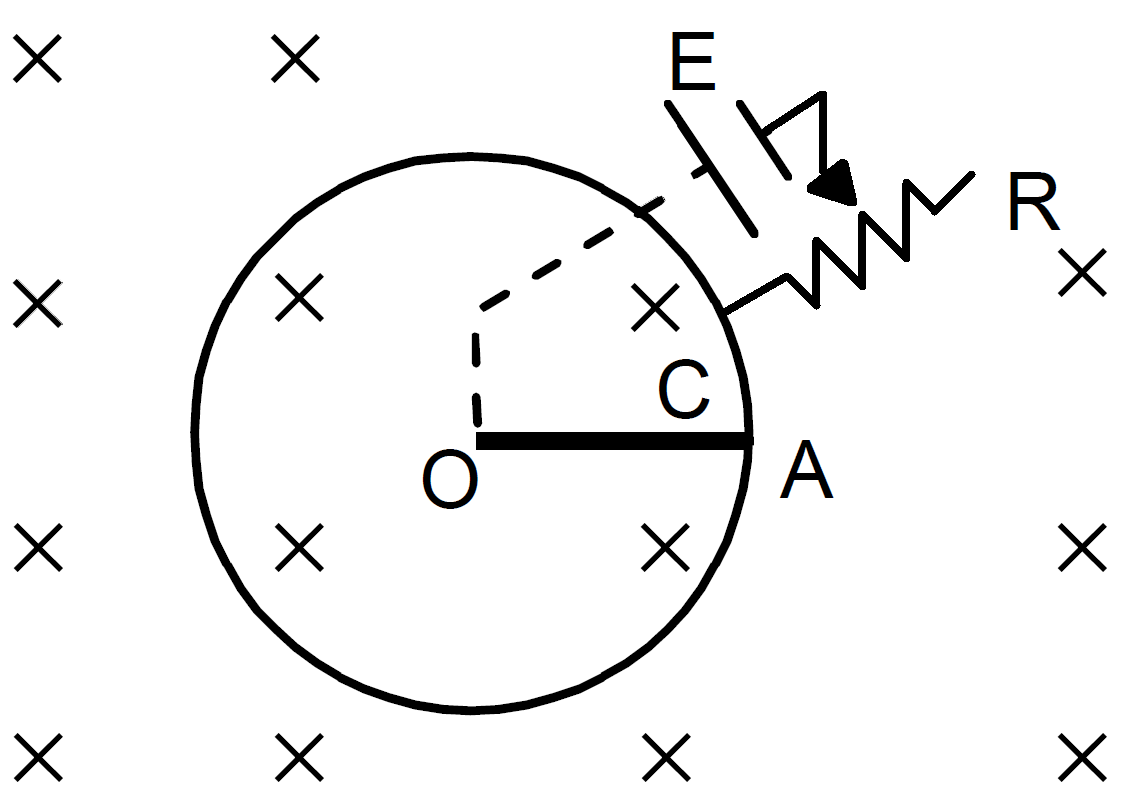
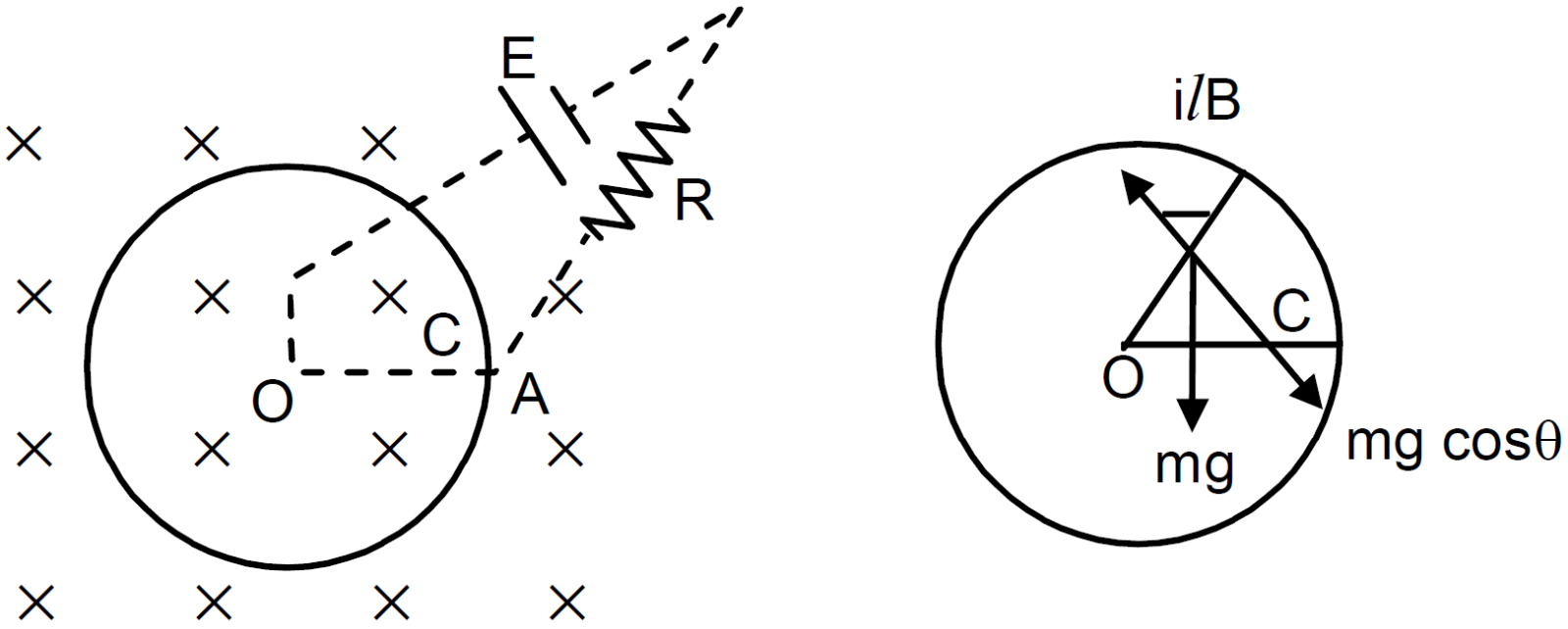
Figure shows a situation similar to the previous problem. All parameters are the same except that a battery of emf $\in$ and a variable resistance R are connected between O and C. The connecting wires have zero resistance. No external force is applied on the rod (except gravity, forces by the magnetic field and by the pivot). In what way should the resistance R be changed so that the rod may rotate with uniform angular velocity in the clockwise direction? Express your answer in terms of the given quantities and the angle $\theta$ made by the rod OA with the horizontal.
Answer


$\text{emf}=\frac{1}{2}\text{B}\omega\text{a}^2$ [from previous problem]
Current $= \frac{\text{e}+\text{E}}{\text{R}}=\frac{\frac{1}{2}\times\text{B}\omega\text{a}^2+\text{E}}{\text{R}}$
$=\frac{\text{B}\omega\text{a}^2 +2\text{E}}{2\text{R}}$
$\Rightarrow \text{mg} \cos \theta =\text{ilB}$ [Net force acting on the rod is O]
$\Rightarrow \text{mg}\cos\theta =\frac{\text{B}\omega\text{a}^2+2\text{E}}{2\text{R}}\text{a}\times\text{B}$
$\Rightarrow \text{R}=\frac{\big(\text{B}\omega\text{a}^2+2\text{E}\big)\text{ab}}{2\text{mg}\cos\theta}$

Need a full question paper?

Generate a complete, print-ready paper with questions like this in minutes — across 16+ boards, with answer keys.

Start Generating Free

Similar questions

Find the time period of mass M when displaced from its equilibrium positon and then released for the system shown in figure.
A current of $1.0A$ exists in a copper wire of cross-section $1.0mm^2$. Assuming one free electron per atom, calculate the drift speed of the free electrons in the wire. The density of copper is $9000kg/m^{-3}$.
Assuming the length of a chain to be L and coefficient of static friction $\mu,$ calculate the maximum length of the chain which can be held outside a table without sliding.
Find the variation of acceleration due to gravity below the surface of earth at depth d.OR
Write Kepler's laws for planetary motion.
A stone of mass m is tied to an elastic string of negligble mass and spring constant k. The unstretched length of the string is L and has negligible mass. The other end of the string is fixed to a nail at a point P. Initially the stone is at the same level as the point P. The stone is dropped vertically from point P.
  1. Find the distance y from the top when the mass comes to rest for an instant, for the first time.
  2. What is the maximum velocity attained by the stone in this drop?
  3. What shall be the nature of the motion after the stone has reached its lowest point?
A racing car travels on a track (without banking) ABCDEFA ABC is a circular arc of radius 2 R. CD and FA are straight paths of length R and DEF is a circular arc of radius $R = 100 m$. The co-effecient of friction on the road is $\mu = 0.1.$ The maximum speed of the car is $50m s^{–1}$. Find the minimum time for completing one round.
The motion of a particle executing simple harmonic motion is described by the displacement function, $x ( t )= A \cos (\omega t$ $+\phi)$ If the initial $(t=0)$ position of the particle is 1 cm and its initial velocity is $\omega cm / s$, then what are its amplitude and initial phase angle? The angular frequency of the particle is $\pi s ^{-1}$. If instead of the cosine function, we choose the sine function to describe the $SHM , x = B \sin (\omega t +\phi)$, then what are the amplitude and initial phase of the particle with the above initial conditions?
Three vessels of equal capacity have gases at the same temperature and pressure. The first vessel contains neon (monatomic), the second contains chlorine (diatomic), and the third contains uranium hexafluoride (polyatomic). Do the vessels contain equal number of respective molecules? Is the root mean square speed of molecules the same in the three cases? If not, in which case is vrms the largest?
Suppose the particle of the previous problem has a mass m and a speed v before the collision and it sticks to the rod after the collision. The rod has a mass M:
  1. Find the velocity of the centre of mass C of the system constituting ''The rod plus the particle''.
  2. Find the velocity of the particle with respect to C before the collision.
  3. Find the velocity of the rod with respect to C before the collision.
  4. Find the angular momentum of the particle and of the rod about the centre of mass C before the collision.
  5. Find the moment of inertia of the system about the vertical axis through the centre of mass C after the collision.
  6. Find the velocity of the centre of mass C and the angular velocity of the system about the centre of mass after the collision.
A wave is described by the equation$\text{y}=(1.0\text{mm})\sin\pi\Big(\frac{\text{x}}{2.0\text{cm}}-\frac{\text{t}}{0.01\text{s}}\Big).$
  1. Find the time period and the wavelength.
  2. Write the equation for the velocity of the particles. Find the speed of the particle at x = 1.0cm at time t = 0.01s.
  3. What are the speeds of the particles at x = 3.0cm, 5.0cm and 7.0cm at t 0.01s?
  4. What are the speeds of the particles at x 1.0cm at t = 0.011, 0.012, and 0.013s?