Suppose the particle of the previous problem has a mass m and a speed v before the collision and it sticks to the rod after the collision. The rod has a mass M:
- Find the velocity of the centre of mass C of the system constituting ''The rod plus the particle''.
- Find the velocity of the particle with respect to C before the collision.
- Find the velocity of the rod with respect to C before the collision.
- Find the angular momentum of the particle and of the rod about the centre of mass C before the collision.
- Find the moment of inertia of the system about the vertical axis through the centre of mass C after the collision.
- Find the velocity of the centre of mass C and the angular velocity of the system about the centre of mass after the collision.
Download our app for free and get started
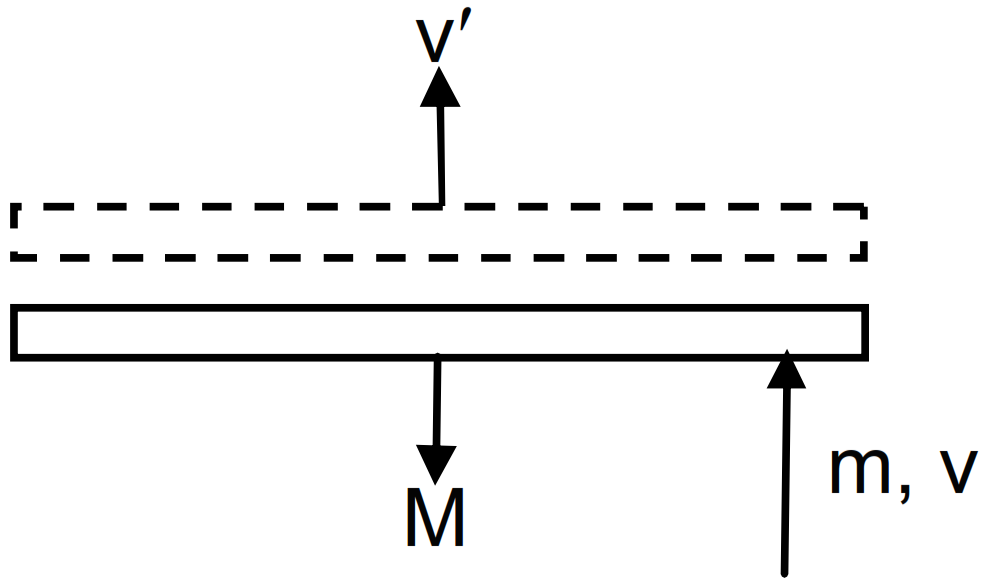
- If we take the two bodies as a system therefore total external force = 0
$\text{mV}=(\text{M}+\text{m})\text{v}'$
$\Rightarrow\text{v}'=\frac{\text{m}\text{v}}{\text{M}+\text{m}}$
- Let the velocity of the particle w.r.t. the centre of mass = V'
$\Rightarrow\text{v}'=\frac{\text{Mv}}{\text{M}+\text{m}}$
- If the body moves towards the rod with a velocity of v, i.e. the rod is moving with a velocity - v towards the particle.
$\Rightarrow\text{V}^{-}=\frac{\text{M}\times\text{O}=\text{m}\times\text{v}}{\text{M}+\text{m}}=\frac{-\text{mv}}{\text{M}+\text{m}}$
- The distance of the centre of mass from the particle
Therefore angular momentum of the particle before the collision
$=\text{l}\omega=\text{Mr}^2\text{cm}\omega$
$=\text{m}\Bigg\{\frac{\text{m}\big(\frac{1}{2}\big)}{(\text{M}+\text{m})}\Bigg\}^2\times\frac{\text{V}}{\frac{1}{2}}$
$=\frac{(\text{mM}^2\text{vl})}{2(\text{M}+\text{m})}$
Distance of the centre of mass from the centre of mass of the rod $=\text{R}^1_{\text{cm}}=\frac{\text{M}\times0+\text{m}\times\big(\frac{1}{2}\big)}{(\text{M}+\text{m})}=\frac{\big(\frac{\text{ml}}{2}\big)}{(\text{M}+\text{m})}$
Therefore angular momentum of the rod about the centre of mass
$=\text{MV}_{\text{cm}}\text{R}_{\text{cm}}^1$
$=\text{M}\times\Big\{\frac{(-\text{mv})}{(\text{M}+\text{m})}\Big\}\Bigg\{\frac{\big(\frac{\text{ml}}2{}\big)}{(\text{M}+\text{m})}\Bigg\}$
$=\Bigg|\frac{-\text{Mm}^2\text{lv}}{2(\text{M}+\text{m})^2}\Bigg|=\frac{\text{Mm}^2\text{lv}}{2(\text{M}+\text{m})^2}$ (If we consider the magnitude only)
- Moment of inertia of the system = M.I. due to rod + M.I. due to particle
$=\frac{\text{Ml}^2(\text{M}+\text{4m})}{12(\text{M}+\text{m})}$
- Velocity of the centre of mass $\text{V}_{\text{m}}=\frac{\text{M}\times0+\text{mV}}{(\text{M}+\text{m})}=\frac{\text{mV}}{(\text{M}+\text{m})}$
(Because External force = 0)
Angular velocity of the system about the centre of mass,
$\text{P}_{\text{cm}}=\text{l}_{\text{cm}}\omega$
$\Rightarrow\text{M}\vec{\text{V}}_{\text{M}}\times\vec{\text{r}}_{\text{m}}+\text{m}\vec{\text{v}}_{\text{m}}\times\vec{\text{r}}_{\text{m}}=\text{l}_{\text{cm}}\omega$
$\Rightarrow\text{M}\times\frac{\text{mv}}{(\text{M}+\text{m})}\times\frac{\text{ml}}{2(\text{M}+\text{m})}+\text{m}\times\frac{\text{Mv}}{(\text{M}+\text{m})}\times\frac{\text{Ml}}{2(\text{M}+\text{m})}$
$=\frac{\text{Ml}^2(\text{M}+\text{4m})}{12(\text{M}+\text{m})}\times\omega$
$\Rightarrow\frac{\text{M}\text{m}^2\text{vl}+\text{m}\text{M}^2\text{vl}}{2(\text{M}+\text{m})^2}=\frac{\text{Ml}^2(\text{M}+\text{m})}{12(\text{M}+\text{m})}\times\omega$
$\Rightarrow\frac{\frac{\text{Mm}}{(\text{M}+\text{m})}}{2(\text{M}+\text{m})^2}=\frac{\text{Ml}^2(\text{M}+\text{m})}{12(\text{M}+\text{m})}\times\omega$
$\Rightarrow\frac{6\text{mv}}{(\text{M}+\text{4m})\text{l}}=\omega$

Download our appand get started for free
Experience the future of education. Simply download our apps or reach out to us for more information. Let's shape the future of learning together!No signup needed.*
Similar Questions
- 1View SolutionObtain an expression for linear acceleration of a cylinder rolling down an inclined plane and hence find the condition for the cylinder to roll down the inclined plane without slipping.
- 2View SolutionShow that a(b × c) is equal in magnitude to the volume of the parallelepiped formed on the three vectors a, b and c.
- 3View SolutionA solid sphere rolls down two different inclined planes of the same heights but different angles of inclination.
- Will it reach the bottom with the same speed in each case?
- Will it take longer to roll down one plane than the other?
- If so, which one and why?
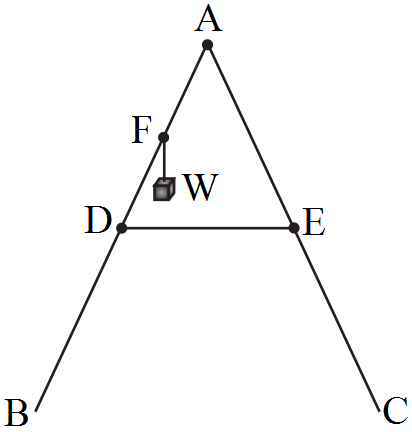
- 4As shown in the two sides of a step ladder BA and CA are $1.6m$ long and hinged at A. A rope DE, $0.5m$ is tied half way up. A weight $40kg$ is suspended from a point F, 1.2m from B along the ladder BA. Assuming the floor to be frictionless and neglecting the weight of the ladder, find the tension in the rope and forces exerted by the floor on the ladder. (Take $g = 9.8m/s^2$) (Hint: Consider the equilibrium of each side of the ladder separately).View Solution
- 5Prove the result that the velocity v of translation of a rolling body (like a ring, disc, cylinder or sphere) at the bottom of an inclined plane of a height h is given by $\text{v}^2=\frac{2\text{gh}}{\Big(\frac{1+\text{k}^2}{\text{R}^2}\Big)}$ using dynamical consideration (i.e. by consideration of forces and torques).View Solution
Note: k is the radius of gyration of the body about its symmetry axis, and R is the radius of the body. The body starts from rest at the top of the plane. - 6A meter stick held vertically, with one end on the ground, is then allowed to fall. What is the value of the radial and tangential acceleration of the top end of the stick when the stick has turned through on angle $\theta?$ What is the speed with which the top end of the stick hits the ground? Assume that the end of the stick in. contact with the ground does not slip.View Solution
- 7In the HCl molecule, the separation between the nuclei of the two atoms is about $1.27\mathring{\text{A}}\big(1\mathring{\text{A}}= 10^{-10} \text{m}\big).$ Find the approximate location of the CM of the molecule, given that a chlorine atom is about 35.5 times as massive as a hydrogen atom and nearly all the mass of an atom is concentrated in its nucleus.View Solution
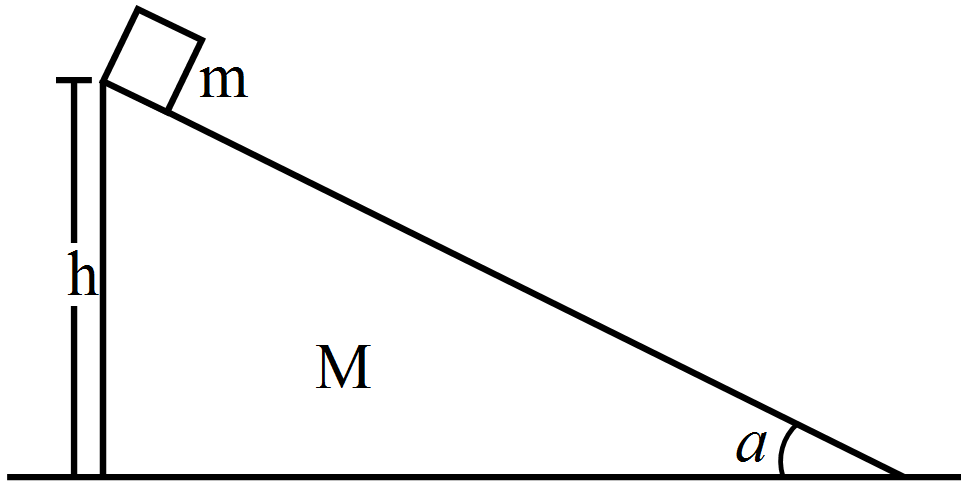
- 8View SolutionA block of mass m is placed on a triangular block of mass M, which in turn is placed on a horizontal surface as shown in figure. Assuming frictionless surfaces find the velocity of the triangular block when the smaller block reaches the bottom end.
- 9View SolutionThe door of an almirah is 6ft high, 1.5ft wide and weighs 8kg. The door is supported by two hinges situated at a distance of 1ft from the ends. If the magnitudes of the forces exerted by the hinges on the door are equal, find this magnitude.
- 10View SolutionDefine radius of gyration and give the physical significance of moment of inertia.